

Song of the White Lotus
Ink on satin
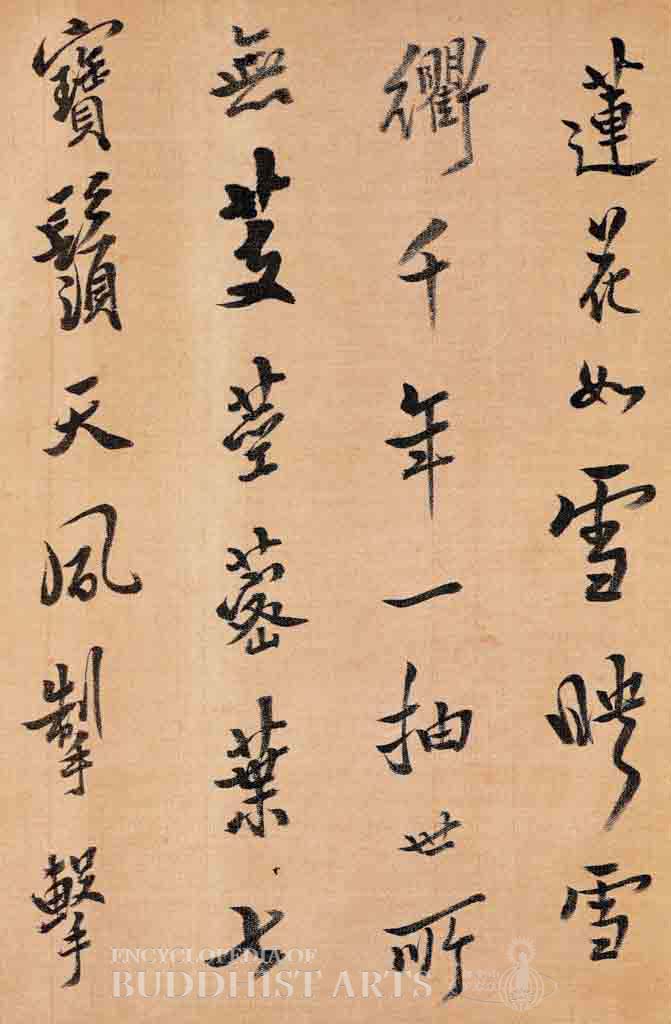
White Lotus Song (detail)
Song of the White Lotus
CHINA; Qing dynasty
Written by the Chan Master Azi Jinwu, the white lotus was used as a symbol of longevity for a birthday greeting in this scroll. The narrow, elongated characters featured in a variety of sizes and line weights are slightly canted and arranged in spacious rows. The calligraphy is subtle in its expressiveness, which is reflective of Azi’s skill. Stylistic influences from Chen Hongshou can be seen in this work, and the remarkable stroke control suggests considerable temperance in the execution. There is a well thought-out balance in the layout, and its tranquility reflects the peaceful state of mind of the calligrapher.
Azi Jinwu’s original surname was Wan. He was a Chan monk and calligrapher from Panyu, Guangdong, who lived during the late Ming (1368–1644) and early Qing (1644–1911) dynasties. He excelled in Chan studies, poetry, as well as calligraphy.
For more details, go to the Encyclopedia of Buddhist Arts: Calligraphy, page 233.
Cite this article:
author = Hsingyun and Youheng and Youlu and Pokorski, Stefanie and Mankuang and Edson, Gary,
booktitle = {Encyclopedia of Buddhist Arts: Calligraphy },
pages = 233,
title = {{Song of the White Lotus}},
volume = 17,
year = {2016}}