
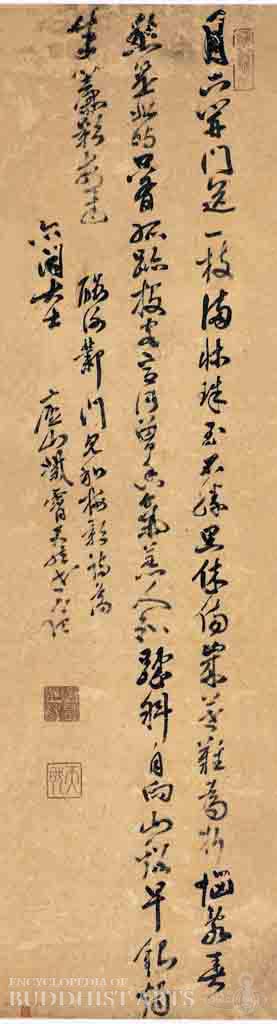
Poem of Plum Shadow
Ink on paper
Poem of Plum Shadow
CHINA; Ming to Qing dynasty
Monk Tianran Hanshi composed this poem as a token of appreciation to a friend. Commencing with a fully-inked brush and writing until the ink dried out, Tianran produced bold and forceful strokes in running script. The spacious arrangement between the lines of characters expresses an obvious artistic conception. Although written quite rapidly, the work shows no indication of impatience, yet is full of steady vigor. Brushstrokes were applied with skill and grace and the overall calligraphy appears tactful and smooth.
Tianran Hanshi was a talented calligrapher, poet, and monk of the late Ming (1368–1644) and early Qing (1644–1911) dynasties. He was known for his loyalty to the Ming dynasty and composed numerous poems in memorandum of anti-Qing martyrs. Tianran’s exemplary conduct and nobility of character earned him great respect, and many supporters of the anti-Qing revolt sought refuge in Buddhism under his guidance.
For more details, go to the Encyclopedia of Buddhist Arts: Calligraphy, page 176.
Cite this article:
author = Hsingyun and Youheng and Youlu and Pokorski, Stefanie and Mankuang and Edson, Gary,
booktitle = {Encyclopedia of Buddhist Arts: Calligraphy },
pages = 176,
title = {{Poem of Plum Shadow}},
volume = 17,
year = {2016}}