
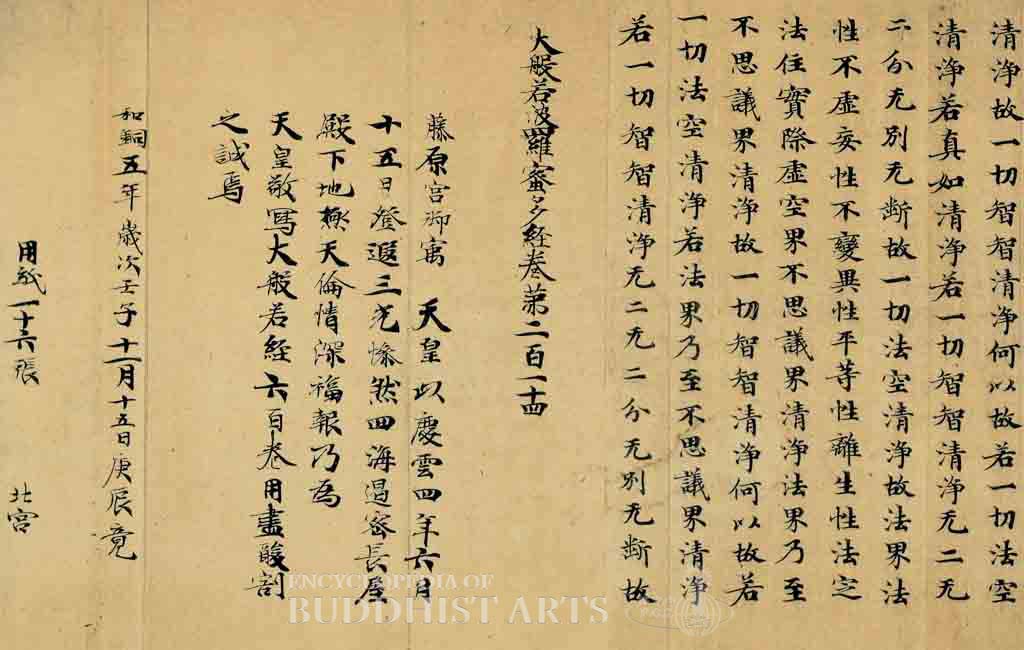
Taiheiji Temple: Mahaprajnaparamita Sutra (detail)
Ink on hemp paper
Taiheiji Temple: Mahaprajnaparamita Sutra
JAPAN, Shiga, Koka; Nara period
Prince Nagaya transcribed 600 fascicles of the Mahaprajnaparamita Sutra as a tribute to his deceased cousin Emperor Monmu (reigned 697–707), inscribing a prayer at the end of each ream. As work commenced from the 712 of the Nara period, this series of sutra transcriptions is also known as the Wado Sutra. It comprises 142 reams in total, and were compiled into an accordion-fold book with each page measuring 23.8 cm by 8.7 cm. This work was listed as a National Treasure in 1962.
This volume of calligraphy is one of the oldest surviving handwritten sutra copies in Japan. Characters in this piece have been rendered exquisitely and incisively using ancient clerical script, and have been laterally compressed, invoking a sense of movement despite the occasional stiff stroke. As a whole, it is considered to be an impressive example of sutra transcription.
Prince Nagaya was the grandson of Emperor Tenmu (reigned 673–686), as well as a court official during the early Nara period (710–794). A man of refined tastes and a skilled calligrapher, his rigorous calligraphic style and forceful strokes are evocative of the works seen during the Six Dynasties (220–589) in China.
For more details, go to the Encyclopedia of Buddhist Arts: Calligraphy, page 251.
Cite this article:
author = Hsingyun and Youheng and Youlu and Pokorski, Stefanie and Mankuang and Edson, Gary,
booktitle = {Encyclopedia of Buddhist Arts: Calligraphy },
pages = 251,
title = {{Taiheiji Temple: Mahaprajnaparamita Sutra}},
volume = 17,
year = {2016}}