
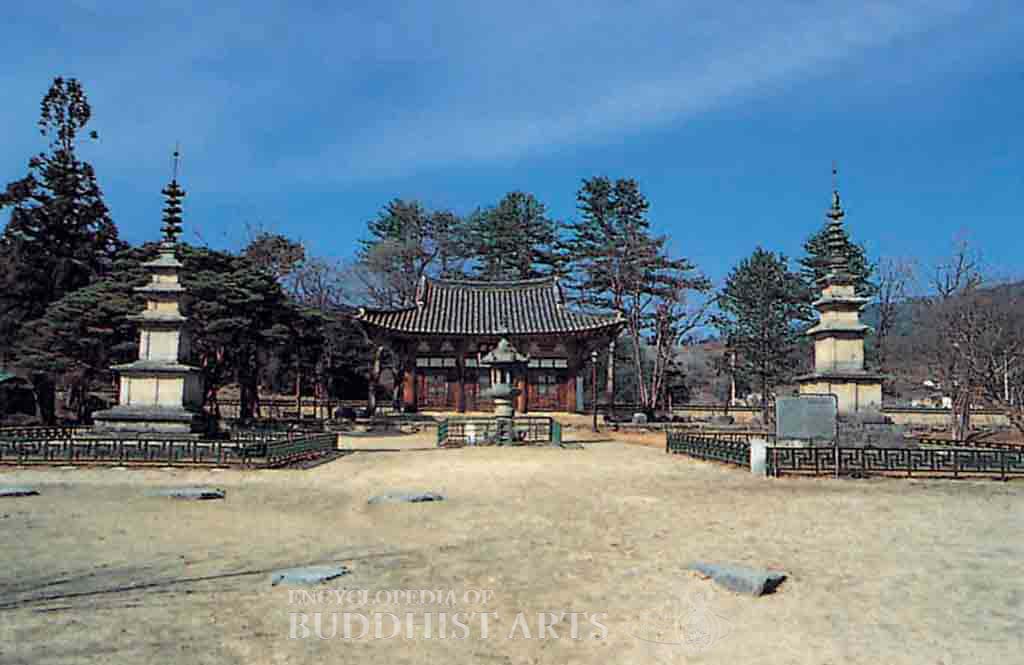
Silsangsa Temple
Silsangsa Temple
SOUTH KOREA, North Jeolla, Namwon
Silsangsa means Temple of True Form and it is located on Jirisan Mountain. The temple was established by National Master Hongcheok in 828 during the Unified Silla dynasty. It was rebuilt in 1679 and 1821 during the Joseon dynasty, but was burned down in 1882 and was reconstructed in 1884 by Master Wolsong.
The buildings of the temple include the Universal Light Hall, Medicine Buddha Hall, Judgment Hall, Ultimate Bliss Hall, and three-tier stone pagoda at Baekjangam Hermitage. The main hall of the temple is the Ultimate Bliss Hall, which is a three-by-three bay structure with a double-eave hip-and-gable roof. The temple houses one National Treasure and eleven Treasures, which include stone pagodas, stone lanterns, stupas of eminent monks, an iron seated Buddha statue, and a bronze incense burner.
Silsangsa Temple has played a leading role in the history of Korean Seon Buddhism and continues to do so with a range of education programs serving the monastic and lay communities.
For more details, go to the Encyclopedia of Buddhist Arts: Architecture M-S, page 1021.
Cite this article:
author = Hsingyun and Youheng and Johnson, Peter and Mankuang and Lancaster, Lewis,
booktitle = {Encyclopedia of Buddhist Arts: Architecture M-S},
pages = 1021,
title = {{Silsangsa Temple}},
volume = 3,
year = {2016}}