
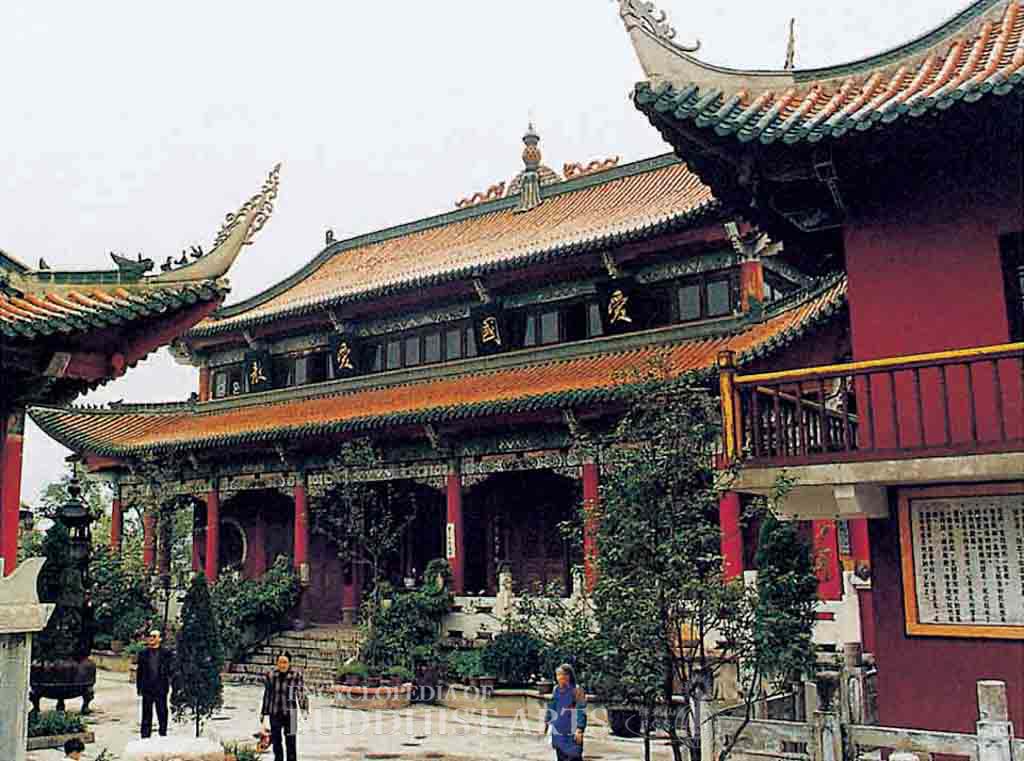
Xiangshan Temple: Great Hero Hall
Xiangshan Temple
CHINA, Guizhou, Zunyi
Xiangshan means Fragrant Mountain. The temple was constructed during the rule of Emperor Chengzong (reigned 1297–1307) of the Yuan dynasty. It was later destroyed but was rebuilt on the original site and expanded during the Qing dynasty (1644–1911). It was abandoned in 1912 and converted to an ammunition warehouse. It did not become a temple again until after the 1950s. It was listed as a Provincial Cultural Heritage Site in 1985.
The temple was built according to the contours of the mountain. The buildings along the central axis include the Heavenly King Hall, Great Hero Hall, and Avalokitesvara Hall. Other buildings include the Skanda Hall, bell tower, sutra repository, stele pavilion, and other subsidiary buildings. On either side of the main temple gate, there are five seven-story pagodas. The Great Hero Hall has a double-eave hip-and-gable roof. It is surrounded with balustrades made from locally carved stone. Inside there are statues of Sakyamuni Buddha flanked by Manjusri and Samantabhadra Bodhisattvas.
For more details, go to the Encyclopedia of Buddhist Arts: Architecture T-Z, page 1312.
Cite this article:
author = Hsingyun and Youheng and Johnson, Peter and Mankuang and Lancaster, Lewis,
booktitle = {Encyclopedia of Buddhist Arts: Architecture T-Z},
pages = 1312,
title = {{Xiangshan Temple}},
volume = 4,
year = {2016}}