
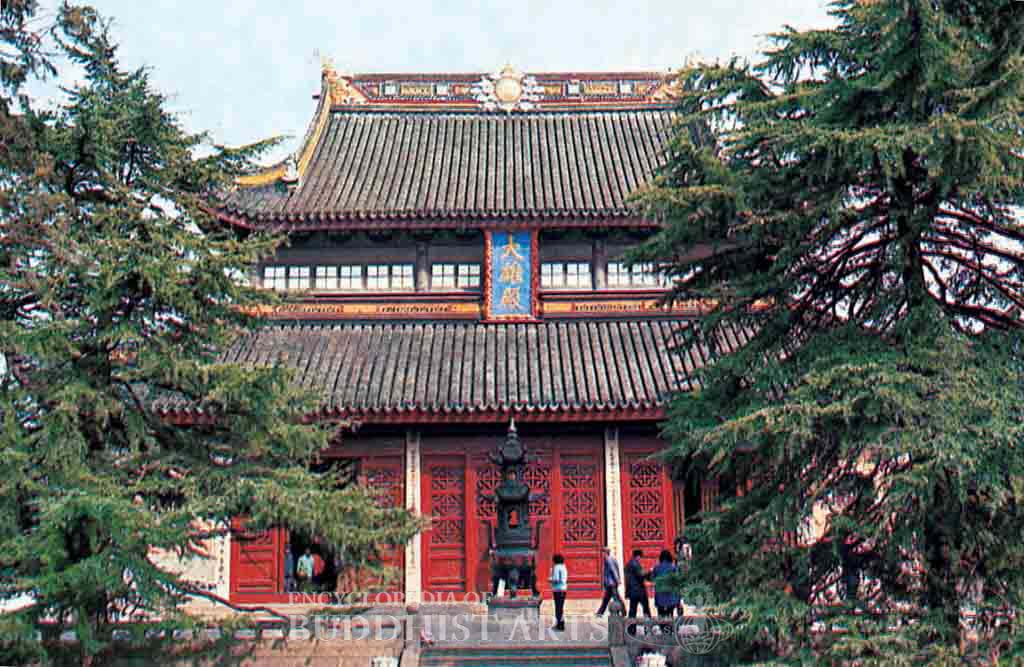
Lingyanshan Temple: Great Hero Hall
Lingyanshan Temple
CHINA, Jiangsu, Suzhou
The temple derives its name from Lingyanshan (Spiritual Rock Mountain) on which it stands. During the final years of the Eastern Jin dynasty (317–420), Luwan, Minister of Works, converted his villa into this temple. The temple has been destroyed and rebuilt a number of times. In 1937 Master Yinguang of the Pure Land school resided there. He undertook the renovation of the halls and also laid down the rules for chanting. The temple thus became a Pure Land temple that specialized in cultivation through the chanting of the Buddha’s name. It was destroyed during the late 1960s and reconstruction started in 1979. A branch of the Chinese Buddhist College was established at the temple in 1980. It was listed as a key Buddhist temple in the Han region of China in 1983.
Facing south, the temple occupies 2.3 ha. It is laid out in three sections: central, east, and west. The central section consists mainly of halls, the east section houses the pagoda courtyard, while the west section contains the garden. The halls of the central section include the Heavenly King Hall, Great Hero Hall, and the chanting hall. The pagoda courtyard consists of the Prabhutaratna Pagoda, bell tower, and the Fragrant Light Hall. The Great Hero Hall has a double-eave hip-and-gable roof, and is 25 m high and 20 m wide. A 6 m high camphor wood statue of a seated Sakyamuni Buddha, flanked by statues of Mahakasyapa and Ananda, is enshrined in the hall. Statues of the Sixteen Arhats line the walls on either side. The chanting hall houses the Amitabha Buddha Triad on the first story, while the sutra repository is located upstairs. It contains more than 47,000 fascicles of Buddhist texts. Also called Lingyan Pagoda, the Prabhutaratna Pagoda was rebuilt in 1147 and is the temple’s oldest structure. The seven-story octagonal pagoda with a brick body and wooden eaves is 34 m high. The pagoda was listed as a Municipal Cultural Heritage Site in 1982.
For more details, go to the Encyclopedia of Buddhist Arts: Architecture G-L, page 674.
Cite this article:
author = Hsingyun and Youheng and Johnson, Peter and Mankuang and Lancaster, Lewis,
booktitle = {Encyclopedia of Buddhist Arts: Architecture G-L},
pages = 674,
title = {{Lingyanshan Temple}},
volume = 2,
year = {2016}}