
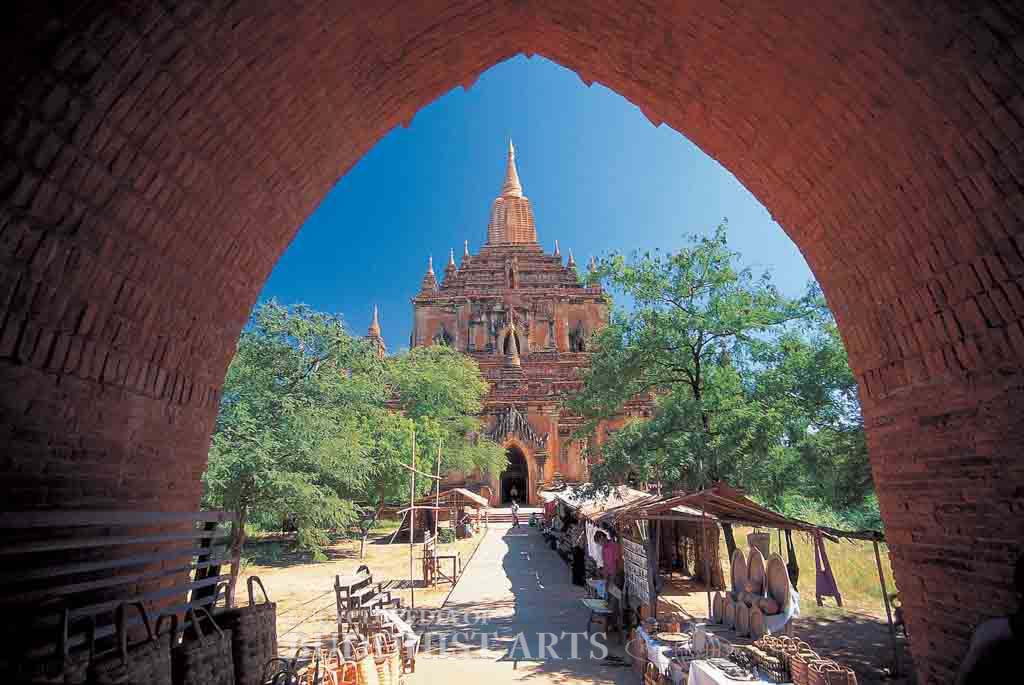
Sulamani Temple
Sulamani Temple
MYANMAR, Mandalay, Bagan
The name of the temple is derived from the Pali word Culamani, which means Crowning Jewel. The temple was built in 1183 by King Narapatisithu (reigned 1173–1210), who according to the chronicles built it in order to achieve nirvana. Once when the king was passing by Tuywin Taung Hill on his return to Bagan, he found a shiny ruby. Overcome by surprise and joy, the king believed it was a sign that he should make a great contribution at that location. Thus, he had the valley filled to build the temple.
The two-story square temple has porticos on all four sides with the east portico projecting further than the other three. Both stories are similar in height and there are three terraces at the top of each with small pagodas at the corners. The terraces are inlaid with glazed terracotta plaques and decorated with parapets. The lower story is surrounded by a vaulted corridor, on each side of which there is a seated Buddha statue. There are narrow stairways set into the thick walls leading up to the terrace above the east portico. From there wide staircases lead to the upper story, which is also surrounded by a vaulted corridor. The eastern side of the corridor has a recess forming a niche. The body of the spire has a tapered cuboid shape with multiple corners followed by stacked rings and finial. The interior of the temple was once painted with murals, which either deteriorated or were covered by later works.
This temple is built in the Burmese architectural style of Thatbyinnyu Temple, where sunlight enters the temple through the main doorways resulting in an even distribution of light during the day.
For more details, go to the Encyclopedia of Buddhist Arts: Architecture M-S, page 1062.
Cite this article:
author = Hsingyun and Youheng and Johnson, Peter and Mankuang and Lancaster, Lewis,
booktitle = {Encyclopedia of Buddhist Arts: Architecture M-S},
pages = 1062,
title = {{Sulamani Temple}},
volume = 3,
year = {2016}}