
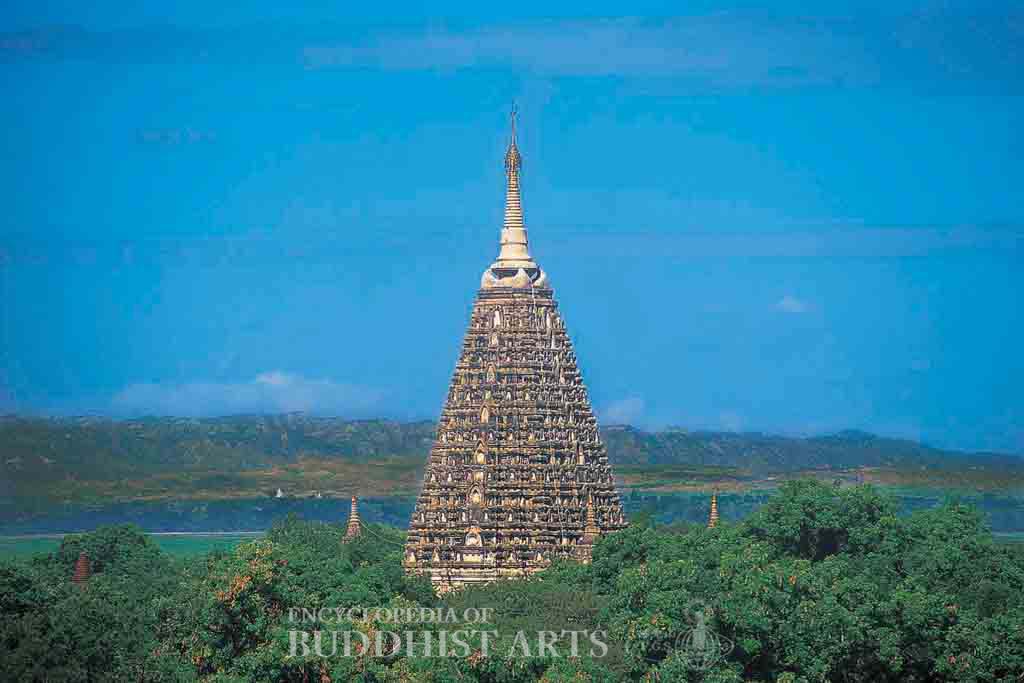
Mahabodhi Temple
Mahabodhi Temple
MYANMAR, Mandalay, Bagan
Mahabodhi means Great Enlightenment, and this temple is named after the Mahabodhi Temple in Bodhgaya, India, where the Buddha attained enlightenment. The temple was built by King Htilominlo (reigned 1210–1234).
The architectural style of the pagoda follows that of the Mahabodhi Temple in Bodhgaya. The building has a square base with multiple corners that rises up into a steep truncated pyramid, with numerous Buddha niches forming a honeycomb effect, which is uncommon in Myanmar. The spire consists of a bell-shaped body supported by leaves, followed by stacked rings, a canopy, and a finial. Inside there is a spacious main shrine used for paying respect to the Buddha and for making offerings, as well as a small shrine on the western side.
The people of Bagan have always had an affinity with Bodhgaya. According to the stele records, King Kyansittha (reigned 1084–1112) dispatched a group of officials on a pilgrimage to the Mahabodhi Temple in Bodhgaya. The group brought back seeds from the Bodhi tree under which the Buddha attained enlightenment and planted them in Bagan.
For more details, go to the Encyclopedia of Buddhist Arts: Architecture M-S, page 714.
Cite this article:
author = Hsingyun and Youheng and Johnson, Peter and Mankuang and Lancaster, Lewis,
booktitle = {Encyclopedia of Buddhist Arts: Architecture M-S},
pages = 714,
title = {{Mahabodhi Temple}},
volume = 3,
year = {2016}}