
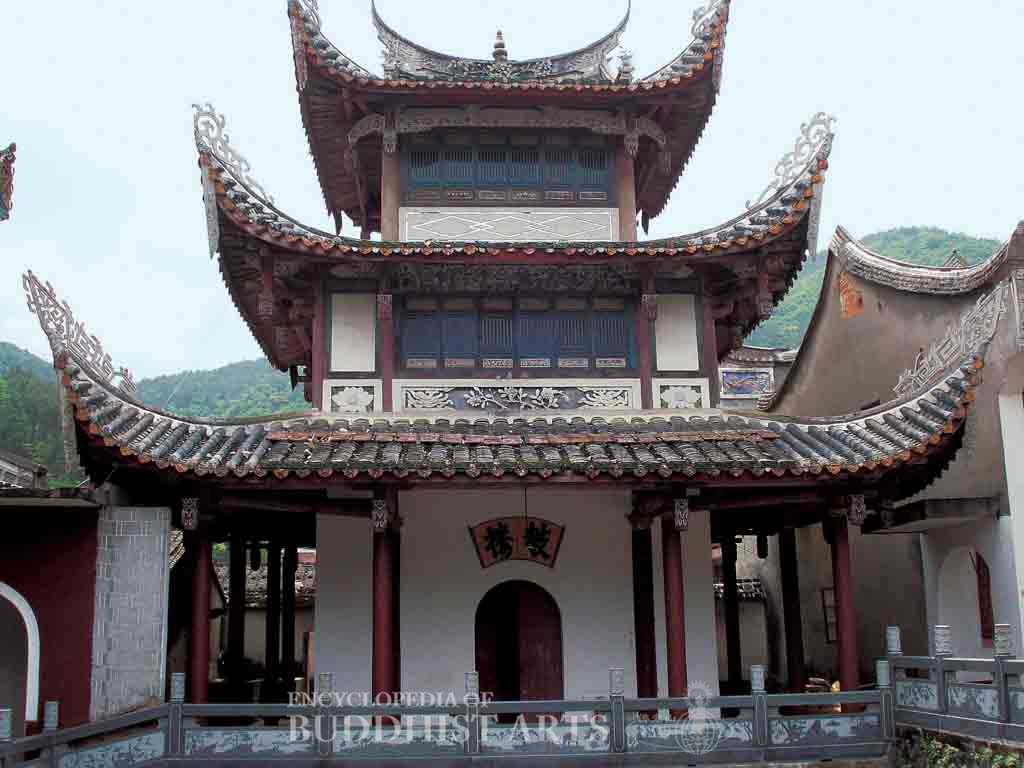
Xuefeng Chongsheng Temple: Drum Tower
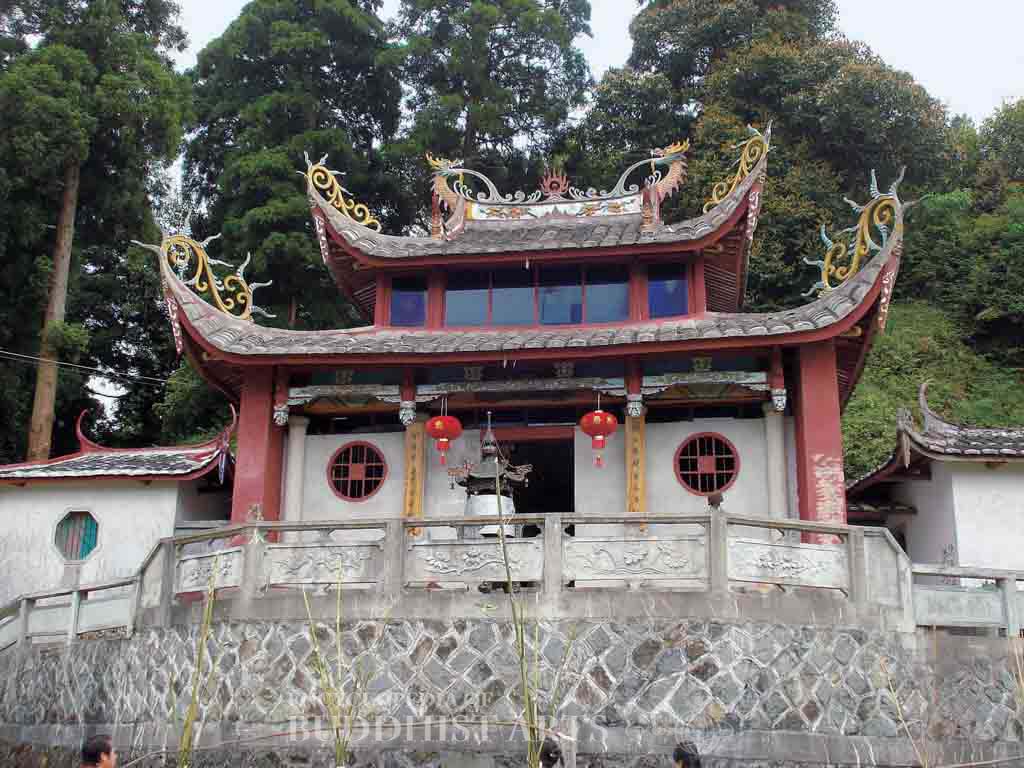
Xuefeng Chongsheng Temple: Original Wooden Hermitage
Xuefeng Chongsheng Temple
CHINA, Fujian, Fuzhou
The temple is situated on Xuefengshan (Snow Peak Mountain). In 870 during the Tang dynasty, Chan Master Yicun arrived at Xuefengshan and built a hut for meditation. A year later, the hut became a wooden hermitage, which is the origin of the temple. Chan Master Yicun followed the teaching of Qingyuan Xingsi’s Chan lineage, which formed two of the seven branches of Chinese Chan Buddhism: the Yunmen and Fayan branches. The temple was later acknowledged as the origin of these two branches. In 978 during the Northern Song dynasty, it became known as Xuefeng Chongsheng Chan Monastery. Most of the surviving buildings were reconstructed during the Qing dynasty. It was listed as a key Buddhist temple in the Han region of China in 1983.
The principal buildings of the temple include the main temple gate, the Dharma Hall, and the Great Hero Hall. The Great Hero Hall houses three jade Buddha statues from Myanmar, as well as the Eighteen Arhats, all in different postures. The temple houses precious versions of the Buddhist Canon, such as the Qisha Tripitaka, palm leaf manuscripts written in Sanskrit, and the complete version of the Pinjia Tripitaka, which has more than 8,000 fascicles. The original wooden hermitage, where Chan Master Yicun meditated, is located on the southeast side of the temple, about 100 m away. It has a double-eave hip-and-gable roof. The temple still follows the traditional Chan teachings, which places equal emphasis on the practice of meditation and farming.
For more details, go to the Encyclopedia of Buddhist Arts: Architecture T-Z, page 1335.
Cite this article:
author = Hsingyun and Youheng and Johnson, Peter and Mankuang and Lancaster, Lewis,
booktitle = {Encyclopedia of Buddhist Arts: Architecture T-Z},
pages = 1335,
title = {{Xuefeng Chongsheng Temple}},
volume = 4,
year = {2016}}