
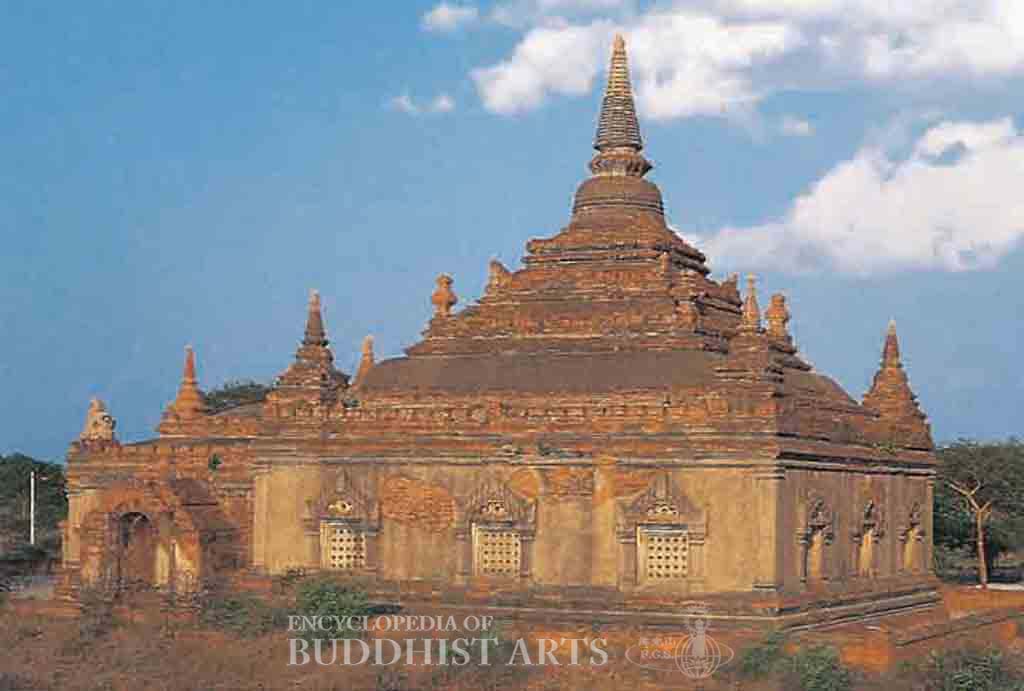
Apeyadana Temple
Apeyadana Temple
MYANMAR, Mandalay, Bagan
Apeyadana Temple is named after the queen of King Kyansittha (reigned 1084–circa 1112). It is the most famous Mahayana temple in Bagan and is known for its murals. It was built by King Kyansittha in the late 11th century. It is said that when he was still a prince, he enraged his older brother, King Sawlu (reigned 1077–1084), and consequently became a fugitive. After he ascended to the throne, King Kyansittha built this temple at the location where Queen Apeyadana waited for him while he was in hiding. However, an alternative account is that the temple was built by Queen Apeyadana herself.
The temple faces north with a portico with an arched doorway projecting from the north side. There are two antechambers which lead to the main chamber. The main chamber houses a Buddha image. It is surrounded by a vaulted corridor, dimly lit by three perforated windows in sides of the walls. Three terraces rise above the main part of the building. Above the bell-shaped pagoda body, there is the base of the spire followed by octagonal stacked rings.
Theravada Buddhism predominates in Myanmar but the murals of Apeyadana Temple depict Mahayana themes such as Bodhisattvas and Indian deities, forming what is considered the best extant murals in Bagan. These murals have generated significant influence on the style of many wall paintings in subsequent periods. From the northern entrance, 547 wall paintings depicting scenes from the Life of the Buddha are presented on the two side walls. The inner wall is divided into two registers. The upper register is composed of paintings of the Buddha, monks, and stupas, while the lower register is painted with images of Brahma and lay devotees. The outer wall is similarly divided into two registers. The upper register contains over 100 Bodhisattvas, with Avalokitesvara located in the center. The lower register depicts Dharma wheels, swords, and other Dharma instruments.
For more details, go to the Encyclopedia of Buddhist Arts: Architecture A-F, page 21.
Cite this article:
author = Hsingyun and Youheng and Johnson, Peter and Mankuang and Lancaster, Lewis,
booktitle = {Encyclopedia of Buddhist Arts: Architecture A-F},
pages = 21,
title = {{Apeyadana Temple}},
volume = 1,
year = {2016}}