
Bupaya Pagoda
Bupaya Pagoda
MYANMAR, Mandalay, Bagan
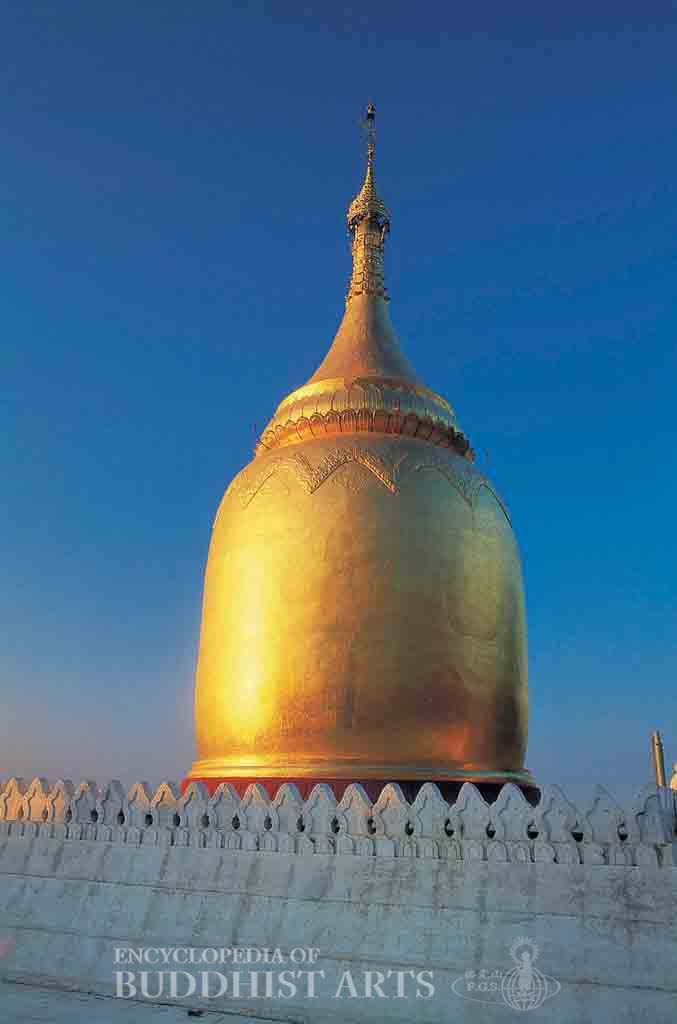
Bupaya means Gourd-Shaped Pagoda. It is located on the bank of the Ayeyarwady River. According to legend, the pagoda was built by King Pyusawhti (reigned 167–242). During the reign of the first king of Bagan, King Thamudarit (reigned 107–152), the kingdom of Bagan was plagued by five great menaces: four fierce animals and one particular gourd tree, which had extensive vines that proliferated all over the land. A man named Pyusawhti defeated these five menaces and gained the hand of the king’s daughter. When Pyusawhti became king, he built a pagoda at each of the locations where he had defeated one of the menaces. The Bupaya Pagoda was built at the location where he defeated the gourd menace. The pagoda was completely destroyed during an earthquake in 1975 and the current pagoda was rebuilt according to the original design.
The gilded pagoda is bulbous in shape and stands on a square white platform. The top section of the pagoda body is decorated with floral designs. The spire consists of a two-tier lotus base, a cone, stacked rings and a multi-tier canopy. This is an excellent example of a Pyu style pagoda.
For more details, go to the Encyclopedia of Buddhist Arts: Architecture A-F, page 109.
Cite this article:
author = Hsingyun and Youheng and Johnson, Peter and Mankuang and Lancaster, Lewis,
booktitle = {Encyclopedia of Buddhist Arts: Architecture A-F},
pages = 109,
title = {{Bupaya Pagoda}},
volume = 1,
year = {2016}}