
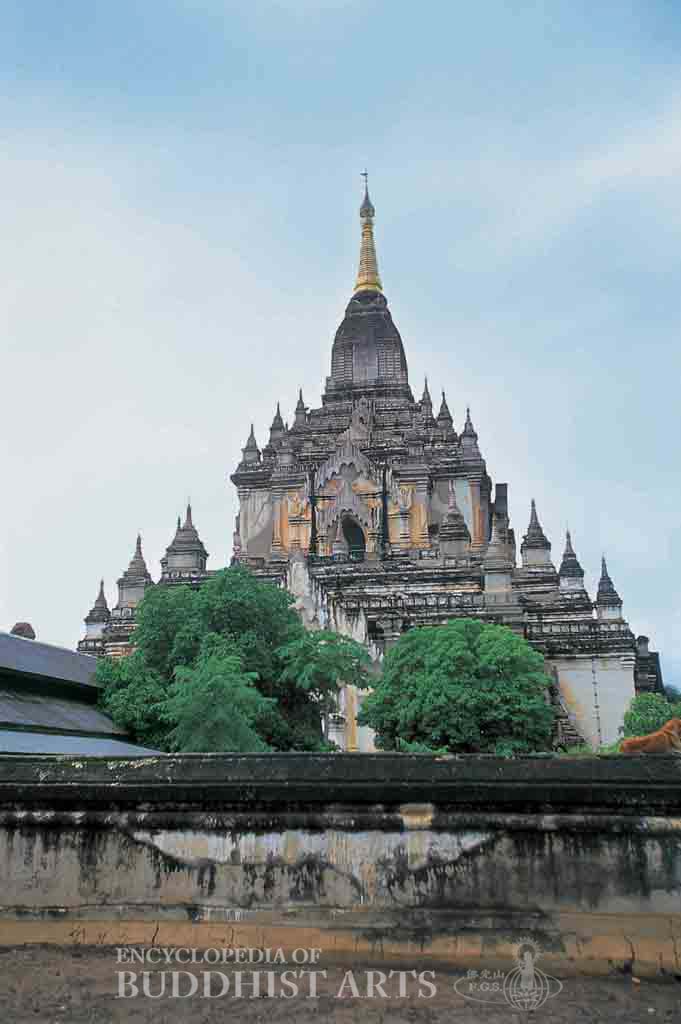
Gawdawpalin Temple
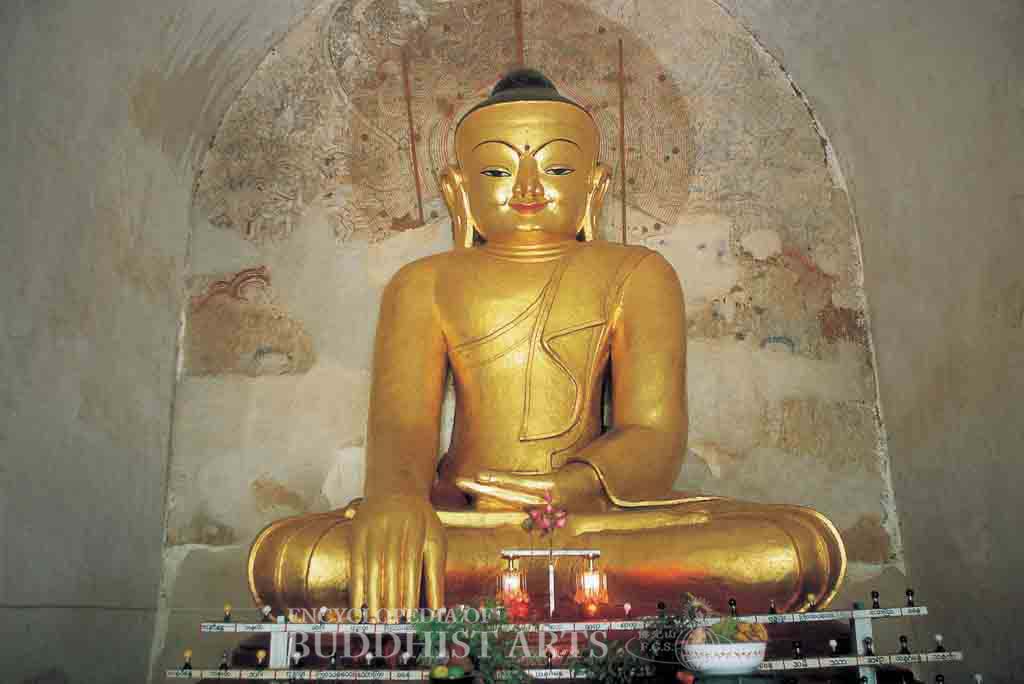
Gawdawpalin Temple: Seated Buddha
Gawdawpalin Temple
MYANMAR, Mandalay, Bagan
Gawdawpalin means Throne of Obeisance. It is one of the largest temples in Bagan. The temple was built in 1183 by King Narapatisithu (reigned 1173–1210). According to legend, the king was arrogant and bragged about his achievements being more glorious than those of his predecessors. As a result, he lost his vision as punishment. He then paid respect to the golden images of the 44 previous kings of Bagan. He built this temple to atone for his boasting and soon regained his vision. The construction of this temple was not finished by the time of King Narapatisithu’s death and his son, King Htilominlo (reigned 1210–1234), carried out his father’s wish and completed the temple. It was damaged during an earthquake in 1975, but was later repaired.
The temple is a two-story structure built in late Bagan style and is similar in form to the Sulamani Temple and Htilominlo Temple. The temple is 55 m high and has a square layout. Three terraces rise above each level with crenellated parapets and ancillary pagodas at the corners. The lower level has a vaulted corridor that surrounds the central block, with images of the Buddha along the walls. A narrow flight of stairs built into the thick walls leads to the upper level, where there is a seated Buddha. The upper level is surmounted by a tapered curved pagoda with a slender golden spire consisting of stacked rings, a canopy, and finial. There are porticos on all four sides. The eastern portico is the main entrance and extends further than the others. It leads to the main shrine in which the principal Buddha image is enshrined.
For more details, go to the Encyclopedia of Buddhist Arts: Architecture G-L, page 368.
Cite this article:
author = Hsingyun and Youheng and Johnson, Peter and Mankuang and Lancaster, Lewis,
booktitle = {Encyclopedia of Buddhist Arts: Architecture G-L},
pages = 368,
title = {{Gawdawpalin Temple}},
volume = 2,
year = {2016}}