
Myatheindan Pagoda
Myatheindan Pagoda
MYANMAR, Sagaing, Mingun
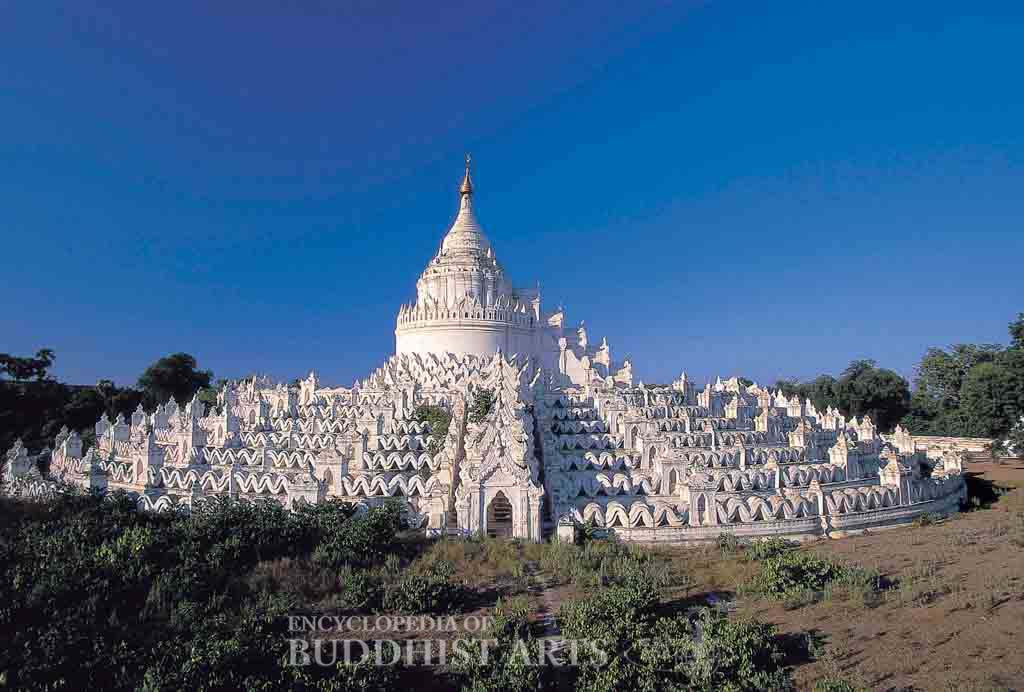
Myatheindan refers to a ruby worth 100,000 kyats, which was enshrined within this pagoda. The pagoda was built in 1816 by King Bagyidaw (reigned 1819–1837) of Konbaung in memory of his first wife, Princess Hsinbyume. For this reason, it is also called the Hsinbyume Pagoda. It was badly damaged by an earthquake in 1838 and was later restored in 1874 by King Mindon (reigned 1853–1878).
The whole structure is circular with a circumference of 98 m. The base is made up of seven concentric terraces, each decorated with wavelike patterns. There are three covered staircases with vaulted roofs leading to the top of the terraces. Above the terraced base, there are four layers of circular platforms; the two lower layers are taller than the two upper layers. There are four small ancillary pagodas located on the two upper layers. The pagoda is in the shape of an inverted bowl with a conical spire, surmounted by a canopy and finial. Other than the golden canopies and finials of the central pagoda and the ancillary pagodas, the rest of the structure is painted a brilliant white.
The pagoda is designed according to Buddhist cosmology: the seven terraces and wavelike patterns represent the seven mountain ranges and the seven seas surrounding Mount Sumeru, the abode of Sakra. The three staircases symbolize those that Sakra built when the Buddha returned to the human world from Trayastrimsa Heaven.
For more details, go to the Encyclopedia of Buddhist Arts: Architecture M-S, page 756.
Cite this article:
author = Hsingyun and Youheng and Johnson, Peter and Mankuang and Lancaster, Lewis,
booktitle = {Encyclopedia of Buddhist Arts: Architecture M-S},
pages = 756,
title = {{Myatheindan Pagoda}},
volume = 3,
year = {2016}}