
Kaunghmudaw Pagoda
Kaunghmudaw Pagoda
Kaunghmudaw Pagoda
MYANMAR, Sagaing
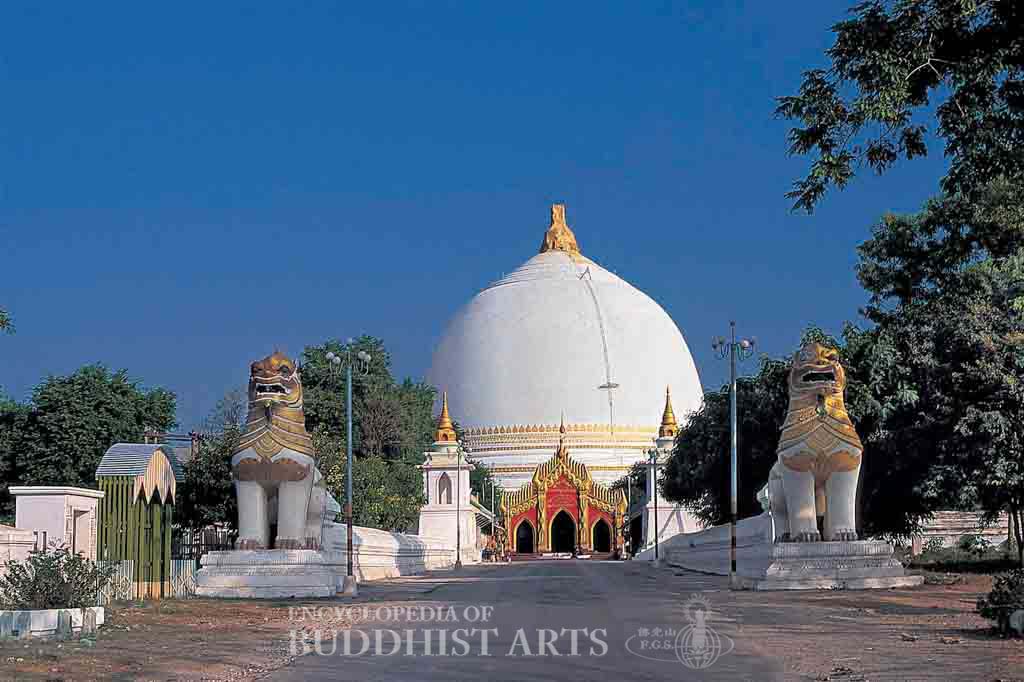
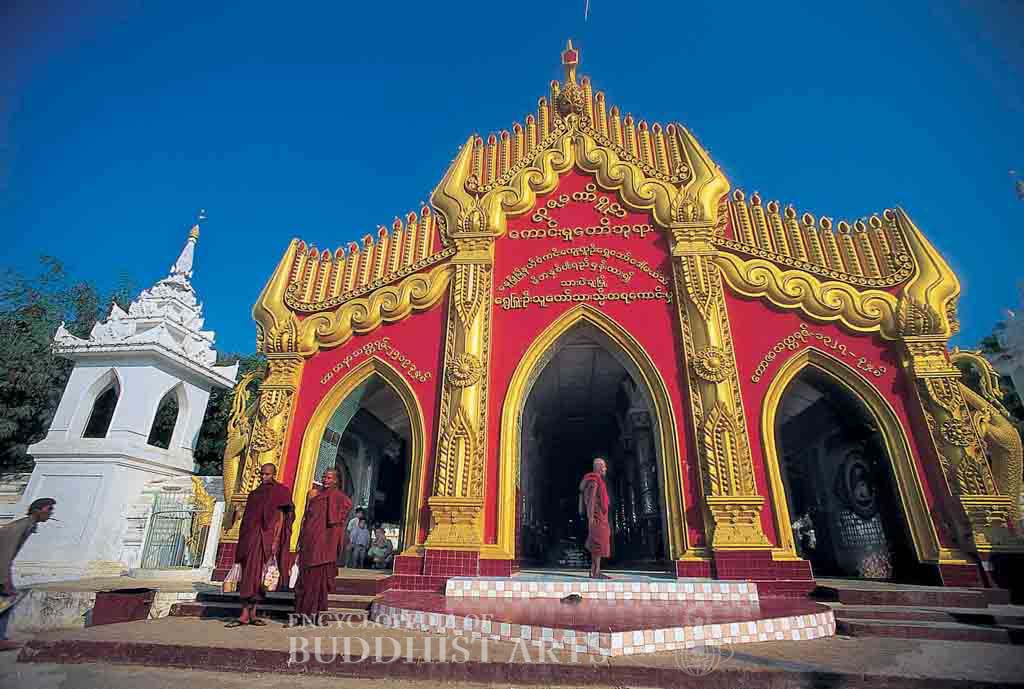
Construction of the pagoda started in 1636 by King Thalun (reigned 1629–1648) to commemorate the re-establishment of the royal capital, and was completed in 1649. Famed for its white, inverted bowl shape, the pagoda is 46 m high, with a circumference of 220 m. It is modeled after the Mahathupa in Sri Lanka and over one million bricks were used in its construction. The 6.7 m high canopy is ornamented with 120 figures of Dharma protectors. The entrance, painted in red and elaborately decorated in gold, contrasts sharply with the plain white exterior of the pagoda.
Two Burmese-style lion statues stand guard in front of the pagoda. There are 802 1.5 m high stone posts surrounding the pagoda. These posts have openings at the top to hold oil lamps, which illuminate the pagoda at night.
For more details, go to the Encyclopedia of Buddhist Arts: Architecture G-L, page 596.
Cite this article:
author = Hsingyun and Youheng and Johnson, Peter and Mankuang and Lancaster, Lewis,
booktitle = {Encyclopedia of Buddhist Arts: Architecture G-L},
pages = 596,
title = {{Kaunghmudaw Pagoda}},
volume = 2,
year = {2016}}