
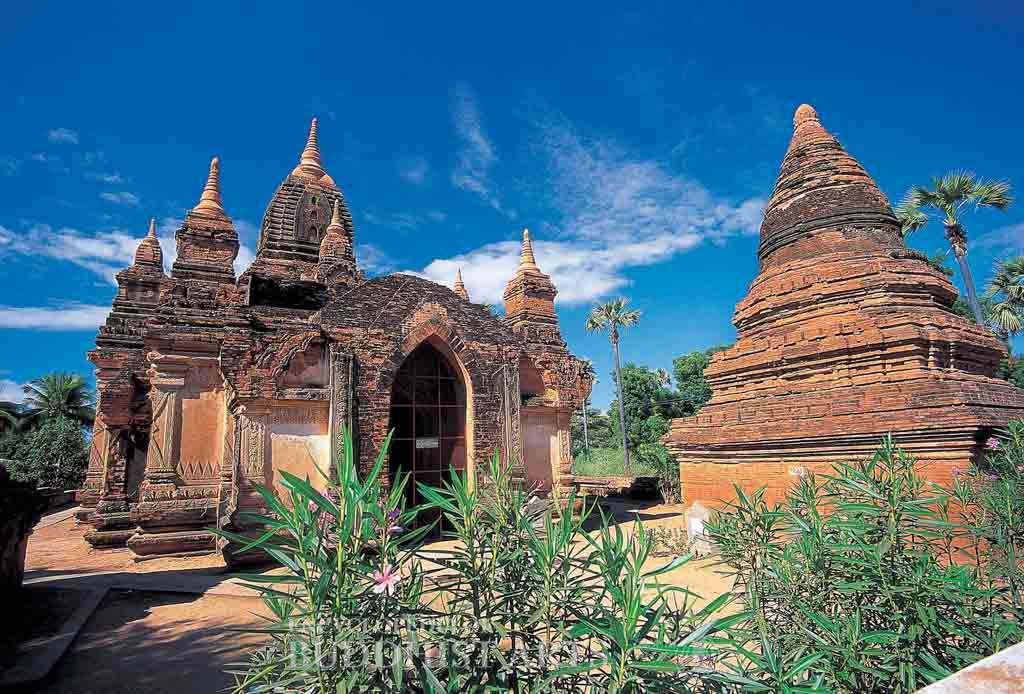
Gubyaukgyi Temple
Gubyaukgyi Temple
MYANMAR, Mandalay, Bagan
Gubyaukgyi means Great Painted Cave Temple. This temple was built in 1113 by Prince Rajakumar, son of King Kyansittha (reigned circa 1084–1112). According to the records, when the king fell critically sick, the prince traded his servants to cast a gold Buddha statue, hoping to accumulate merits for his father and to repay his kindness. The temple was built to house the gold statue.
Typical of the early Bagan style, the temple is constructed in red brick. The temple has two sections: the square section at the rear houses the main shrine and the smaller square section with multiple corners at the front contains the antechamber. Above the main shrine there is a series of tiers culminating in the tapered curved pagoda with multiple corners. The pagoda is surmounted by a spire of stacked rings. There are ancillary pagodas at the corners. The exterior of the temple is decorated with exquisite stucco reliefs, especially along the base, above the windows, on the pilasters, and on the upper section of the walls.
The main shrine is surrounded by a vaulted corridor with an entrance on the east side. The interior of the temple is dimly lit by perforated windows. Apart from the seated Buddha in the main shrine, stone Buddha statues are also enshrined in niches along the corridors.
The temple walls are filled with murals within the portico, antechamber, and main shrine. They are believed to be the oldest remaining murals in Bagan. The murals in the antechamber depict the scene in which the Buddha, attended by Brahma and Sakra, returns from Trayastrimsa Heaven. The paintings in the portico depict illustrious scenes of the heavenly palaces described in the Vimana Vatthu of the Pali Canon. In the main shrine, the murals are laid out in nine rows, each of which depicts scenes from the Jataka tales.
In 1911 the Myazedi inscription was unearthed. It is the oldest surviving stone inscription in Myanmar and plays an important role in deciphering the Pyu language.
For more details, go to the Encyclopedia of Buddhist Arts: Architecture G-L, page 408.
Cite this article:
author = Hsingyun and Youheng and Johnson, Peter and Mankuang and Lancaster, Lewis,
booktitle = {Encyclopedia of Buddhist Arts: Architecture G-L},
pages = 408,
title = {{Gubyaukgyi Temple}},
volume = 2,
year = {2016}}