
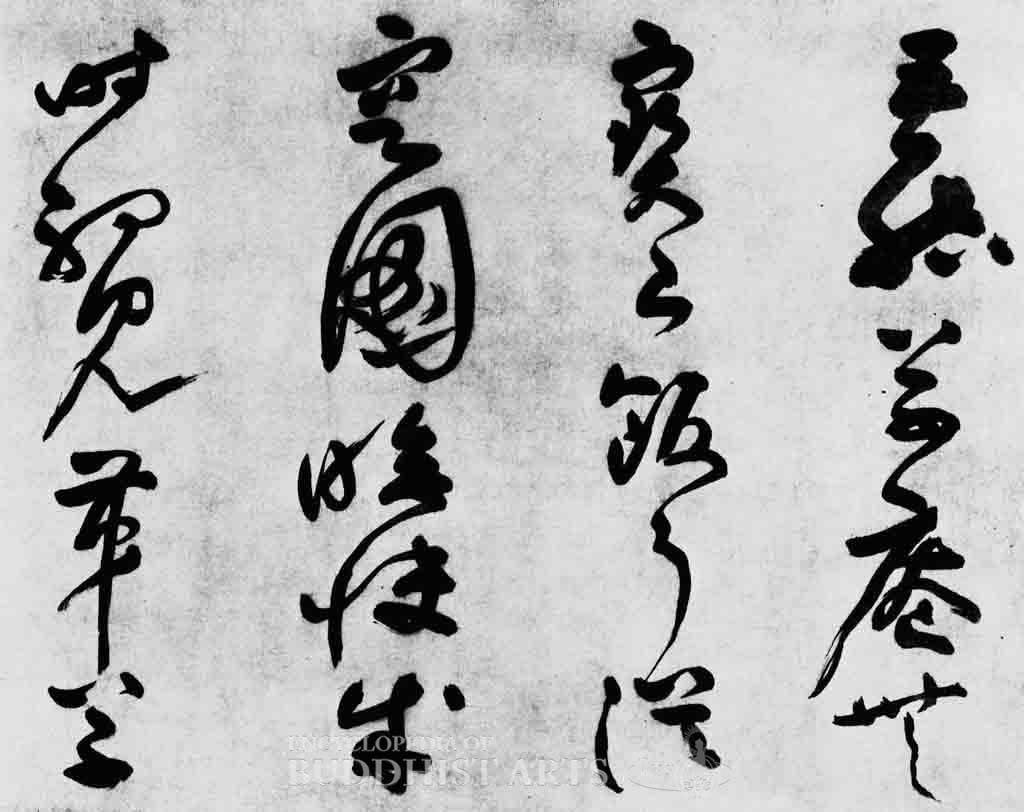
Song of the Grass Hut by Master Shitou (detail)
Ink on paper
Song of the Grass Hut by Master Shitou
CHINA; Yuan dynasty
Master Shitou Xiqian originally composed the Song of the Grass Hut. It was later transcribed by Master Puguang of the Yuan dynasty (1271–1368) in 42 lines with 216 characters. Master Shitou was a Chan monk who lived during the Tang dynasty (618–907). He was a disciple of Master Huineng, the Sixth Patriarch of the Chan lineage before he became a disciple of Qingyuan Xingsi, from whom he received Dharma transmission. The text describes the simple and contented life of Shitou, who lived in a grass hut. It implies that cultivation practice is independent of external conditions or appearances. The aspirant should search for the Dharma from within.
There are very few extant calligraphic works of Puguang, and cursive script pieces are extremely rare. He used the pseudonym Old Man Xuanwu in the colophon, which suggests that this piece was written in his later years. The strokes in this calligraphy are round, thick, and rustic. The cursive script shows influence from Tang dynasty calligrapher Sun Guoting, but is articulated in a unique style. A liquid vibrancy flows through the curvaceous lines and vigorous movements of the entire piece. Puguang’s ability to express spontaneity without losing each character’s form and structure demonstrates his mastery of calligraphy.
For more details, go to the Encyclopedia of Buddhist Arts: Calligraphy, page 232.
Cite this article:
author = Hsingyun and Youheng and Youlu and Pokorski, Stefanie and Mankuang and Edson, Gary,
booktitle = {Encyclopedia of Buddhist Arts: Calligraphy },
pages = 232,
title = {{Song of the Grass Hut by Master Shitou}},
volume = 17,
year = {2016}}