
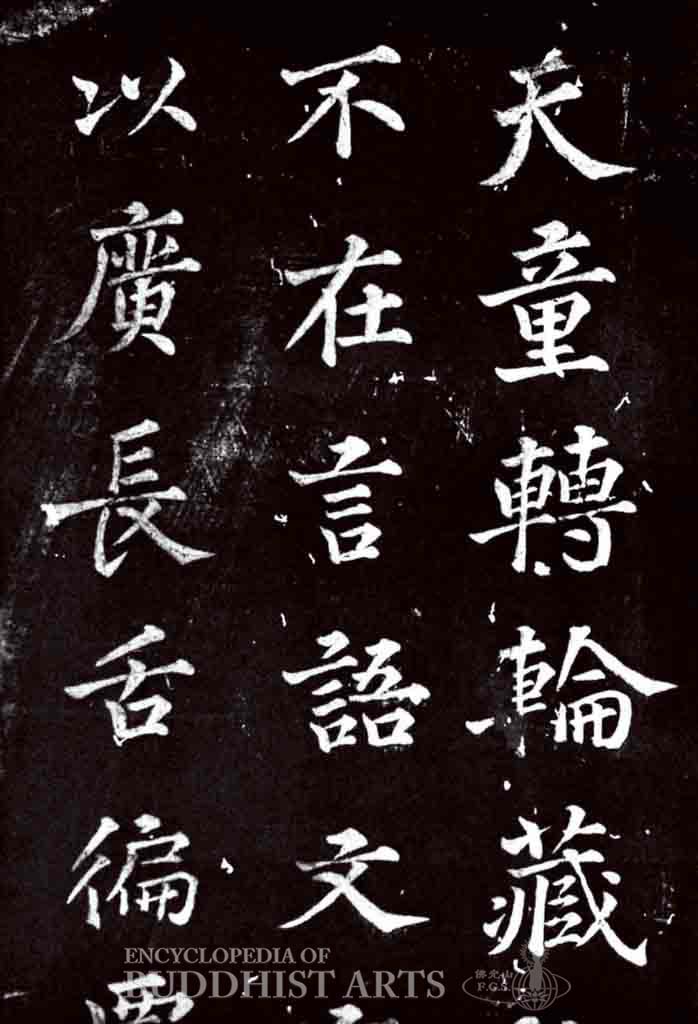
Inscription of Revolving Sutra Repository at Jingde Temple (detail)
Rubbing
Inscription of Revolving Sutra Repository at Jingde Temple
CHINA; Northern Song dynasty
Engraved by Chen Yi, this stele inscription features the calligraphy of Daoqian and consists of 13 lines, each with 23 characters. This particular stele rubbing was part of a collection that was brought back to Japan from China by Enni Ben’nen.
Abbot Kezhai Shengyi of Jingde Temple invited Chen Guan, a scholarly official from the Song dynasty, to write an essay on the Sutra Repository. The resulting written work reflects on the idea that although Buddhist canons contain the words of the Buddha, one should not be overly concerned or influenced by the choice of words and phrasing used in them. Rather, one should seek to comprehend the deeper meaning behind the words.
Daoqian was a monk and calligrapher of the Northern Song dynasty (960–1127). He was greatly influenced by the large regular script of Su Shi, as can be seen in this particular work.
For more details, go to the Encyclopedia of Buddhist Arts: Calligraphy, page 105.
Cite this article:
author = Hsingyun and Youheng and Youlu and Pokorski, Stefanie and Mankuang and Edson, Gary,
booktitle = {Encyclopedia of Buddhist Arts: Calligraphy },
pages = 105,
title = {{Inscription of Revolving Sutra Repository at Jingde Temple}},
volume = 17,
year = {2016}}