
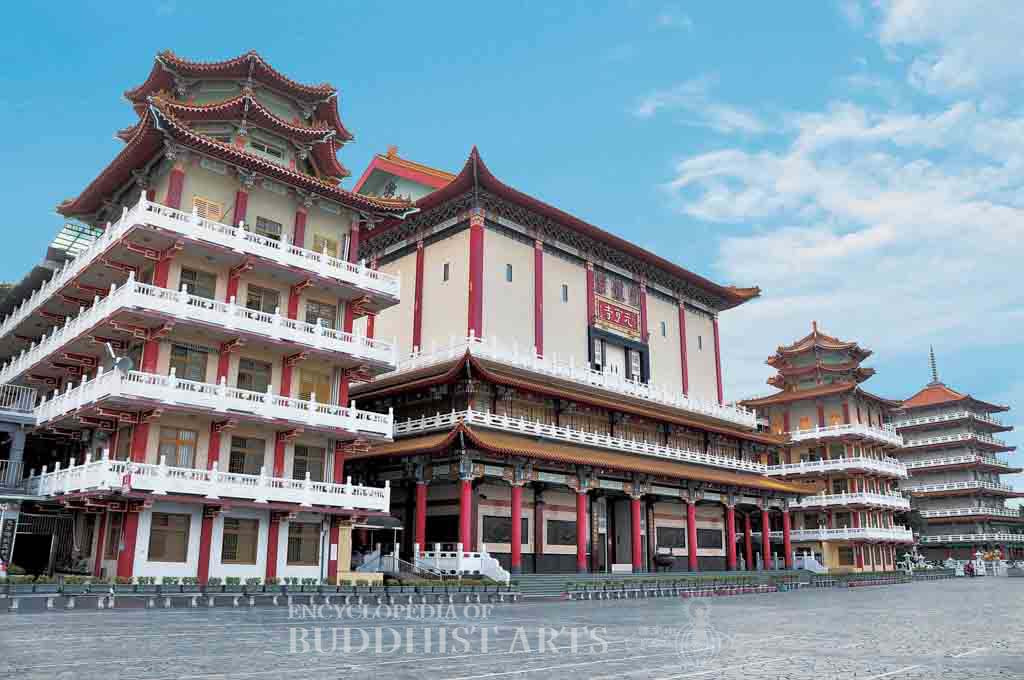
Yuanheng Temple
Yuanheng Temple
TAIWAN, Kaohsiung
This was originally called Yuanxing Temple and was built in 1743 in veneration of Avalokitesvara Bodhisattva by the Fujianese monk Jingyuan. The temple was destroyed by fire in 1891. It was moved to its present site and renamed Yuanheng Temple. It was reconstructed in 1926 and later expanded.
The east-facing temple consists of the main temple gate, Heavenly King Hall, Avalokitesvara Hall, Great Hero Hall, Ten Thousand Buddha Hall, pagoda, bell tower, and an educational building. The three-bay wide main temple gate was built in 1965. Its main ridge has a miniature pagoda in the center and there are dragons at either end. In 2000 a two-story building was constructed with the Heavenly King Hall on the upper story and the Avalokitesvara Hall on the lower story. The Heavenly King Hall houses Maitreya Bodhisattva and the Four Heavenly Kings, while the Avalokitesvara Hall contains statues of Avalokitesvara Bodhisattva and the Eighteen Arhats. The interior and external walls of both halls are inlaid with stone carvings of Buddhist stories.
The Great Hero Hall was completed in 1984 and occupies an area of 1,900 sq m. The hall houses Sakyamuni, Amitabha and Medicine Buddhas with Manjusri and Samantabhadra Bodhisattvas on either side. Skanda and Sangharama Bodhisattvas are on the outside. The hall contains 3,000 miniature Buddha and Arhat statues, while the walls are inlaid with reliefs depicting the Eight Great Events from the Life of the Buddha. The Ten Thousand Buddha Hall is located above the Great Hero Hall, and contains the Amitabha Buddha Triad. The walls are filled with ten thousand miniature Buddha statues. The bell tower is located to the north of the Great Hero Hall. A large Japanese bell weighing 20 t hangs in the tower, and has the Diamond Sutra engraved on it.
Since 1988 the temple has published a Chinese translation of the Pali Canon. It has established institutes for research into the Pali Canon in both Taiwan and Sri Lanka, which has greatly encouraged cultural exchange between the northern and southern traditions of Buddhism.
For more details, go to the Encyclopedia of Buddhist Arts: Architecture T-Z, page 1370.
Cite this article:
author = Hsingyun and Youheng and Johnson, Peter and Mankuang and Lancaster, Lewis,
booktitle = {Encyclopedia of Buddhist Arts: Architecture T-Z},
pages = 1370,
title = {{Yuanheng Temple}},
volume = 4,
year = {2016}}