
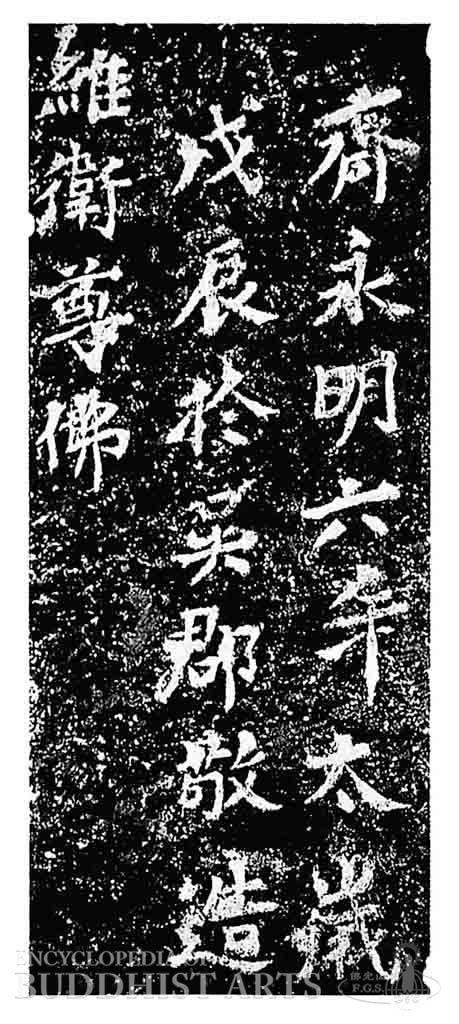
Inscription of Sculpture at Miaoxiang Temple
Rubbing
Inscription of Sculpture at Miaoxiang Temple
CHINA; Southern Qi dynasty
This stele inscription contains a total of 18 characters that date it to the year 488 of the Southern Qi dynasty, and denote its place of creation as Wujun (present day Suzhou, Jiangsu). The inscription was found on the back of a stone statue of Vipasyin Buddha located at Miaoxiang Temple. Vipasyin Buddha is the first of the Seven Buddhas of the Past. Such inscriptions as this were not common to the Southern Dynasties (420–589), and thus, this work is considered a particularly rare and precious piece of calligraphic history.
The stone engraving style seen in this stele rubbing is an example of the style that came after the transition from clerical to regular script, which occurred sometime between the Liu Song (420–479) and Southern Qi (479–502) dynasties. The calligraphy has more regular script characteristics, featuring an oblique and tight structure. Although the work only has a few characters, an overall energetic quality is evident in each brushstroke.
For more details, go to the Encyclopedia of Buddhist Arts: Calligraphy, page 104.
Cite this article:
author = Hsingyun and Youheng and Youlu and Pokorski, Stefanie and Mankuang and Edson, Gary,
booktitle = {Encyclopedia of Buddhist Arts: Calligraphy },
pages = 104,
title = {{Inscription of Sculpture at Miaoxiang Temple}},
volume = 17,
year = {2016}}