
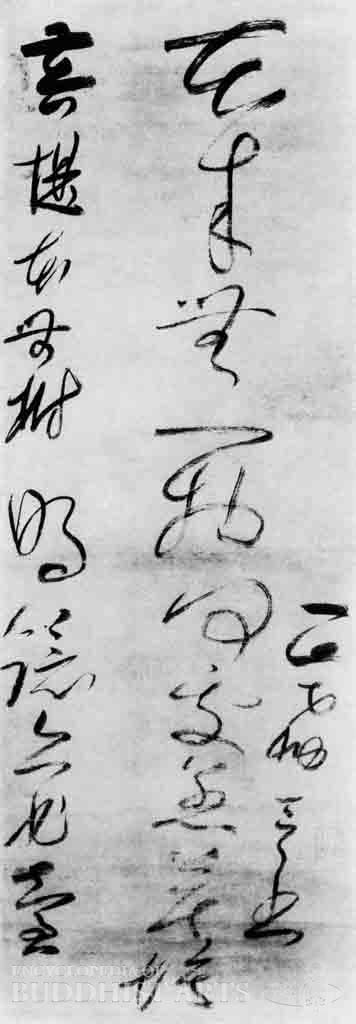
Daitokuji Temple: Verse by Master Huineng on the Bodhi Tree
Ink on paper
Daitokuji Temple: Verse by Master Huineng on the Bodhi Tree
JAPAN, Kyoto; Kamakura period
This scroll contains a verse composed by Huineng, the Sixth Patriarch of the Chan school. The text reads, “Bodhi is fundamentally not a tree, and the bright mirror is not a stand. There is originally nothing, where would the dust land?” The Fifth Patriarch, Hongren, read this and saw that Huineng comprehended the true meaning of emptiness. He handed his robe and alms bowl to Huineng and named him the Sixth Patriarch as a result. This calligraphic piece by Yishan Yining was designated as an Important Cultural Property of Japan in 1953.
The strong, rounded brushstrokes and continuous lines in this work suggest stylistic influences from the Tang dynasty (618–907) calligrapher, Huaisu, whose autobiographical work included similar articulations. The execution in this piece is more random and casual than Huaisu’s calligraphy, and this free-form style has an unassuming and natural quality that characterizes Chan calligraphy.
Yishan Yining, also known as Issan Ichinei in Japanese, was a monk of the Linji school of Chan Buddhism. He was sent on a diplomatic mission to Japan in 1299, and in 1313, he gained the admiration of Emperor Go-Uda (reigned 1274–1287), who invited him to Kyoto to become the third abbot of Nanzenji Temple. Yishan not only revived and popularized Zen Buddhism in Japan, he also encouraged the study of Chinese literature, which laid a firm foundation for the flourishing of the Zen literature works collectively known as Literature of the Five Mountains. He was posthumously bestowed the title of National Master.
For more details, go to the Encyclopedia of Buddhist Arts: Calligraphy, page 42.
Cite this article:
author = Hsingyun and Youheng and Youlu and Pokorski, Stefanie and Mankuang and Edson, Gary,
booktitle = {Encyclopedia of Buddhist Arts: Calligraphy },
pages = 42,
title = {{Daitokuji Temple: Verse by Master Huineng on the Bodhi Tree}},
volume = 17,
year = {2016}}