
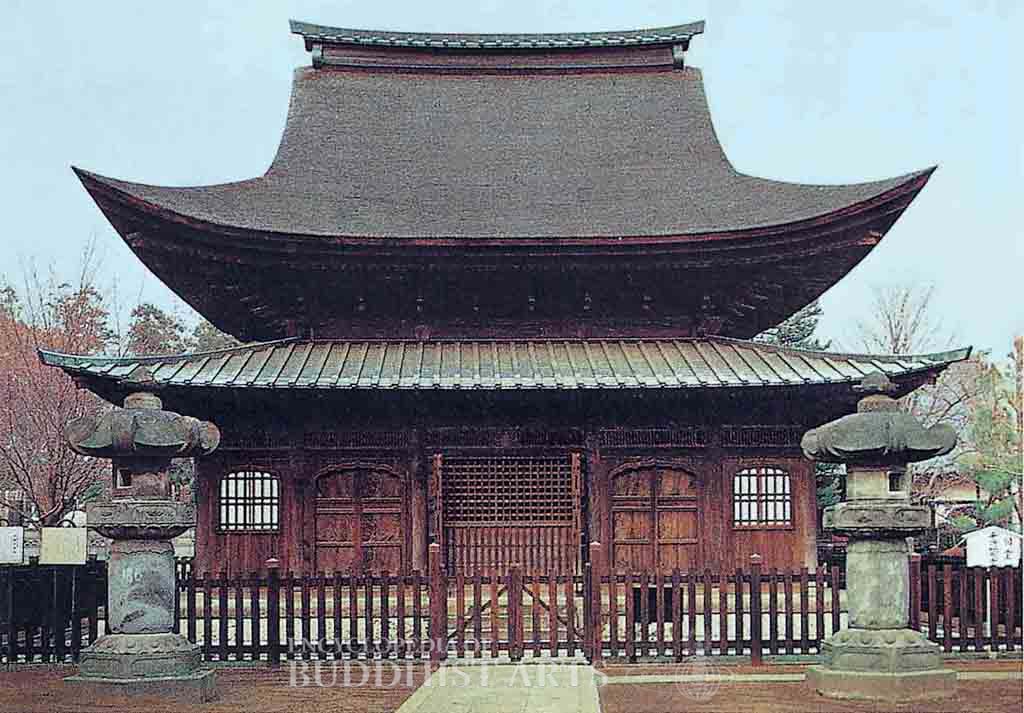
Shofukuji Temple Ksitigarbha Hall
Shofukuji Temple Ksitigarbha Hall
JAPAN, Tokyo, Higashimurayama
Shofukuji Temple belongs to the Kenjoji branch of the Rinzai school of Japanese Buddhism. The temple is believed to have been constructed in 1278 during the Kamakura period. The Ksitigarbha Hall, built in 1407 during the Muromachi period, exhibits features of Zen-style Buddha halls from the Kamakura (1185–1333) and Muromachi (1392–1573) periods. The hall was listed as a National Treasure in 1952.
The three-by-three bay hall has a double-eave hip-and-gable roof. Each side measures 8.5 m. The upper roof is covered with thin cypress shingles, while the lower roof is covered with copper sheets. The upper roof has a steep slope and the eaves are supported by three-tier bracket sets. The central bays on both the front and the back have lattice doors. At the front the bays on either side of the central bay have arch-shaped lattice doors, while the outer bays have bell-shaped windows. The ceiling within the hall is composed of inlaid wood. A standing statue of Ksitigarbha Bodhisattva is enshrined within the hall.
For more details, go to the Encyclopedia of Buddhist Arts: Architecture M-S, page 1002.
Cite this article:
author = Hsingyun and Youheng and Johnson, Peter and Mankuang and Lancaster, Lewis,
booktitle = {Encyclopedia of Buddhist Arts: Architecture M-S},
pages = 1002,
title = {{Shofukuji Temple Ksitigarbha Hall}},
volume = 3,
year = {2016}}