
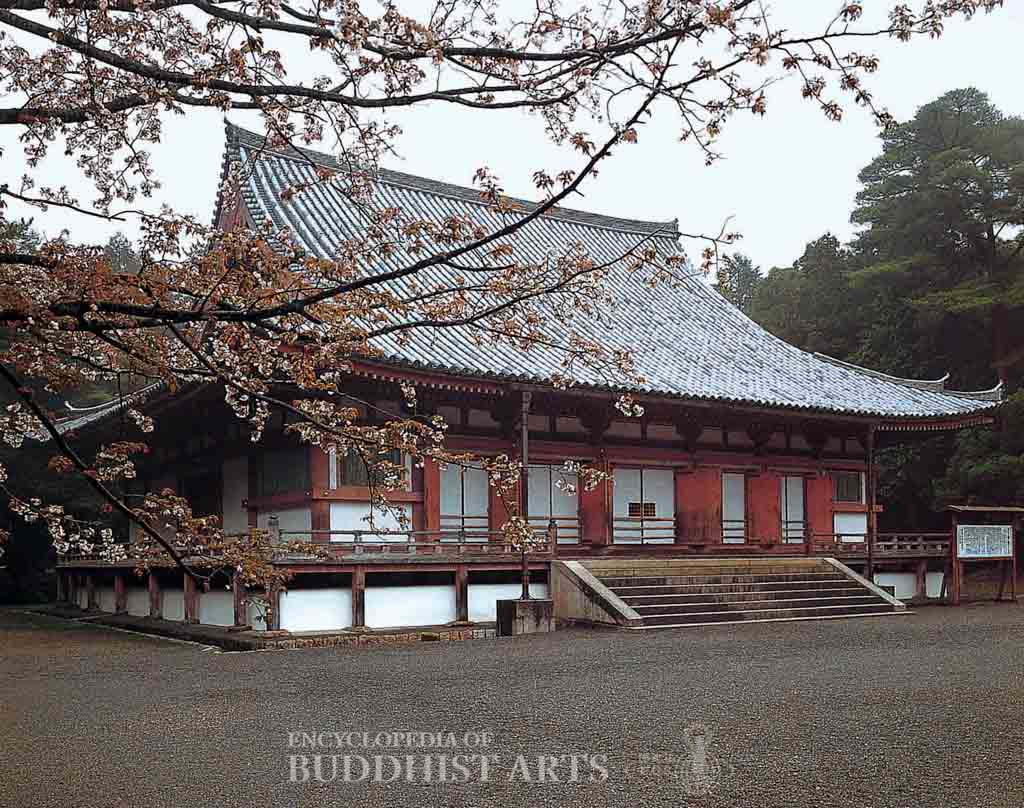
Daigoji Temple: Golden Hall
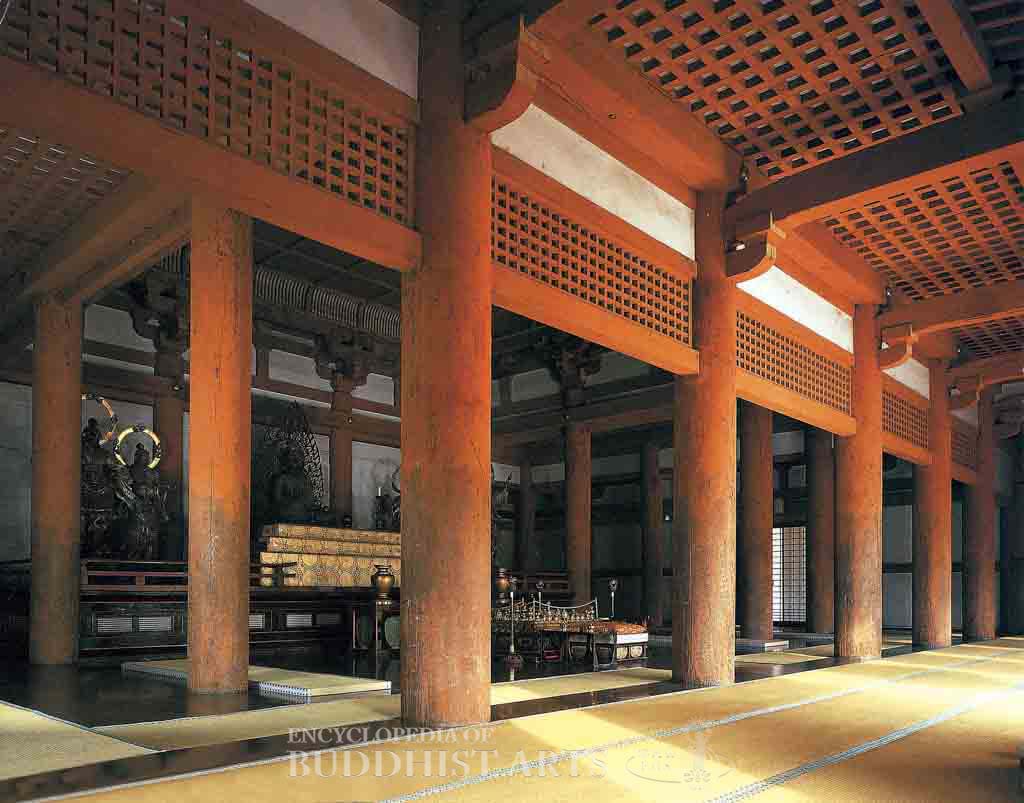
Daigoji Temple: Golden Hall (interior)
Daigoji Temple
JAPAN, Kyoto
It is the head temple of the Daigo branch of the Shingon school and is the 11th of the 33 Avalokitesvara temples of the Saigoku Kannon Pilgrimage of southern-central Japan. The temple was established in 874 during the Heian period by Master Rigen to enshrine a statue of Avalokitesvara. After the Kamakura period (1185–1333), the temple flourished with the support of the military government. It was destroyed during the Onin War (1467–1477) and was restored by Toyotomi Hideyoshi to its present form. As part of the Historic Monuments of Ancient Kyoto, it was listed as a UNESCO World Heritage Site in 1994.
The temple occupies an area of 661.2 ha and consists of upper and lower temples. The main buildings include the Gate of Benevolent Kings, Cintamanicakra Hall, Golden Hall, Medicine Buddha Hall, and five-story pagoda, with the latter three listed as National Treasures.
The seven-by-five bay Golden Hall was constructed in 1599 reusing the materials from the main hall of Manganji Temple in Wakayama. It has a single-eave hip-and-gable roof covered with cylindrical tiles. With large spaces between the columns, large bracket sets and bracket arms above the beams, the temple is an example of Heian period (794–1185) architectural style. The five-by-four bay Medicine Buddha Hall was built in 1121 during the Heian period. It has a single-eave hip-and-gable roof covered with cypress bark. The five-story pagoda is the oldest wooden structure in Kyoto.
Having received extensive royal patronage in the 10th century, the temple was blessed with tremendous development and it owns a large number of sculptures and paintings left behind by aristocrats. The temple possesses 18 National Treasures, including buildings, and houses several dozen Important Cultural Properties. Approximately 600 boxes containing calligraphy scrolls, books, and artifacts from the Nara (710–794) and Heian periods, and the Azuchi-Momoyama (1573–1615) and Edo (1615–1868) periods offer a rich source of information on Japanese society of those times.
For more details, go to the Encyclopedia of Buddhist Arts: Architecture A-F, page 194.
Cite this article:
author = Hsingyun and Youheng and Johnson, Peter and Mankuang and Lancaster, Lewis,
booktitle = {Encyclopedia of Buddhist Arts: Architecture A-F},
pages = 194,
title = {{Daigoji Temple}},
volume = 1,
year = {2016}}