
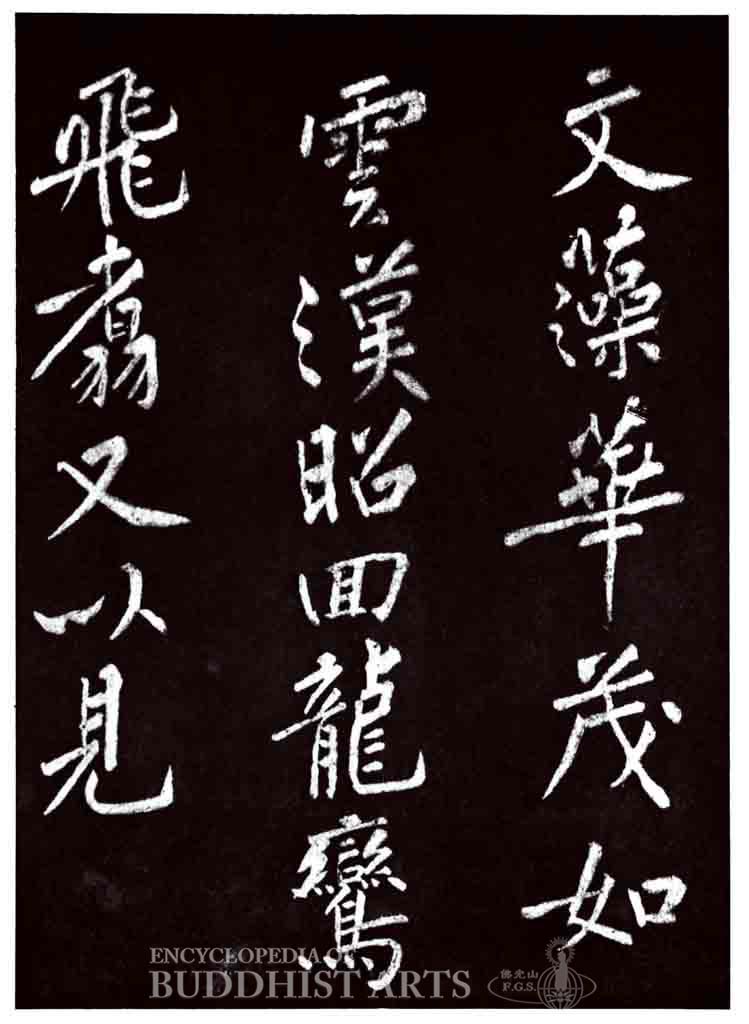
Ayuwang Temple: Stele of Foding Guangming Pagoda (detail)
Rubbing
Ayuwang Temple: Stele of Foding Guangming Pagoda
CHINA, Zhejiang, Ningbo; Southern Song dynasty
Emperor Gaozong (reigned 1127–1162) of the Song dynasty wrote this calligraphic piece when he was 27 years old. Master Jingtan, the head abbot of Ayuwang Temple in Ningbo, presented the calligraphic works of Song emperors in the temple collection to Emperor Gaozong during the Southern Song dynasty (1127–1279). Emperor Gaozong, to show his appreciation, issued a handwritten decree for the temple, the contents and calligraphy of which were subsequently engraved onto a stele. The inscription consists of three parts and is endorsed with the emperor’s imperial seal.
Emperor Gaozong studied the calligraphy of Huang Tingjian during his early years. This particular piece bears many elements of Huang’s style, though in comparison, Gaozong’s composition is more uniform and the characters are more widely spaced. The stele was erected at the main door of the temple, and likely served as a template for monks who wished to study Huang’s style.
The founding emperor of the Southern Song dynasty, Emperor Gaozong was also known by the names Zhao Gou or Deji. He excelled in calligraphy, particularly in running and cursive scripts, and his elegant and beautiful style greatly influenced the calligraphic style of the Song imperial family.
For more details, go to the Encyclopedia of Buddhist Arts: Calligraphy, page 17.
Cite this article:
author = Hsingyun and Youheng and Youlu and Pokorski, Stefanie and Mankuang and Edson, Gary,
booktitle = {Encyclopedia of Buddhist Arts: Calligraphy },
pages = 17,
title = {{Ayuwang Temple: Stele of Foding Guangming Pagoda}},
volume = 17,
year = {2016}}