
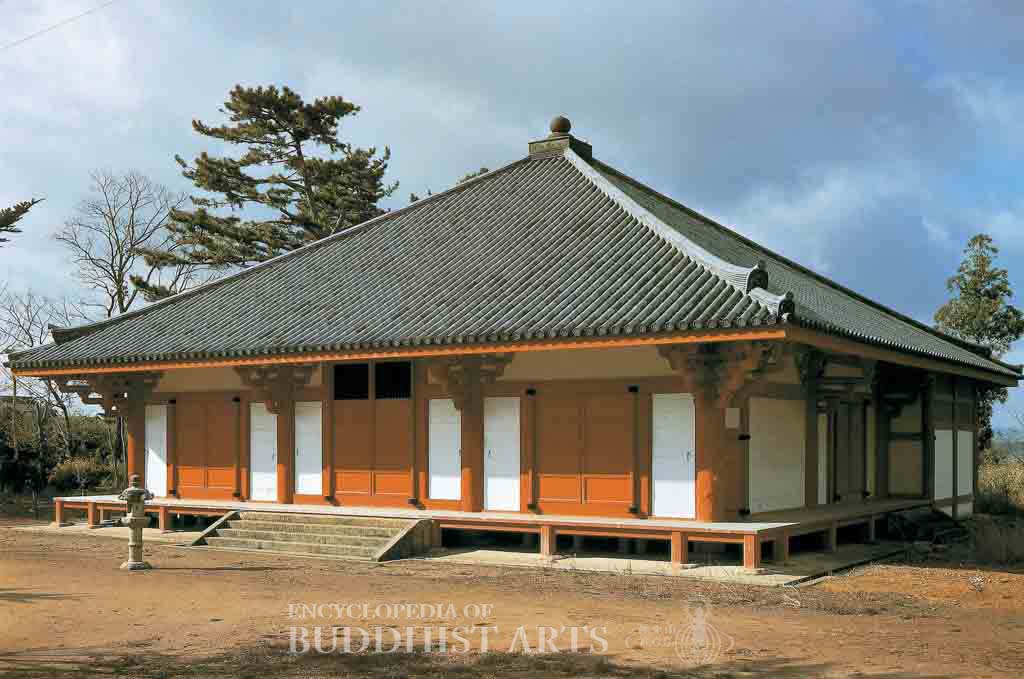
Jodoji Temple Pure Land Hall
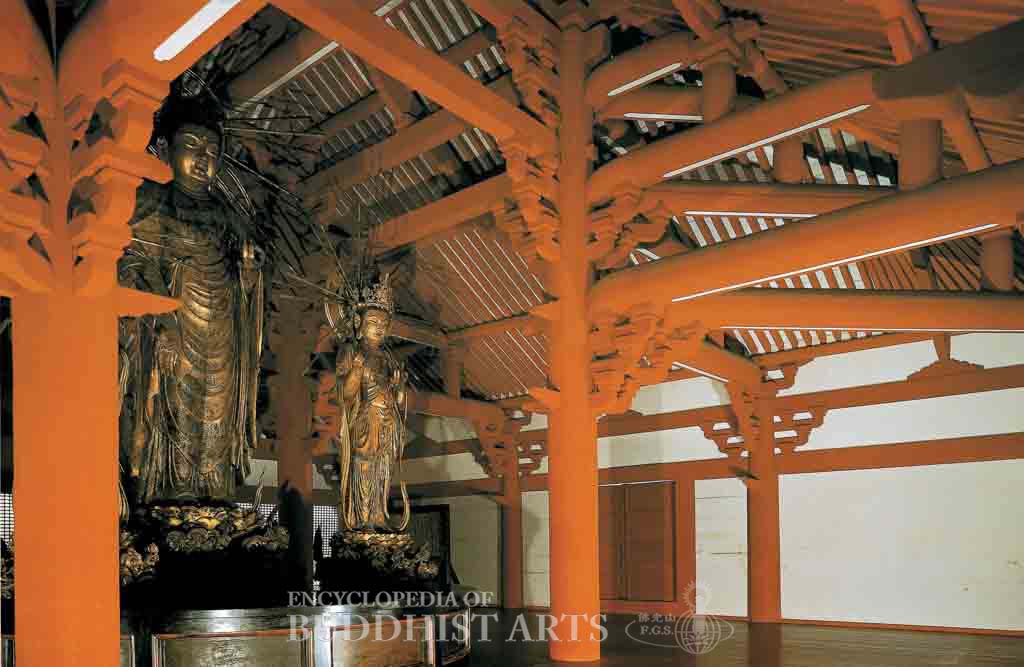
Jodoji Temple Pure Land Hall (interior)
Jodoji Temple Pure Land Hall
JAPAN, Hyogo, Ono
The hall is also known as Amitabha Hall. It was built by Shunjobo Chogen between 1192 and 1194 during the Kamakura period. It is the oldest building in the daibutsuyou architectural style, which was introduced to Japan when Chogen constructed the Great Buddha Hall of Todaiji Temple. The hall was listed as a National Treasure in 1952.
The three-by-three bay hall has a single-eave pyramidal roof with straight hips, covered with cylindrical tiles. In the center of the roof are a harmika and jewel. At the front of the building there are doors in the center of each bay. When the sun sets it shines through the back windows, creating an attractive nimbus effect around the statue of Amitabha Buddha.
The interior has exposed beams and columns, and the beams radiate outwards. The capitals have three-tier bracket sets supporting double-crescent beams. The circular Sumeru platform houses a large statue of the Amitabha Buddha flanked by smaller statues of the two attendant Bodhisattvas, Avalokitesvara and Mahasthamaprapta. The Buddha Triad was carved by Kaikei during the Kamakura period (1185–1333).
For more details, go to the Encyclopedia of Buddhist Arts: Architecture G-L, page 551.
Cite this article:
author = Hsingyun and Youheng and Johnson, Peter and Mankuang and Lancaster, Lewis,
booktitle = {Encyclopedia of Buddhist Arts: Architecture G-L},
pages = 551,
title = {{Jodoji Temple Pure Land Hall}},
volume = 2,
year = {2016}}