
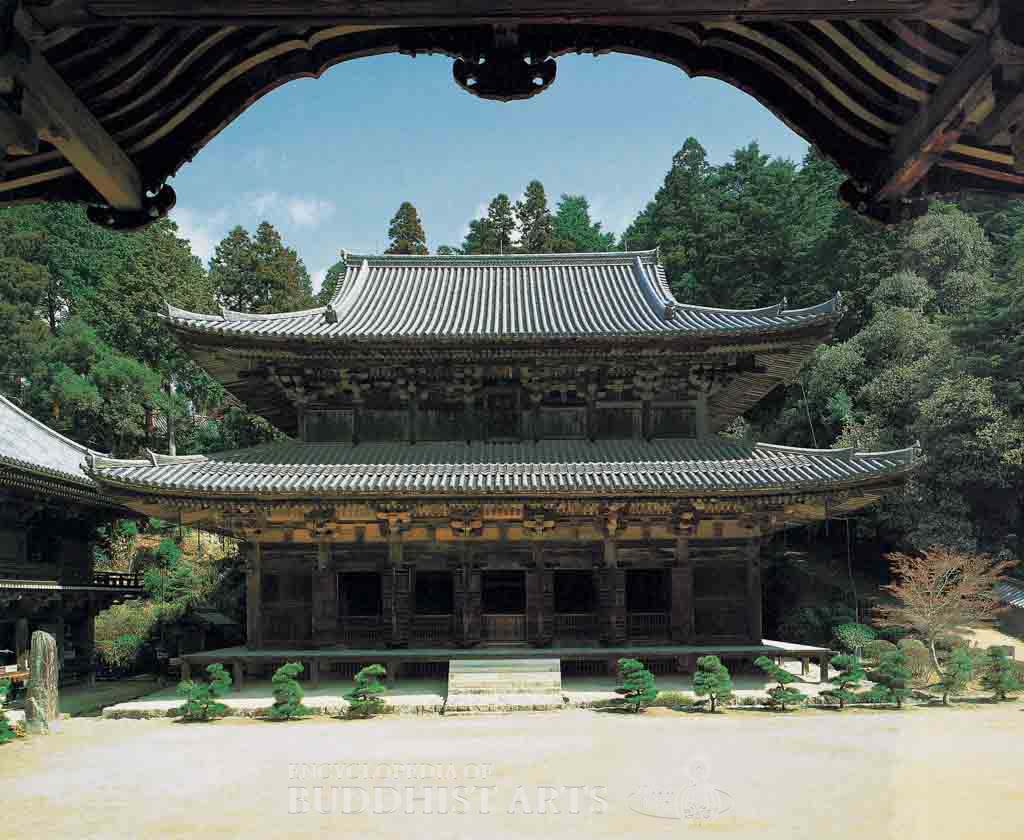
Engyoji Temple: Great Lecture Hall
Engyoji Temple
JAPAN, Hyogo, Himeji
Engyoji, or Perfect Teaching Temple, is located on Shoshazan Mountain. It belongs to the Tendai school of Japanese Buddhism and was founded in 966 during the Heian period by Master Shoku. It is the 27th of the 33 Avalokitesvara temples of the Saigoku Kannon Pilgrimage of southern-central Japan. The temple flourished as the court and imperial family turned to Buddhism for spiritual refuge. It became one of the Three Major Temples of the Tendai school, the other two being Enryakuji Temple at Hieizan Mountain and Daisenji Temple in Daisen. The temple has been damaged and reconstructed many times. Most of its present structures were built during the Muromachi period (1392–1573).
The principal buildings of the temple include the Great Lecture Hall, Vajra Hall, Amitabha Hall, bell tower, and dining hall. All of these halls were listed as Important Cultural Properties between 1913 and 1956. The three main buildings, the Great Lecture Hall, dining hall, and Amitabha Hall, known collectively as the Three Halls, are built in a U-shape with their eaves touching. The seven-by-six bay Great Lecture Hall, which is the temple’s main hall, was rebuilt in 1462 during the Muromachi period. It has a hip-and-gable roof covered with round flat tiles. The two-story hall has two-tier bracket sets. The five central bays on the first story have lattice doors with mullioned windows at either end. On the second story there are doors only in the central bays and the remaining bays consist of wooden walls. There are statues of the Sakyamuni Buddha Triad enshrined on the Sumeru platform within the hall.
The dining hall, known as the Long Hall, has become the temple’s museum. The two-story building is approximately 40 m wide. The five-by-five bay Amitabha Hall, built in 1453 during the Muromachi period, has a single-eave hip-and-gable roof covered with round flat tiles. The hall is used for the practice of pratyutpanna samadhi.
For more details, go to the Encyclopedia of Buddhist Arts: Architecture A-F, page 274.
Cite this article:
author = Hsingyun and Youheng and Johnson, Peter and Mankuang and Lancaster, Lewis,
booktitle = {Encyclopedia of Buddhist Arts: Architecture A-F},
pages = 274,
title = {{Engyoji Temple}},
volume = 1,
year = {2016}}