
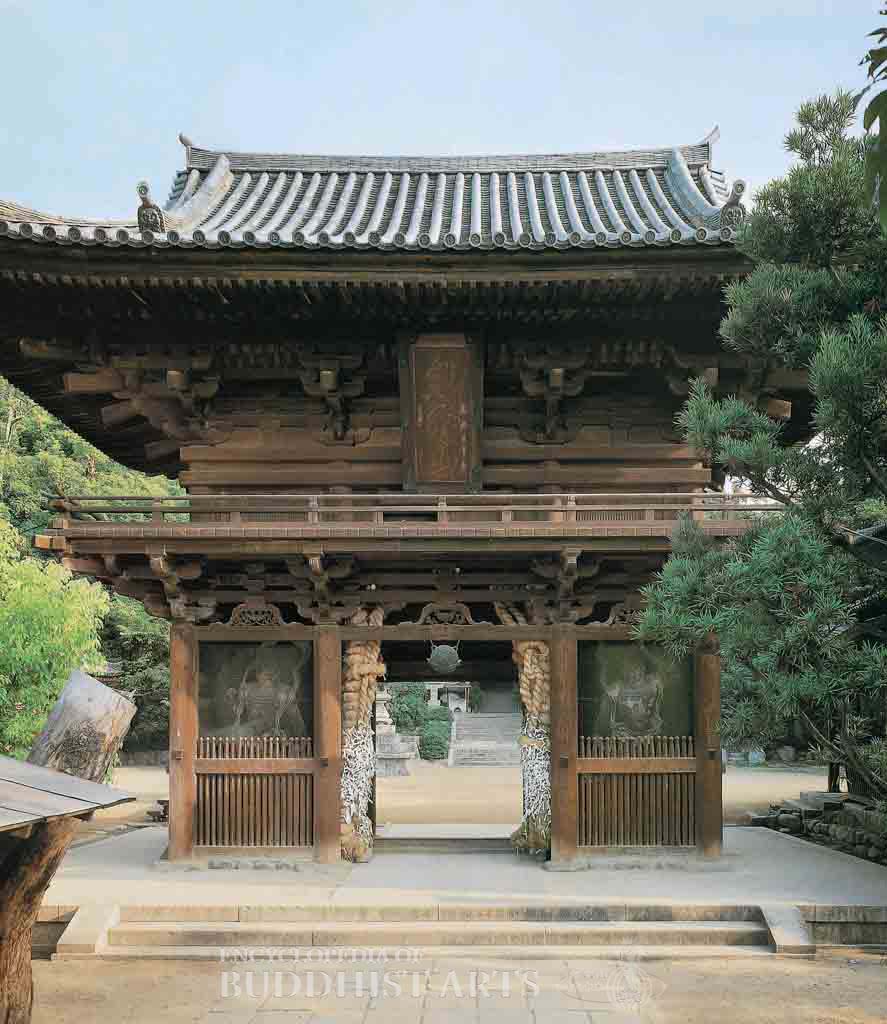
Ishiteji Temple Gate of Two Kings
Ishiteji Temple Gate of Two Kings
JAPAN, Ehime, Matsuyama
The temple was built as Annoyoji in 728 during the Nara period by monk Gyoki. It was renamed Ishiteji, or Stone Hand Temple, in 892 during the Heian period. The temple flourished near the end of the Heian period (794–1185) when the monastic compound was completed. The gate is said to have been built in 1318. It was listed as a National Treasure in 1952.
The two-story three-bay wide gate has a hip-and-gable roof covered in cylindrical tiles. Three-tier bracket sets are placed on top of the circular pillars on the first level, with camel-hump supports on the horizontal beam. The decoration is detailed and conveys a sense of elegance. Two Dharma protectors are located inside the bays on either side of the central bay. There are three-tier bracket sets supporting the roof of the gate. There is also a low balustrade surrounding the second level. This traditional and simple structure is a typical example of this type of gate.
For more details, go to the Encyclopedia of Buddhist Arts: Architecture G-L, page 493.
Cite this article:
author = Hsingyun and Youheng and Johnson, Peter and Mankuang and Lancaster, Lewis,
booktitle = {Encyclopedia of Buddhist Arts: Architecture G-L},
pages = 493,
title = {{Ishiteji Temple Gate of Two Kings}},
volume = 2,
year = {2016}}