
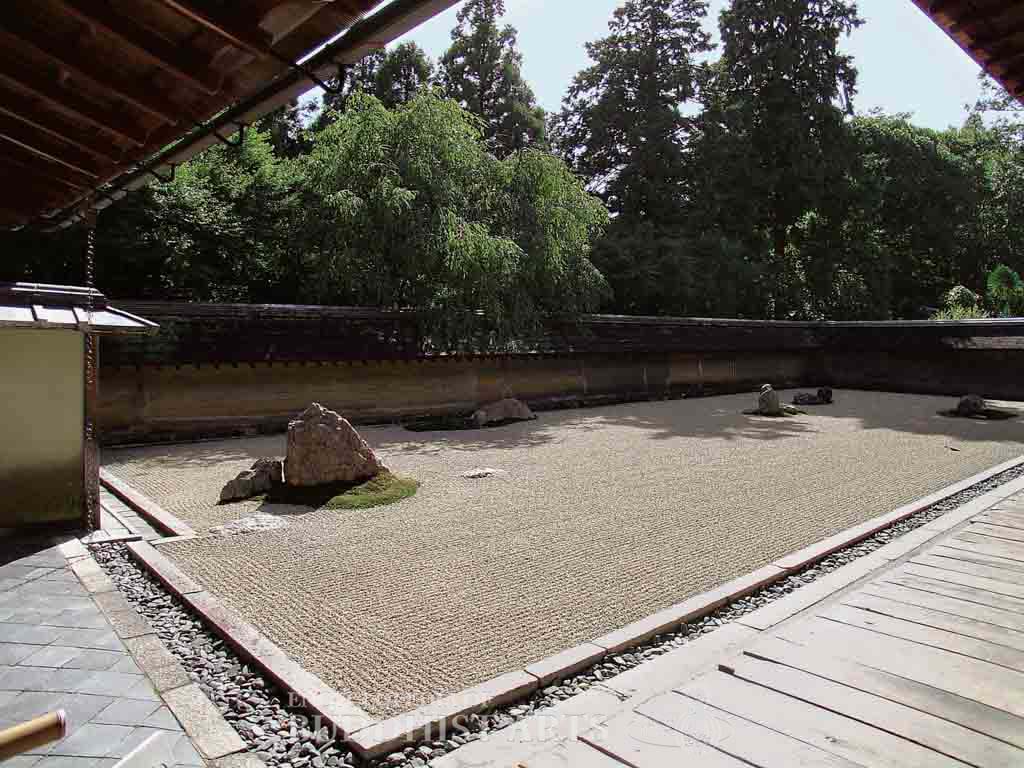
Ryoanji Temple: Rock Garden
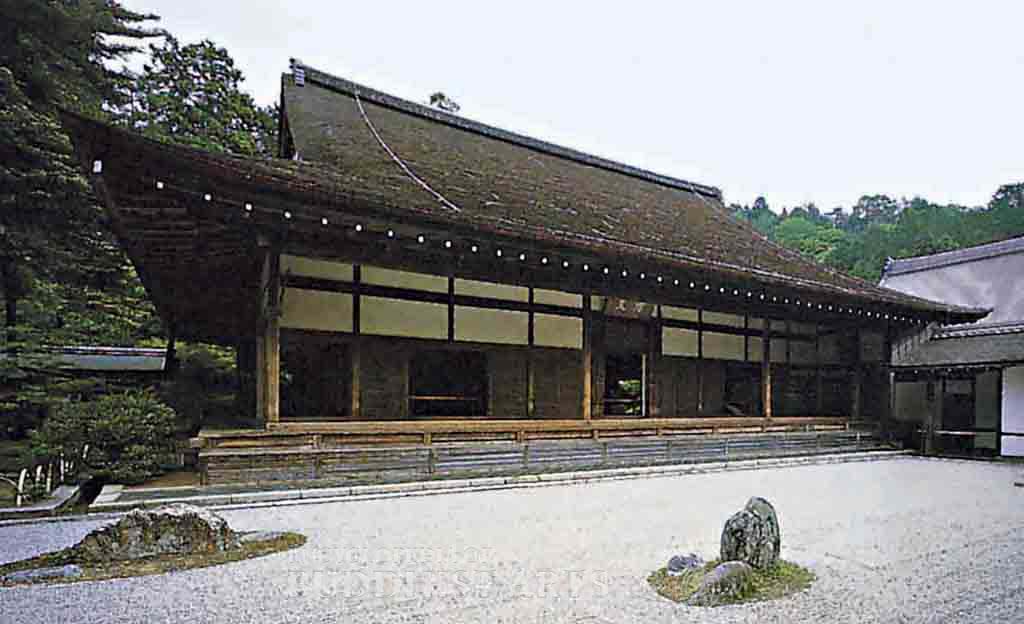
Ryoanji Temple: Abbot’s Quarters
Ryoanji Temple
JAPAN, Kyoto
Ryoanji means Temple of the Peaceful Dragon. It belongs to the Myoshinji branch of the Rinzai school of Japanese Buddhism. The temple was constructed in 1450 during the Muromachi period by Hosokawa Katsumoto. Giten Gensho of Myoshinji Temple was asked to establish the temple. At the time of establishment, the temple already consisted of the seven major aspects of a monastery, and had more than twenty subsidiary temples. It was destroyed during the Onin War (1467–1477), and was rebuilt in 1488 during the Muromachi period by Katsumoto’s son, Masamoto. It was later destroyed and rebuilt. As part of the Historic Monuments of Ancient Kyoto, the temple was listed as a UNESCO World Heritage Site in 1994.
The present temple buildings include the Buddha Hall, worship hall, Nirvana Hall, abbot’s quarters, and kuri, as well as subsidiary temples Daijuin and Seigenin. The abbot’s quarters were destroyed by fire in 1797 during the Edo period, and replaced by the abbot’s quarters from Seigenin. The 21 bay by 18 bay structure has a single-eave hip-and-gable roof and has the appearance of traditional Azuchi-Momoyama period (1573–1615) architecture.
In front of the abbot’s quarters there is a dry landscape rock garden that is listed as a Historic Site and a Special Place of Scenic Beauty. It was originally the garden of Tokudaiji Temple built in the Kamakura period (1185–1333). The garden measures 23 m long from east to west, and 9 m long from north to south. There are 15 rocks of various sizes arranged within the garden of raked gravel.
For more details, go to the Encyclopedia of Buddhist Arts: Architecture M-S, page 908.
Cite this article:
author = Hsingyun and Youheng and Johnson, Peter and Mankuang and Lancaster, Lewis,
booktitle = {Encyclopedia of Buddhist Arts: Architecture M-S},
pages = 908,
title = {{Ryoanji Temple}},
volume = 3,
year = {2016}}