
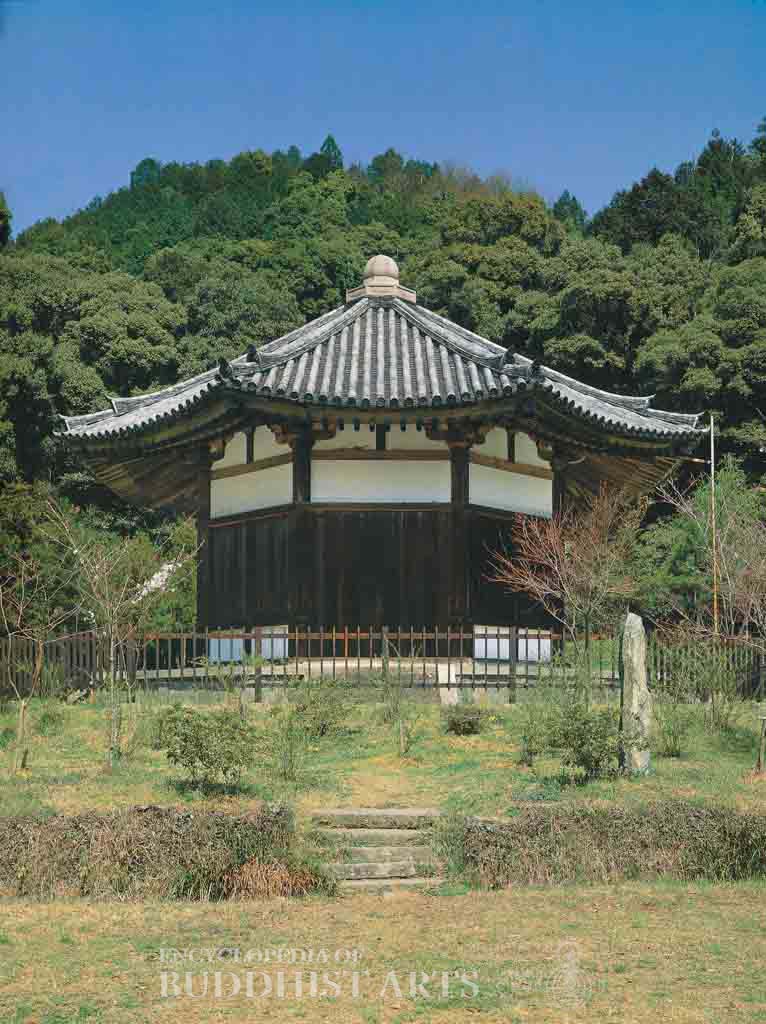
Eizanji Temple Octagonal Hall
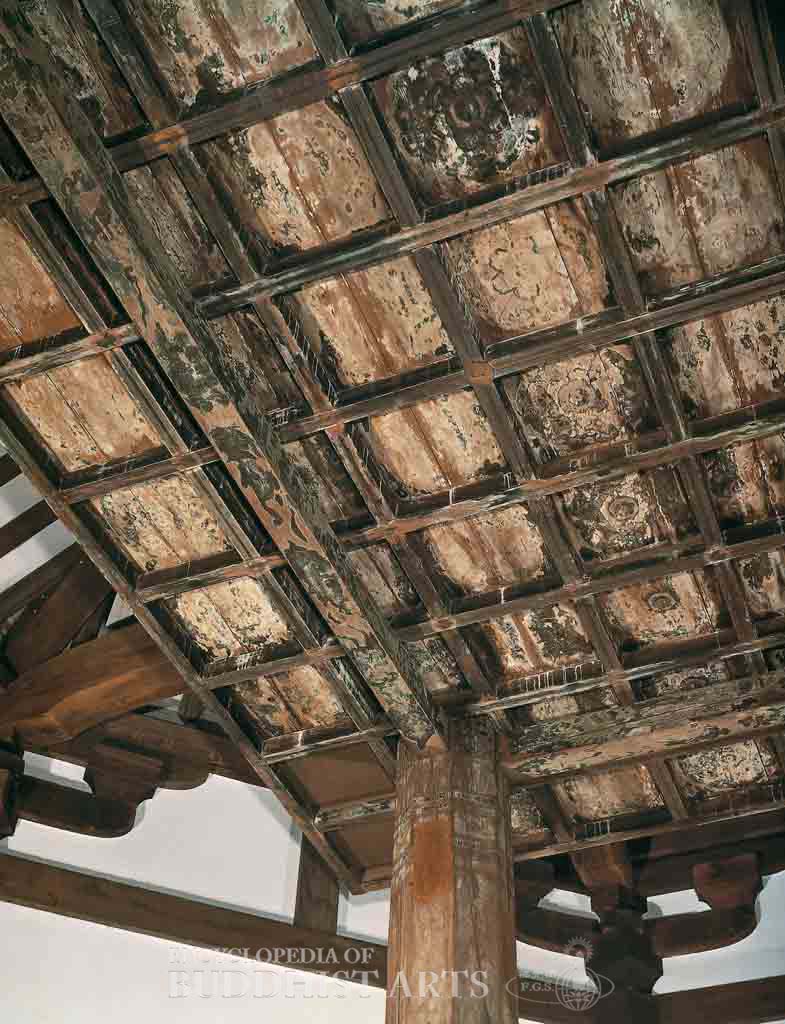
Eizanji Temple Octagonal Hall: Coffered Ceiling
Eizanji Temple Octagonal Hall
JAPAN, Nara, Gojo
This hall is one of few octagonal halls from the Nara period (710–794). It was constructed by Fujiwara between 757 and 765 in memory of his parents. It was fully renovated in 1911. The hall was listed as a National Treasure in 1952.
This hall is built on a base platform and has a single-eave octagonal pyramidal roof covered with cylindrical tiles. The columns have triple bracket sets at the capitals. There are doors on four cardinal sides and windows with vertical bars on the other four sides. The spire consists of a simple stone-carved base and a jewel. Internally there are four octagonal columns marking out the sacred area at the center of the building, where there are seated Buddha images. A coffered ceiling is suspended from the four columns. The columns and beams are decorated with Bodhisattvas, apsaras, floral patterns, and birds.
For more details, go to the Encyclopedia of Buddhist Arts: Architecture A-F, page 264.
Cite this article:
author = Hsingyun and Youheng and Johnson, Peter and Mankuang and Lancaster, Lewis,
booktitle = {Encyclopedia of Buddhist Arts: Architecture A-F},
pages = 264,
title = {{Eizanji Temple Octagonal Hall}},
volume = 1,
year = {2016}}