
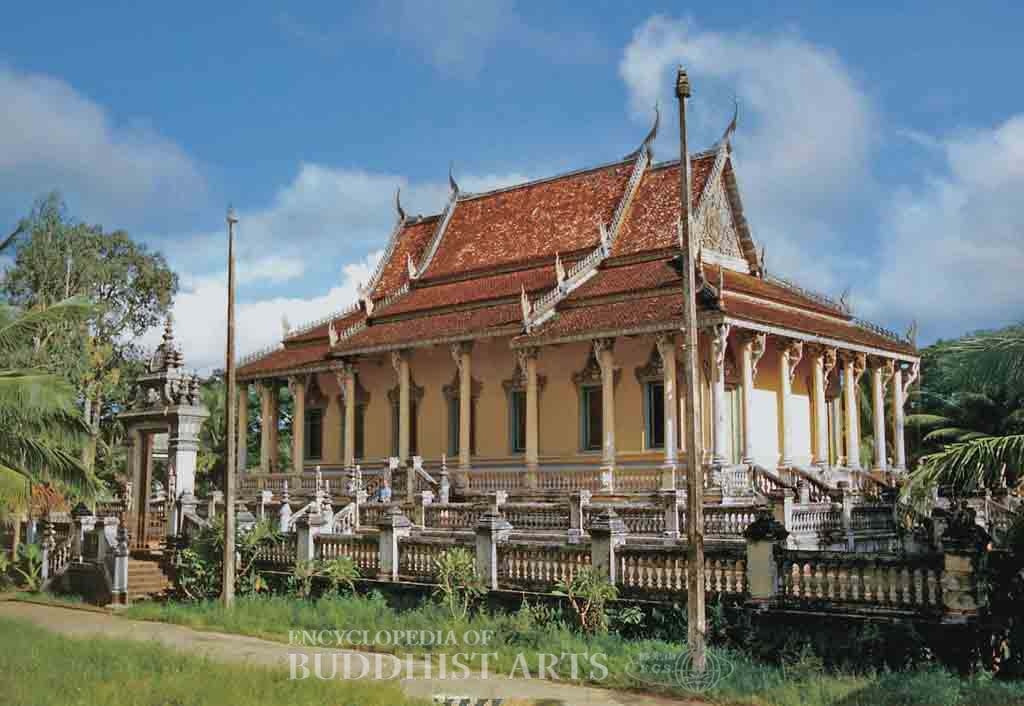
Khleang Temple

Khleang Temple: Main Hall (interior)
Khleang Temple
VIETNAM, Soc Trang
This is a Theravada Buddhist temple and was originally established as a small building with a thatched roof in 1533. It was later rebuilt with a tiled roof. This building, which became the main hall, was first repaired in 1916. It underwent a second renovation in 1975 by Abbot Tang No. The temple was listed as a National Cultural Heritage Site in 1990.
The principal buildings include the main hall and the pagoda. The east-facing main hall is 9 m wide by 12.8 m deep and stands on a 1 m high platform. Three sets of steps decorated with brick-laid garudas lead to the veranda surrounding the building. The veranda is lined with columns that are 1.1 m in height. The capital of each column consists of a carving of a garuda in the form of a half-human, half-bird. The main door is sculpted with reliefs depicting the conquest of demons by deities. The building has a gable roof with three sections of overlapping roofs and triple-tier eaves. The roof is decorated with naga bargeboards that terminate with the necks of the nagas curving and stretching their heads. The tails of these nagas merge at the ridge end, extending upwards in a sinuous finial. Within the hall there are 12 columns painted in black and decorated with images of nagas and fish. There is a 6.8 m high gilded statue of Sakyamuni Buddha enshrined within the hall.
For more details, go to the Encyclopedia of Buddhist Arts: Architecture G-L, page 605.
Cite this article:
author = Hsingyun and Youheng and Johnson, Peter and Mankuang and Lancaster, Lewis,
booktitle = {Encyclopedia of Buddhist Arts: Architecture G-L},
pages = 605,
title = {{Khleang Temple}},
volume = 2,
year = {2016}}