

Saimyoji Temple Three-Story Pagoda
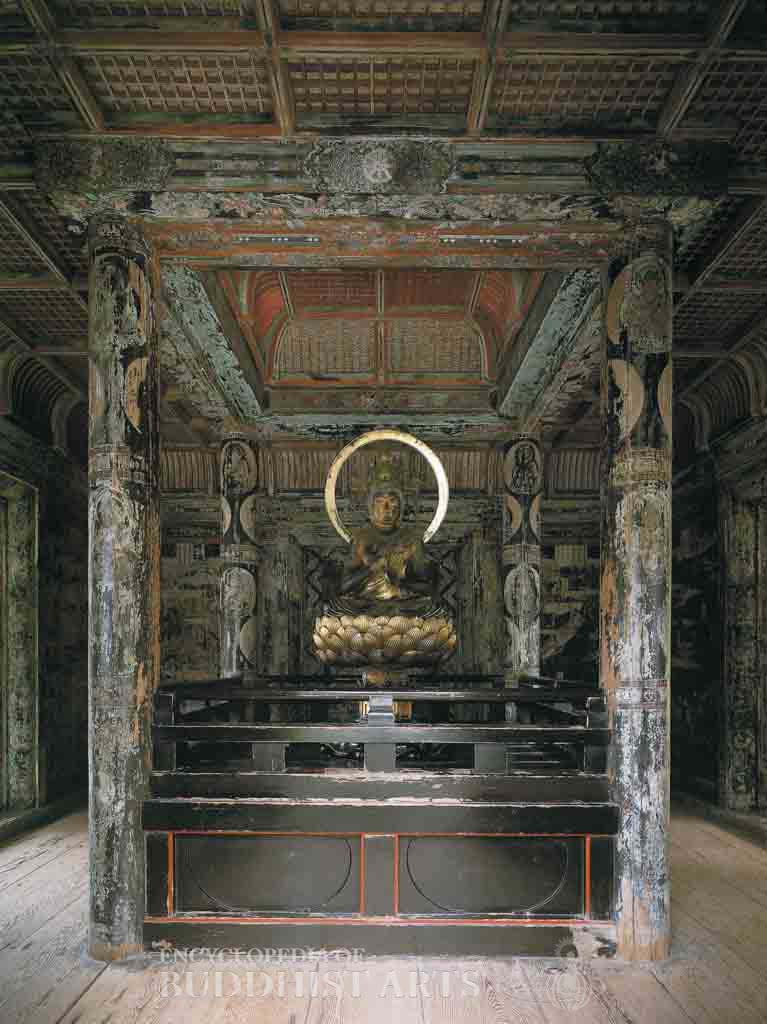
Saimyoji Temple Three-Story Pagoda (interior)
Saimyoji Temple Three-Story Pagoda
JAPAN, Shiga, Inukami
The pagoda was built during the late Kamakura period (1185–1333) by a master carpenter from Gifu. It was listed as a National Treasure in 1952.
The three-by-three bay wooden pagoda is 19.7 m high. Its roofs are covered in cypress bark. The eaves are supported by three-tier bracket sets. The first story is surrounded by a veranda, while the second and third stories have low balustrades. The extended eaves are upturned at the corners.
Within the first story a statue of Vairocana Buddha is enshrined on a Sumeru throne. The four columns around the central worship area as well as the door panels are painted with illustrations from the Buddha’s life. There are murals produced in the Kose school style using pure mineral pigments. They include illustrations from the Lotus Sutra, Bodhisattvas, birds, flowers, and other exquisite images that form a representation of the Diamond Realm Mandala.
For more details, go to the Encyclopedia of Buddhist Arts: Architecture M-S, page 913.
Cite this article:
author = Hsingyun and Youheng and Johnson, Peter and Mankuang and Lancaster, Lewis,
booktitle = {Encyclopedia of Buddhist Arts: Architecture M-S},
pages = 913,
title = {{Saimyoji Temple Three-Story Pagoda}},
volume = 3,
year = {2016}}