
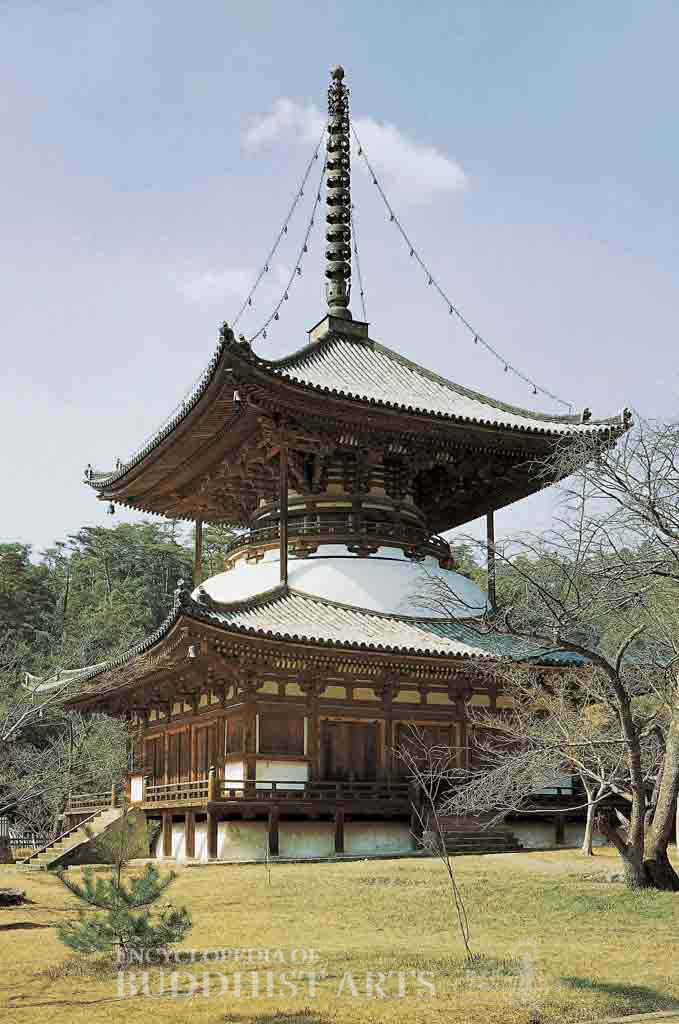
Negorodera Temple Prabhutaratna Pagoda
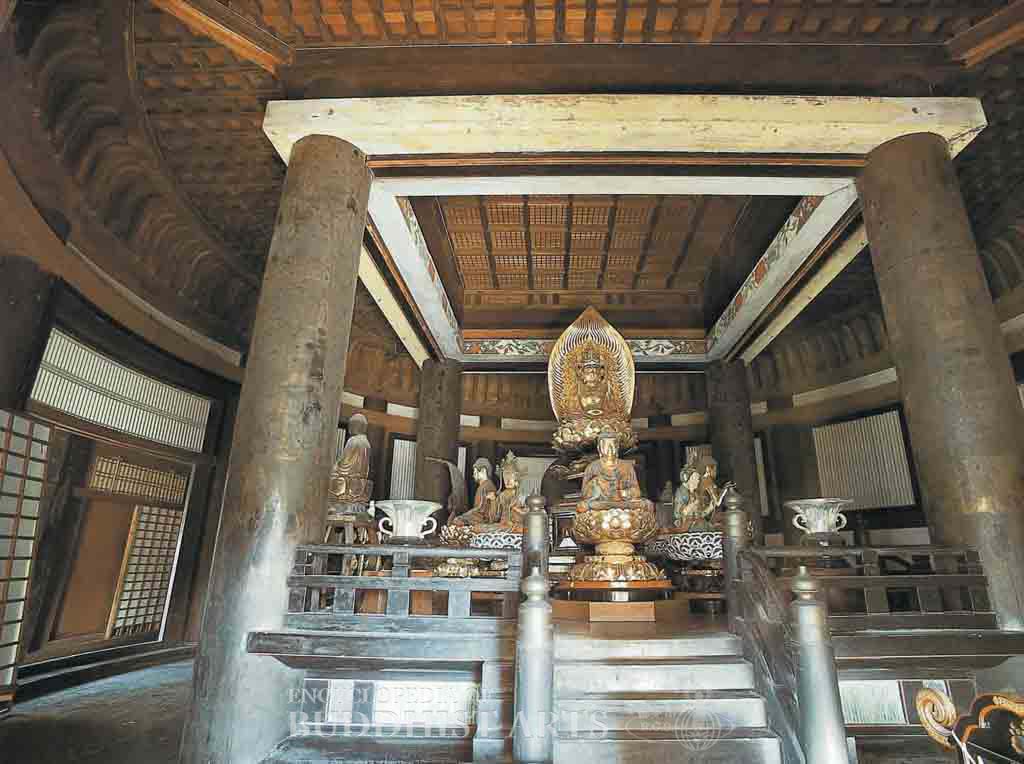
Negorodera Temple Prabhutaratna Pagoda (interior)
Negorodera Temple Prabhutaratna Pagoda
JAPAN, Wakayama, Naga
Also known as the Great Pagoda, it was built in 1513, during the Muromachi period, and managed to survive the destruction of the war during the Azuchi-Momoyama period (1573–1615). It was listed as a National Treasure in 1952.
The five-by-five bay pagoda is 35.9 m high and each side has a length of 14.9 m. The roof on each story is covered with cylindrical tiles. The first story is in the shape of a dome which extends upwards through the lower eaves. These are supported by two-tier bracket sets, while four-tier bracket sets are used for the second story eaves. The extended eaves on the second story are supported by four slim columns. The spire consists of a harmika, inverted bowl, upturned lotus, nine stacked rings, a flame, and a jewel. Chains with miniature bells connect the top of the spire to the four corners of the roof.
The central worship area is defined by four sturdy columns. A number of statues are enshrined on the platform, including the Five Dhayani Buddhas: Vairocana, Aksobhya, Ratnasambhava, Amitabha, and Amoghasiddhi.
For more details, go to the Encyclopedia of Buddhist Arts: Architecture M-S, page 791.
Cite this article:
author = Hsingyun and Youheng and Johnson, Peter and Mankuang and Lancaster, Lewis,
booktitle = {Encyclopedia of Buddhist Arts: Architecture M-S},
pages = 791,
title = {{Negorodera Temple Prabhutaratna Pagoda}},
volume = 3,
year = {2016}}