
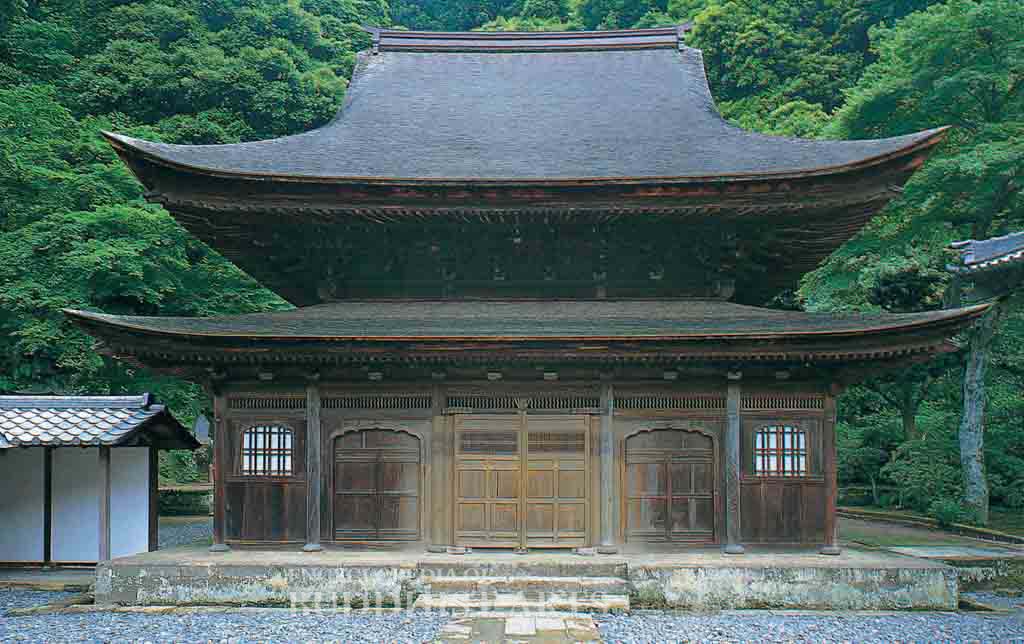
Engakuji Temple Relic Hall
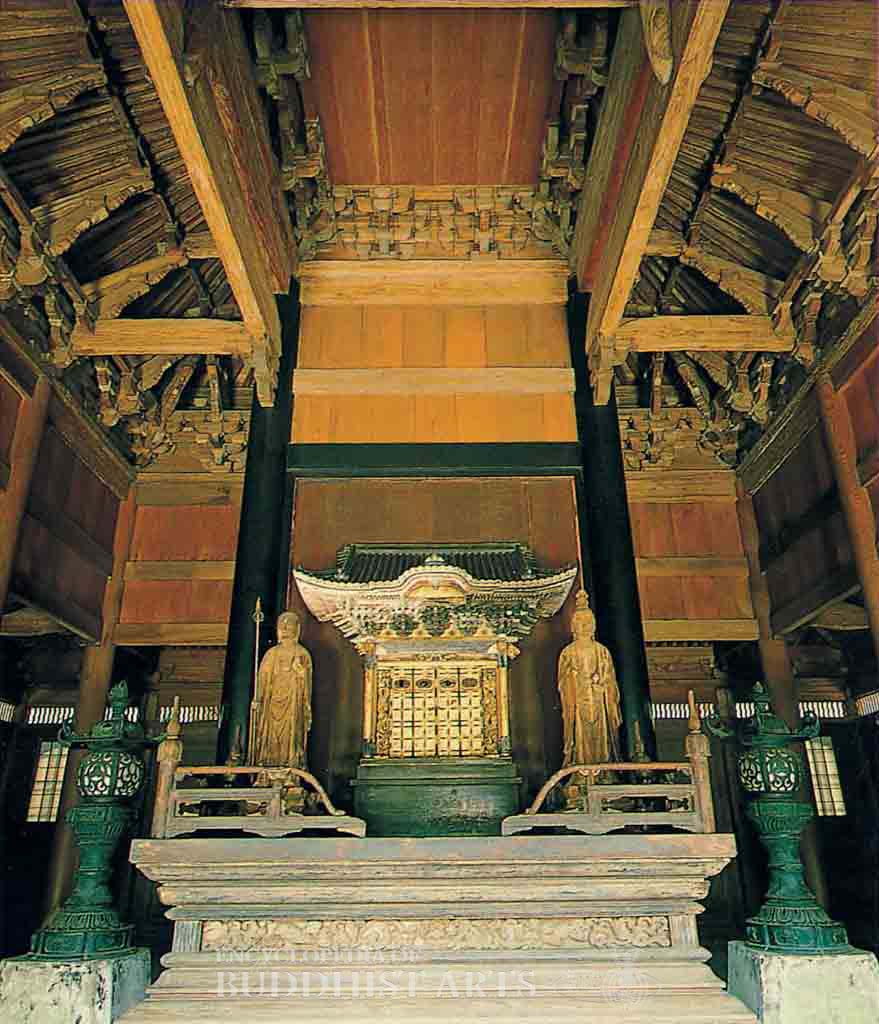
Engakuji Temple Relic Hall (interior)
Engakuji Temple Relic Hall
JAPAN, Kanagawa, Kamakura
The hall was built in 1285 during the Kamakura period, but was destroyed by fire in 1563 during the Muromachi period. The existing structure was built by re-using materials from Taiheiji Temple. The hall was listed as a National Treasure in 1951.
The Relic Hall has a double-eave hip-and-gable roof covered with thin cypress shingles. The upper roof has a steep slope and slightly upturned eaves supported by three-tier bracket sets, while the lower roof has a much more gentle slope and the eaves are supported by single-tier bracket sets. The lattice doors, windows, and ventilation holes show characteristics of Zen-style temples. Inside the hall, the columns near the back wall have two-tier bracket sets to support a canopy underneath the high ceiling. The capitals of the remaining columns support crescent beams with bracket sets and cantilevers. The ends of the rafters are arranged in a radial layout. A Buddha niche is placed on the Sumeru throne and contains the Buddha relics brought back by General Minamoto no Sanetomo from China during the Song dynasty (960–1279).
For more details, go to the Encyclopedia of Buddhist Arts: Architecture A-F, page 273.
Cite this article:
author = Hsingyun and Youheng and Johnson, Peter and Mankuang and Lancaster, Lewis,
booktitle = {Encyclopedia of Buddhist Arts: Architecture A-F},
pages = 273,
title = {{Engakuji Temple Relic Hall}},
volume = 1,
year = {2016}}