
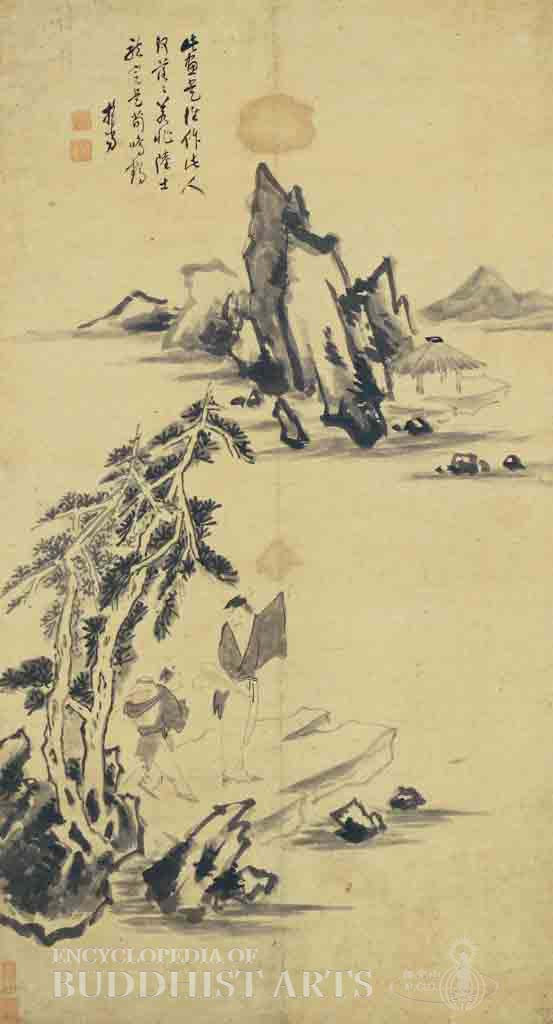
Noblemen by Dandang Puhe; Ming dynasty
Ink on paper
Dandang Puhe
CHINA, Yunnan, Kunming; Ming to Qing dynasty
Born in Jinning county of Kunming, Dandang Puhe was a Chan monk who had an original name of Tang Tai and an alias of Da Lai. He renounced under Chan Master Wuzhu and subsequently traveled to study under well-known masters in the Jiangsu and Zhejiang regions. Master Dandang attained realization under the guidance of Master Zhanran, the Sixth patriarch of the Tiantai school, and eventually settled in Shizhong Temple in Yunnan. His written works include Bequeathed Poems of Dandang, Snapping Grass Hut, and Hundred Rhymes of Flower-Nipping Ode; later generations compiled his works into Complete Collection of Dandang’s Calligraphy and Paintings.
Master Dandang was a well-versed artist in the three disciplines of painting, poetry, and calligraphy. In his earlier years, he learned painting under Dong Qichang. His landscape paintings were modeled after that of Huang Gongwang and Ni Zan, utilizing a dry brush with flowing and unhindered strokes. Exhibiting a spiritual and graceful style that was full of Chan essence, his works earned the praise, “Poems within paintings, Chan within poems.” Master Dandang also wrote a well-known couplet, now kept in Luohan Hall of Qiongzhu Temple in Yunnan, that reads, “Returning from alms-begging, not for the sounding of bells and drums; Leaving after meal-eating, for knowing the exhaustion of salt and coal.” His calligraphic pieces in cursive script were smooth, bold, and unrestrained.
Extant works by Master Dandang include Noblemen, an ink painting featuring a scenic view of the sky and water with remote mountains in the background. A pair of wanderers stand on a rock in the foreground; the older figure points toward the shore across the way, perhaps indicating that the land beyond is a place of happiness. This painting, along with Wugaoshan, is kept at the Yunnan Provincial Museum in Kunming, while his work entitled Landscape is at the Tianjin Museum. His representative calligraphic piece, Five-Character Quatrain in cursive script, can be found at the Ho’s Calligraphy Foundation in Taipei, Taiwan.
For more details, go to the Encyclopedia of Buddhist Arts: People, page 35.
Cite this article:
author = Hsingyun and Youheng and Youlu and Pokorski, Stefanie and Yichao and Mankuang and Miaohsi,
booktitle = {Encyclopedia of Buddhist Arts: People },
pages = 35,
title = {{Dandang Puhe}},
volume = 19,
year = {2016}}