
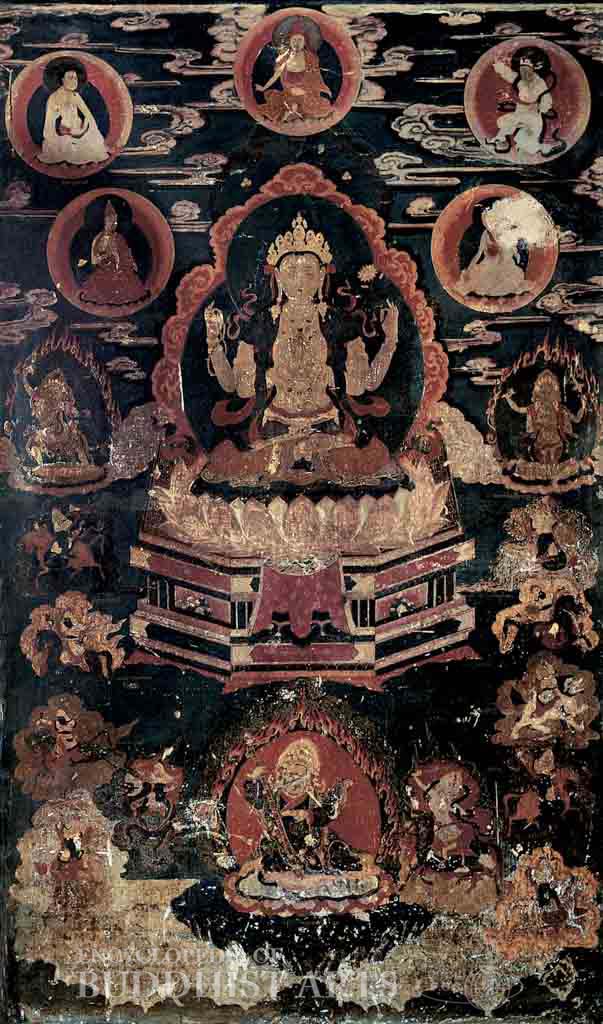
Dabaoji Palace Murals: Four-Armed Avalokitesvara
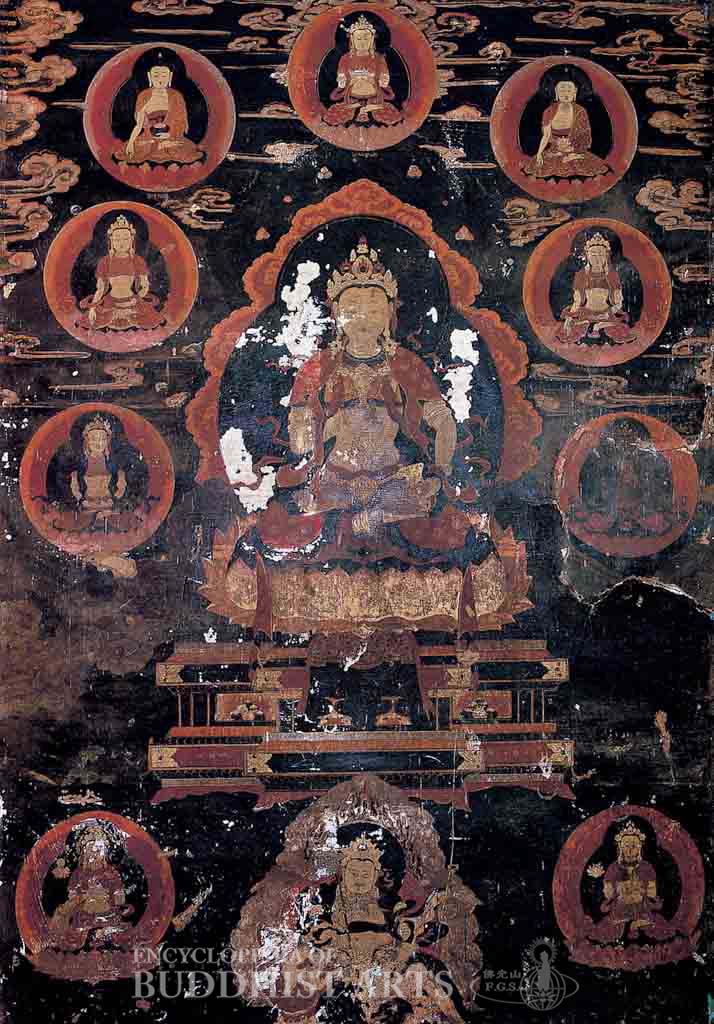
Dabaoji Palace Murals: Five Buddhas of the Womb Realm
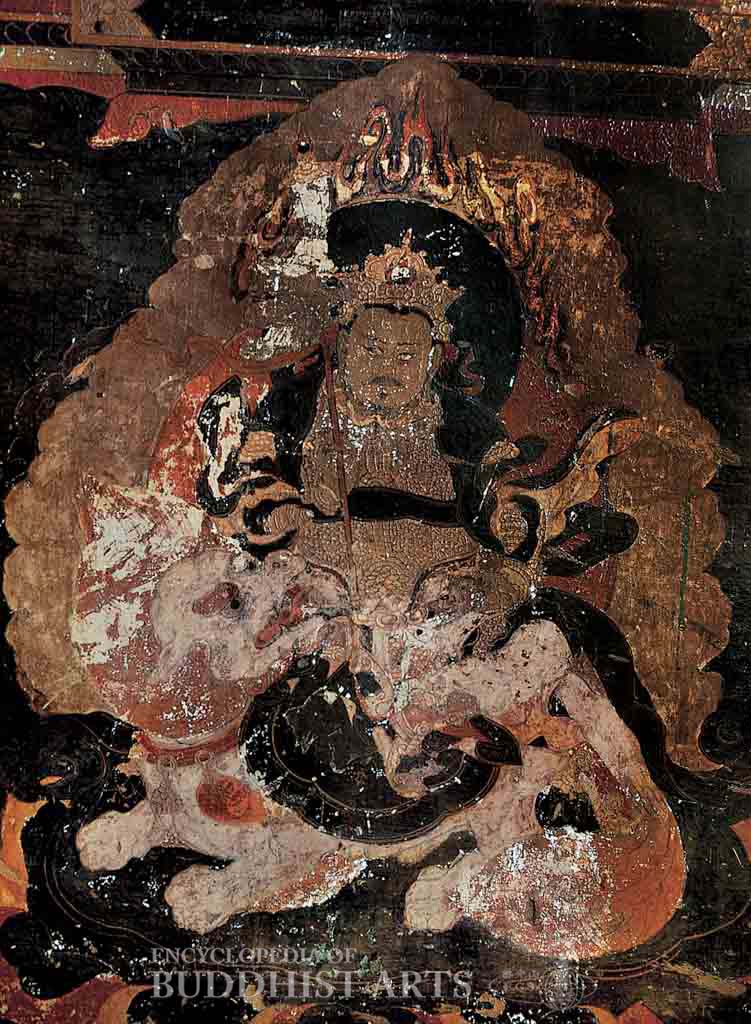
Dabaoji Palace Murals: Vaisravana
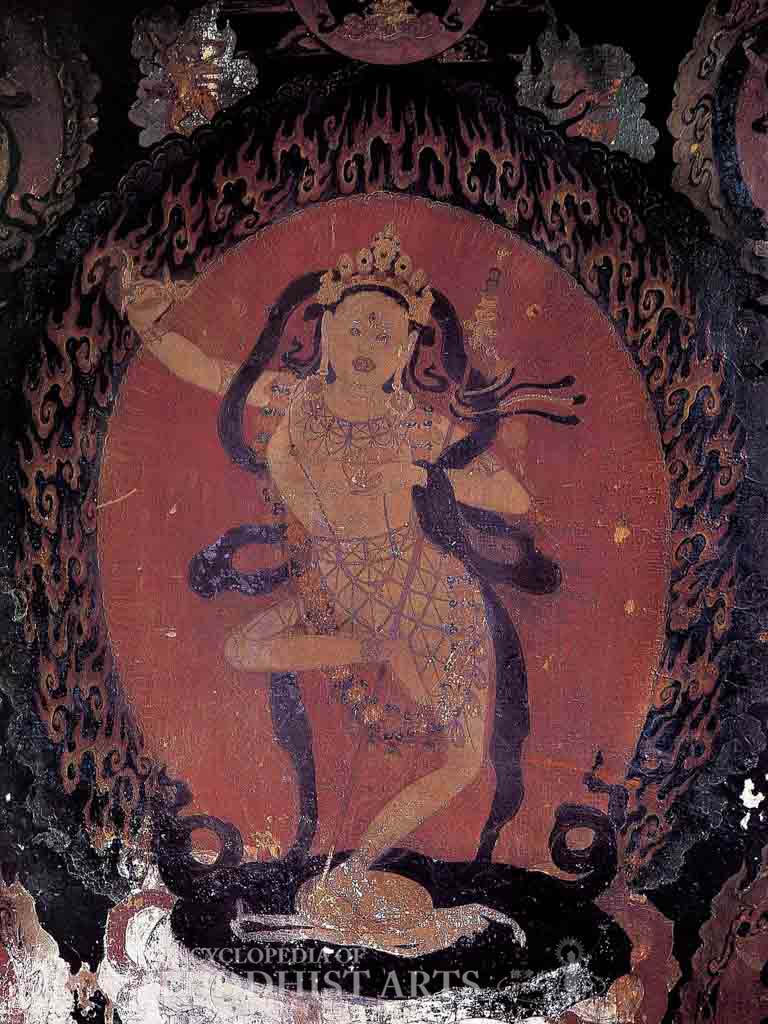
Dabaoji Palace Murals: Vajravarahi
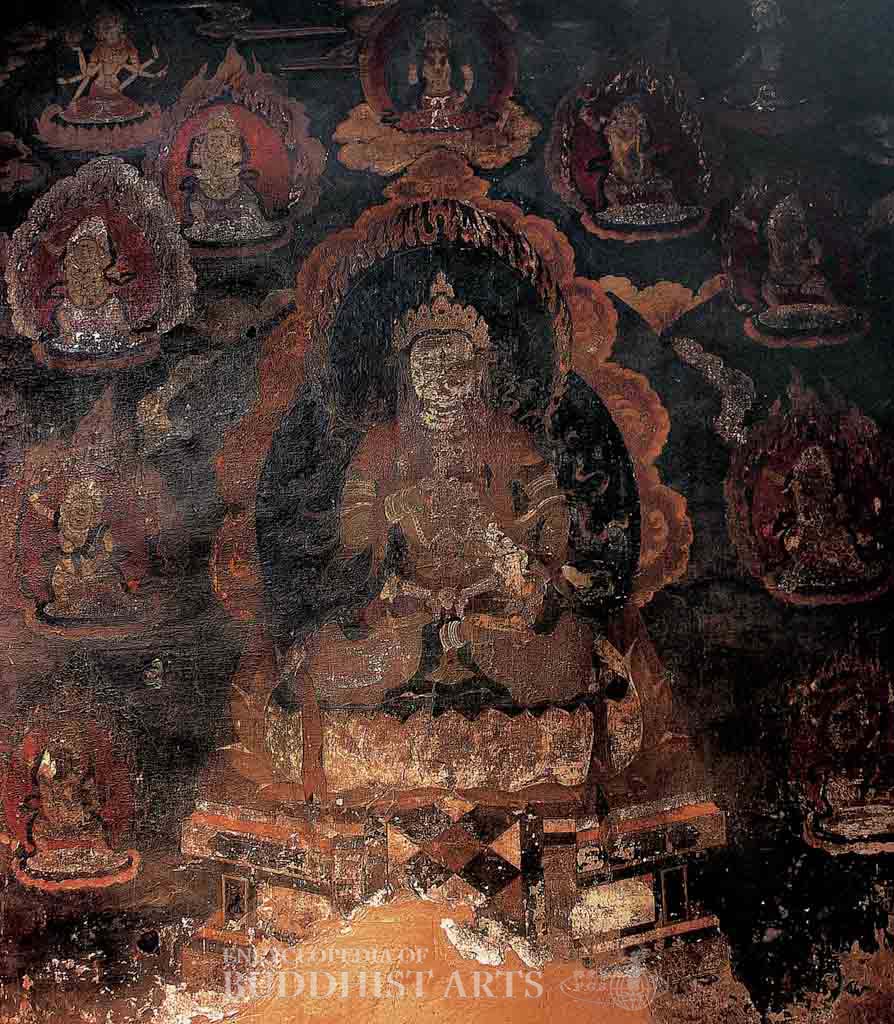
Dabaoji Palace Murals: Green Tara
Dabaoji Palace Murals
CHINA, Yunnan, Lijiang; Ming dynasty
During the Ming dynasty (1368–1644), the chieftains of the Mu clan ruled Yunnan for 13 generations. They were devout Buddhists, constructing temples throughout the region and commissioning local artists to decorate them with large-scale murals. Known together as the Lijiang Murals, these artworks depict figures from the Mahayana and Vajrayana Buddhist traditions, as well as Daoist deities. The Dabaoji Palace was built by Chieftain Mu Wang in 1582. It is named after the Maharatnakuta Sutra, in which “ratna” translates as “bao,” meaning the wondrous treasure of the Mahayana teachings, and “kuta” translates as “ji,” meaning the accumulation of merit through the various practices. The murals painted in the palace are the most magnificent, the largest, and the best preserved among the Lijiang Murals. An inscription on the north wall dates them to 1583.
The west, north, and south walls are painted with 12 murals: four depicting Tibetan Buddhist themes, two illustrating Daoist figures, and the rest portraying a mix of figures from Mahayana and Vajrayana Buddhism. The murals are 203 cm high and range between 94 and 446 cm in width. The only mural on the west wall depicts the Sakyamuni Buddha Assembly. The mural in the center of the south wall illustrates Mahamayuri and Vidyarajni. The remaining murals include images of the Five Buddhas of the Womb Realm, Padmasambhava, Green Tara, Four-Armed Avalokitesvara, and Vajravarahi. Swirling clouds are painted behind the figures.
The murals are painted with fine strokes, resulting in intricate, vivid representations. Although centuries of incense smoke have darkened the surface of the walls, the bright colors remain visible in various shades of purple, red, yellow, and orange. Golden paint, embossed sections, and gold foil were used to accent the clothing, headdresses, belts, and armor of the Buddhas and Bodhisattvas. The remaining traces of gold hint at the magnificence of the murals when they were first completed. The clouds in the backgrounds show a variety of strokes and color shades, adding a decorative effect to the murals.
For more details, go to the Encyclopedia of Buddhist Arts: Painting A-H, page 164.
Cite this article:
author = Hsingyun and Youheng and Youlu and Wilson, Graham and Manho and Mankuang and Huntington, Susan,
booktitle = {Encyclopedia of Buddhist Arts: Painting A-H},
pages = 164,
title = {{Dabaoji Palace Murals}},
volume = 14,
year = {2016}}