
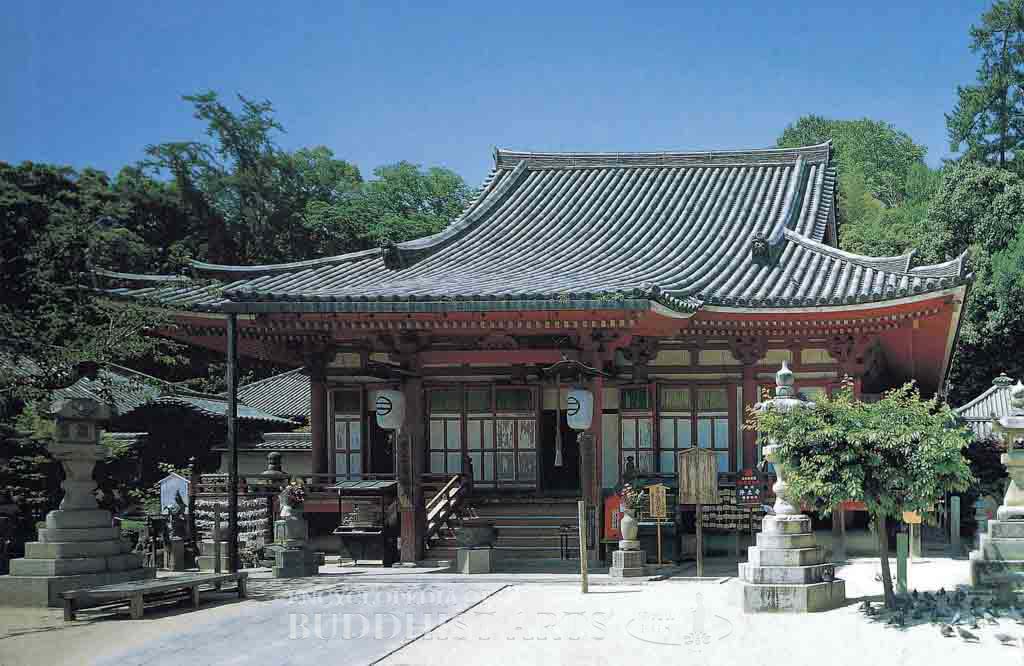
Jodoji Temple: Main Hall
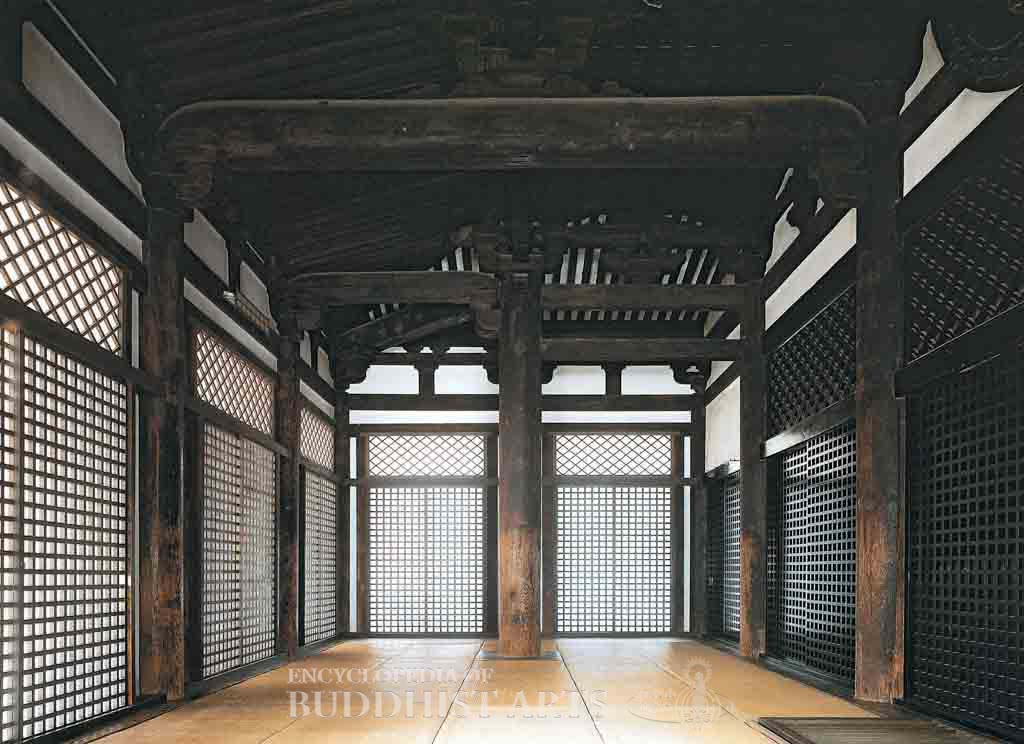
Jodoji Temple: Main Hall (interior)
Jodoji Temple
JAPAN, Hiroshima, Onomichi
Jodoji means Pure Land Temple. It is the head temple of the Sennyuji branch of the Shingon school. According to the temple records, it was founded in 616 during the Asuka period by Prince Shotoku and restored in 1306 during the Kamakura period. Although the temple was later burned down, it was reconstructed and subsequently thrived during the Muromachi period (1392–1573), when it received the protection of General Ashikaga Takauji.
The principal buildings of the temple include the temple gate, Pure Land Hall, founder’s hall, abbot’s quarters, guest hall, and kitchen, as well as the main hall and Prabhutaratna Pagoda, both of which were listed as National Treasures in 1953. The five-by-five bay main hall was reconstructed before the Muromachi period. It has a hip-and-gable roof covered with cylindrical tiles. There are lattice doors on the sides of the building. The hall is divided into an inner shrine and a space for praying with a partition door decorated with square, diamond, and floral patterns. A statue of the Eleven-Headed Avalokitesvara Bodhisattva is enshrined within the hall.
The five-by-four bay Pure Land Hall, rebuilt in 1345 during the Nanbokucho period, has a single-eave hip roof covered with cylindrical tiles. Statues of the Amitabha Buddha Triad are enshrined within the hall. The Prabhutaratna Pagoda was built between the Kamakura (1185–1333) and Muromachi periods. The abbot’s quarters, rebuilt in 1690 during the Edo period, has a hip roof covered with cylindrical tiles. The building measures 16.7 by 13.1 m and is surrounded by a veranda. It consists of five rooms. The kitchen, rebuilt in 1719 during the Edo period, has a overhanging gable roof covered with cylindrical tiles. The building measures 15.9 by 12 m, and is large and well-proportioned.
For more details, go to the Encyclopedia of Buddhist Arts: Architecture G-L, page 549.
Cite this article:
author = Hsingyun and Youheng and Johnson, Peter and Mankuang and Lancaster, Lewis,
booktitle = {Encyclopedia of Buddhist Arts: Architecture G-L},
pages = 549,
title = {{Jodoji Temple}},
volume = 2,
year = {2016}}