
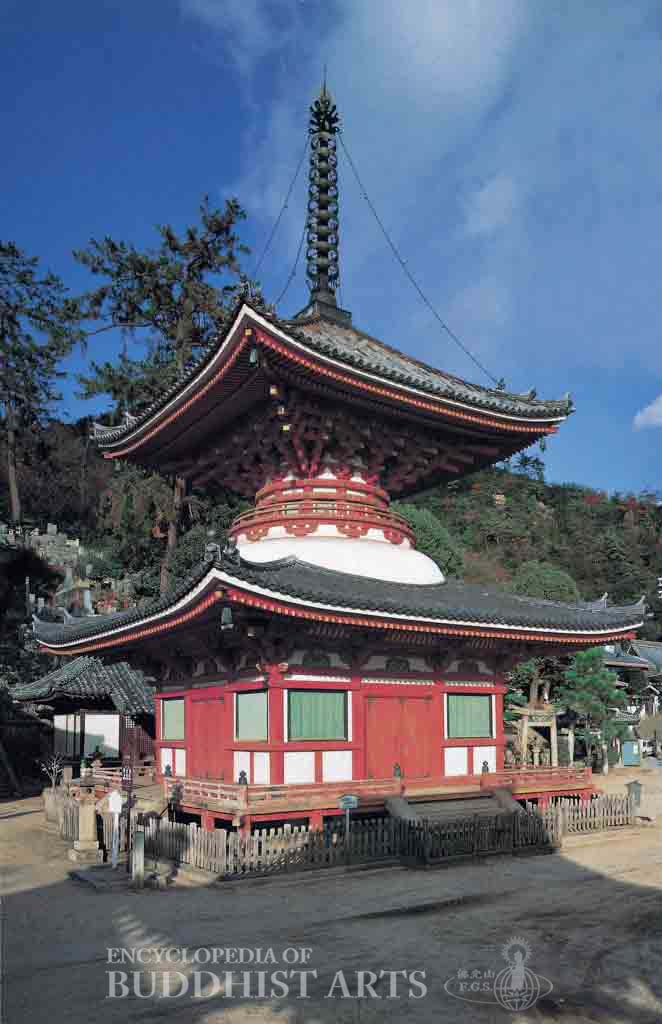
Jodoji Temple Prabhutaratna Pagoda
Jodoji Temple Prabhutaratna Pagoda
JAPAN, Hiroshima, Onomichi
According to temple records, the pagoda was reconstructed in 1328 in a style similar to that of pagodas from the late Kamakura period (1185–1333). It was listed as a National Treasure in 1953.
The three-by-three bay pagoda is 20.5 m high. It has double eaves and the roofs are covered in cylindrical tiles. The lower tier of the body is square, while the upper tier is round. The eaves of the lower tier are small and wide and hang low. On the lower tier there are square columns, architraves, and camel-hump braces decorated with a fretwork of lotus patterns, with jewels and Dharma wheels embedded in its center. The upper level has four-tier bracket sets supporting the upper eaves. The spire consists of a harmika, inverted bowl, upturned lotus, nine stacked rings, a flame, and a jewel. Within the pagoda, seated statues of Vairocana Buddha flanked by Sakyamuni Buddha and the Medicine Buddha are enshrined on a raised platform. The domed ceiling has a grid pattern and the beams have detailed and colorful paintings.
For more details, go to the Encyclopedia of Buddhist Arts: Architecture G-L, page 550.
Cite this article:
author = Hsingyun and Youheng and Johnson, Peter and Mankuang and Lancaster, Lewis,
booktitle = {Encyclopedia of Buddhist Arts: Architecture G-L},
pages = 550,
title = {{Jodoji Temple Prabhutaratna Pagoda}},
volume = 2,
year = {2016}}