
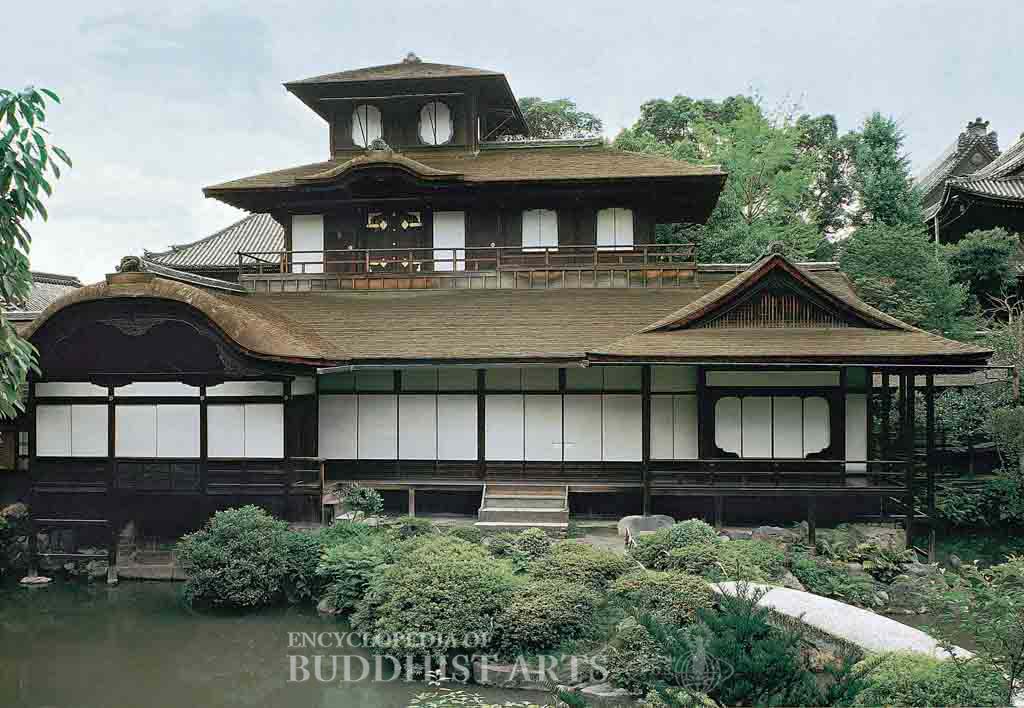
Nishi Honganji Temple Flying Cloud Pavilion
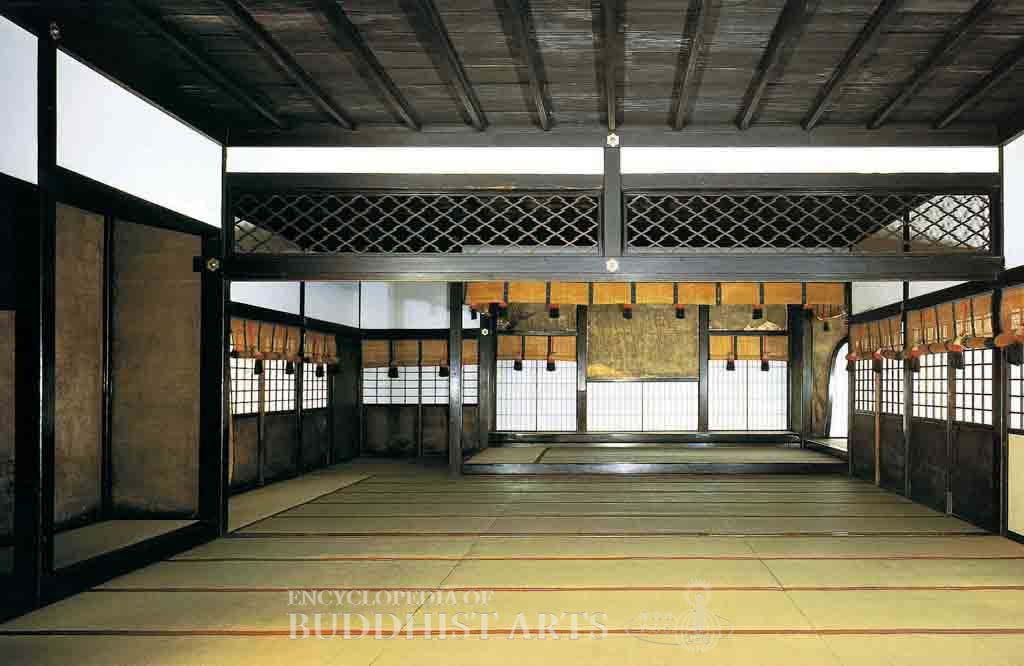
Nishi Honganji Temple Flying Cloud Pavilion (interior)
Nishi Honganji Temple Flying Cloud Pavilion
JAPAN, Kyoto
The pavilion is said to have been constructed between 1586 and 1587 during the Momoyama period, according to Toyotomi Hideyoshi’s wishes. This pavilion, along with those at Rokuonji and Jishoji temples, are known collectively as the Three Pavilions of Kyoto. This one was listed as a National Treasure in 1951.
The pavilion is situated in the southeast corner of the temple complex, next to the Soroi Pond and Tekisui Garden. It consists of two stories, above which there is a small tower. On one side of the first story, there is a short projecting roof with a curved bargeboard, while on the other side there is a short hip-and-gable roof. Its roof is covered with cypress shingles. The north and south sides are 25.8 m long, while east and west sides are 11.8 m and 12.5 m long, respectively. The first story consists of the Invitation to Wisdom Hall, Room of Eight Views, a tea room, and moorings for boats carrying visitors across the pond.
The second story is much smaller: it has a curved bargeboard above the entrance and is surrounded by low balustrades. Above the second story there is a small tower with a square pyramidal roof. The pavilion has translucent paper walls, sliding windows, sliding doors, mullioned windows, and ogee arched windows.
For more details, go to the Encyclopedia of Buddhist Arts: Architecture M-S, page 799.
Cite this article:
author = Hsingyun and Youheng and Johnson, Peter and Mankuang and Lancaster, Lewis,
booktitle = {Encyclopedia of Buddhist Arts: Architecture M-S},
pages = 799,
title = {{Nishi Honganji Temple Flying Cloud Pavilion}},
volume = 3,
year = {2016}}