
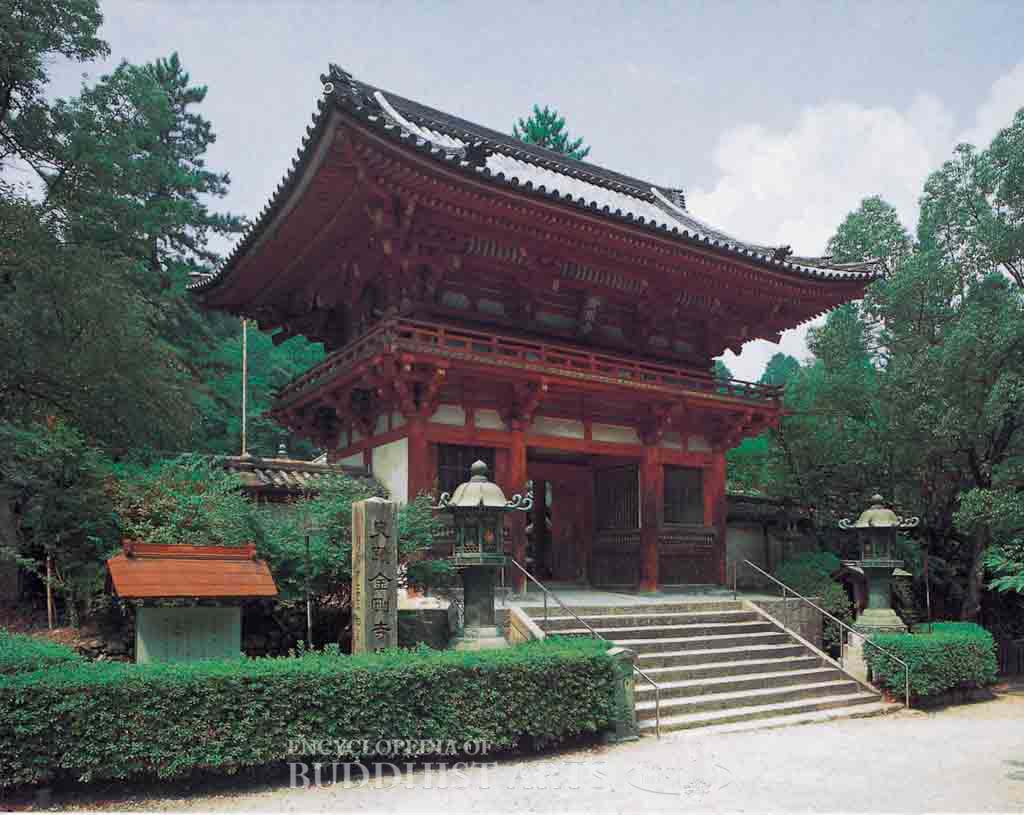
Kongoji Temple: Tower Gate
Kongoji Temple
JAPAN, Osaka, Kawachinagano
Kongoji is the head temple of the Omuro branch of the Shingon school of Buddhism. It was founded by monk Gyoki on the orders of Emperor Shomu during the Nara period (710–794). The temple was destroyed in wartime during the 14th century. In 1583 during the Azuchi-Momoyama period, it underwent numerous repairs with the help of Toyotomi Hideyoshi.
The main buildings include the tower gate, Golden Hall, founder’s hall, Prabhutaratna Pagoda, bell tower, Five Buddhas Hall, Medicine Buddha Hall, and lecture hall. The Golden Hall was listed as an Important Cultural Property in 1900, while the tower gate, founder’s hall, and Prabhutaratna Pagoda were listed as Important Cultural Properties in 1907. Both the tower gate and the Golden Hall have single-eave hip-and-gable roofs covered with cylindrical tiles. The tower gate was built in 1279 during the Kamakura period. It has two levels, and on either side are statues of the Two Heavenly Kings. The seven-by-seven bay Golden Hall was built in 1320, during the Kamakura period, and underwent a major restoration during the rule of Emperor Go-Yozei (reigned 1586–1611). Statues of Vairocana Buddha, Acala, and Trailokyavijaya are enshrined within the hall. The group of three statues is a three-dimensional representation of the Usnisavijaya Mandala. The Prabhutaratna Pagoda, built during the late Heian period (794–1185), houses a statue of Vairocana Buddha.
For more details, go to the Encyclopedia of Buddhist Arts: Architecture G-L, page 619.
Cite this article:
author = Hsingyun and Youheng and Johnson, Peter and Mankuang and Lancaster, Lewis,
booktitle = {Encyclopedia of Buddhist Arts: Architecture G-L},
pages = 619,
title = {{Kongoji Temple}},
volume = 2,
year = {2016}}