
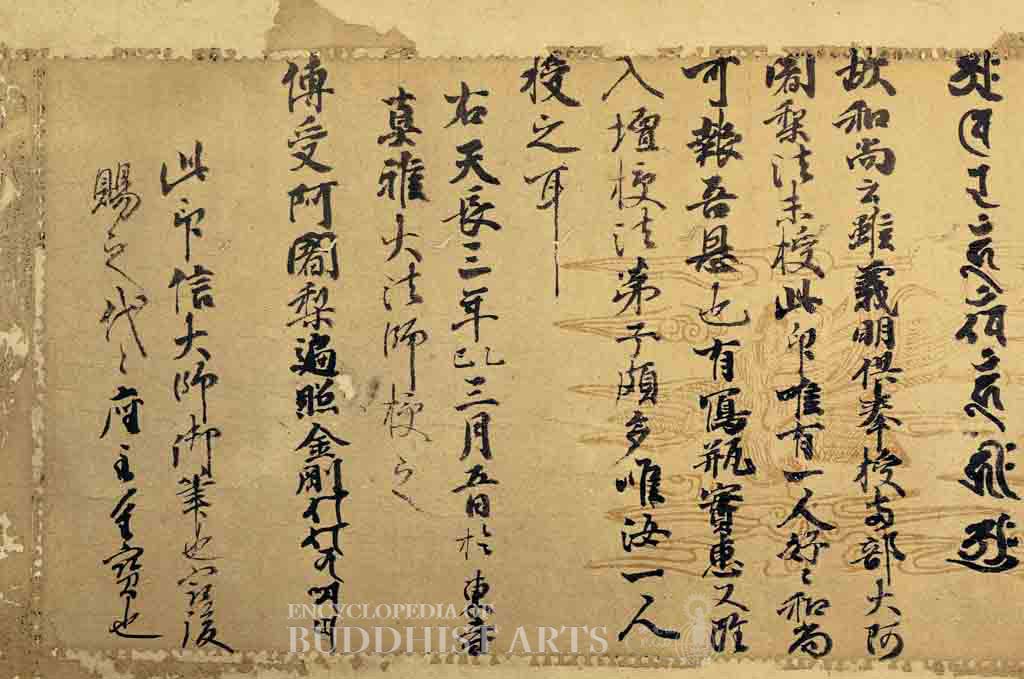
Daigoji Temple: Credentials Conferred by Master Kukai (detail)
Ink on paper
Daigoji Temple: Credentials Conferred by Master Kukai
JAPAN, Kyoto; Nanbokucho period
This transcription was written by Emperor Go-Daigo (reigned 1318–1339) of the Kamakura period at the request of Master Koshin, the abbot of Daigoji Temple. It was listed as a National Treasure of Japan in 1951.
The original work was conferred by Master Kukai on his disciple Shinga in the year 825. It was originally named “Tencho Injin” for the era in which it was written. An “injin” is a certificate presented by a master to his student after the completion of their initiation ceremony in Vajrayana Buddhism.
Emperor Go-Daigo was the son of Emperor Uda (reigned 887–897) of the Heian period, and surpassed his father in his studies of Buddhism and academic pursuits. He advocated Chan Buddhism and Academic studies during the Song dynasty, developing his own insights. His calligraphic style displays influences from his father, as well as Kukai. The combination of these two influences can be seen in the poise and flow of his works.
For more details, go to the Encyclopedia of Buddhist Arts: Calligraphy, page 38.
Cite this article:
author = Hsingyun and Youheng and Youlu and Pokorski, Stefanie and Mankuang and Edson, Gary,
booktitle = {Encyclopedia of Buddhist Arts: Calligraphy },
pages = 38,
title = {{Daigoji Temple: Credentials Conferred by Master Kukai}},
volume = 17,
year = {2016}}