
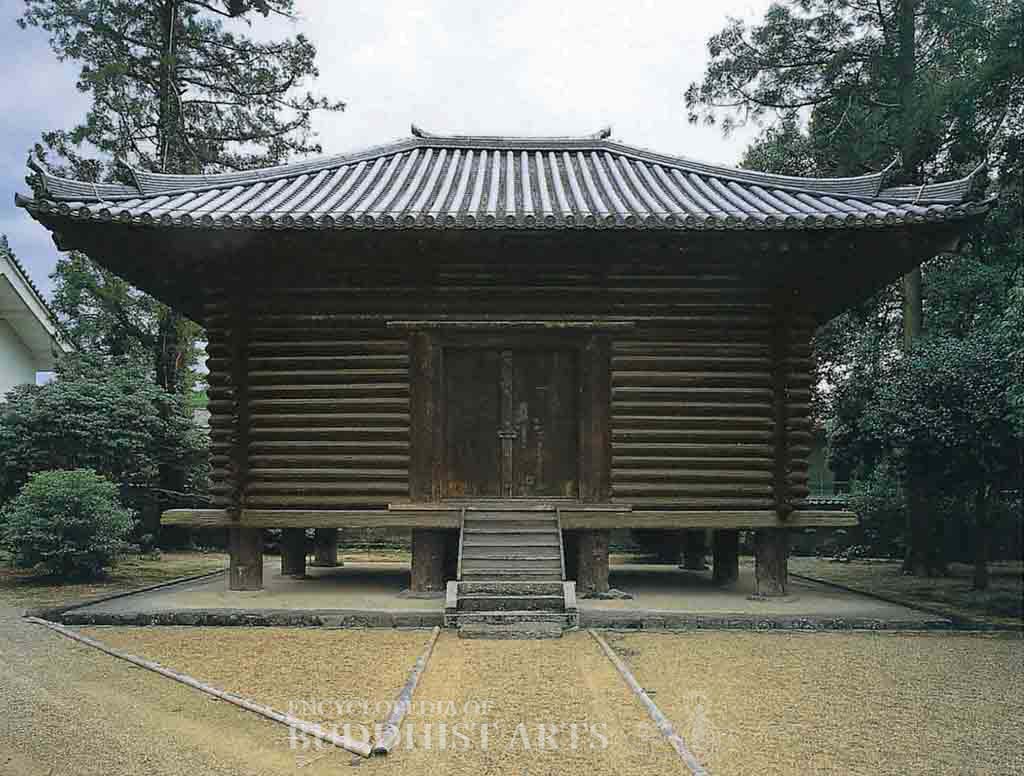
Todaiji Temple Sutra Repository
Todaiji Temple Sutra Repository
JAPAN, Nara
Located within Todaiji (Great Eastern Temple), this building was constructed during the Nara period (710–794). It was originally situated northeast of the Golden Hall as a storage for the lamp oil of the main hall. It was moved to its current location, northeast of the south gate, in 1714 during the Edo period. It then became a sutra repository, was listed as a National Treasure in 1953.
This three-by-two bay building has a hip roof covered with cylindrical tiles. It is constructed in azekura style with horizontal logs interlocking at the corners. This type of structure is useful for preserving valuables because it provides excellent ventilation and prevents moisture and fungal growth. On the stone foundation there are 12 pillars used to elevate the structure and prevent rats from entering. The structure is very strong, sturdy, and simple. Such buildings have been used for storage since ancient times.
It underwent restoration during the Kamakura (1185–1333) and Muromachi (1392–1573) periods, when most of its building materials were replaced but its Nara-style construction has been almost entirely preserved. This sutra repository, along with the treasure house, are representative examples of the azekura-style construction of the Nara period.
For more details, go to the Encyclopedia of Buddhist Arts: Architecture T-Z, page 1139.
Cite this article:
author = Hsingyun and Youheng and Johnson, Peter and Mankuang and Lancaster, Lewis,
booktitle = {Encyclopedia of Buddhist Arts: Architecture T-Z},
pages = 1139,
title = {{Todaiji Temple Sutra Repository}},
volume = 4,
year = {2016}}