
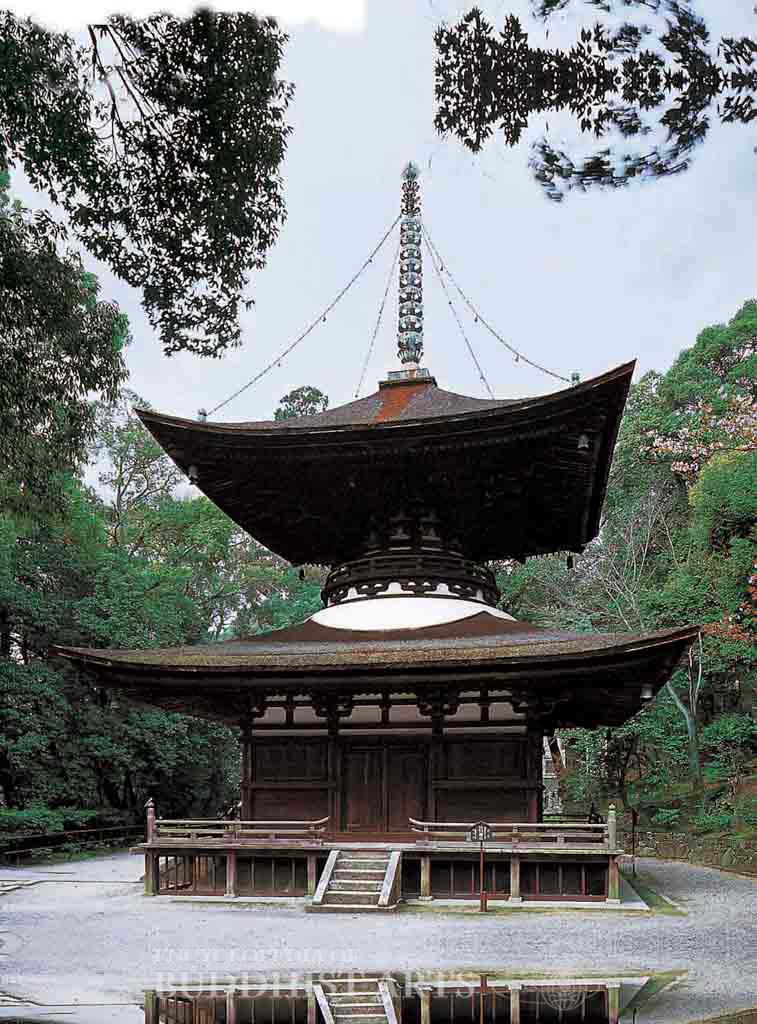
Ishiyamadera Temple Prabhutaratna Pagoda
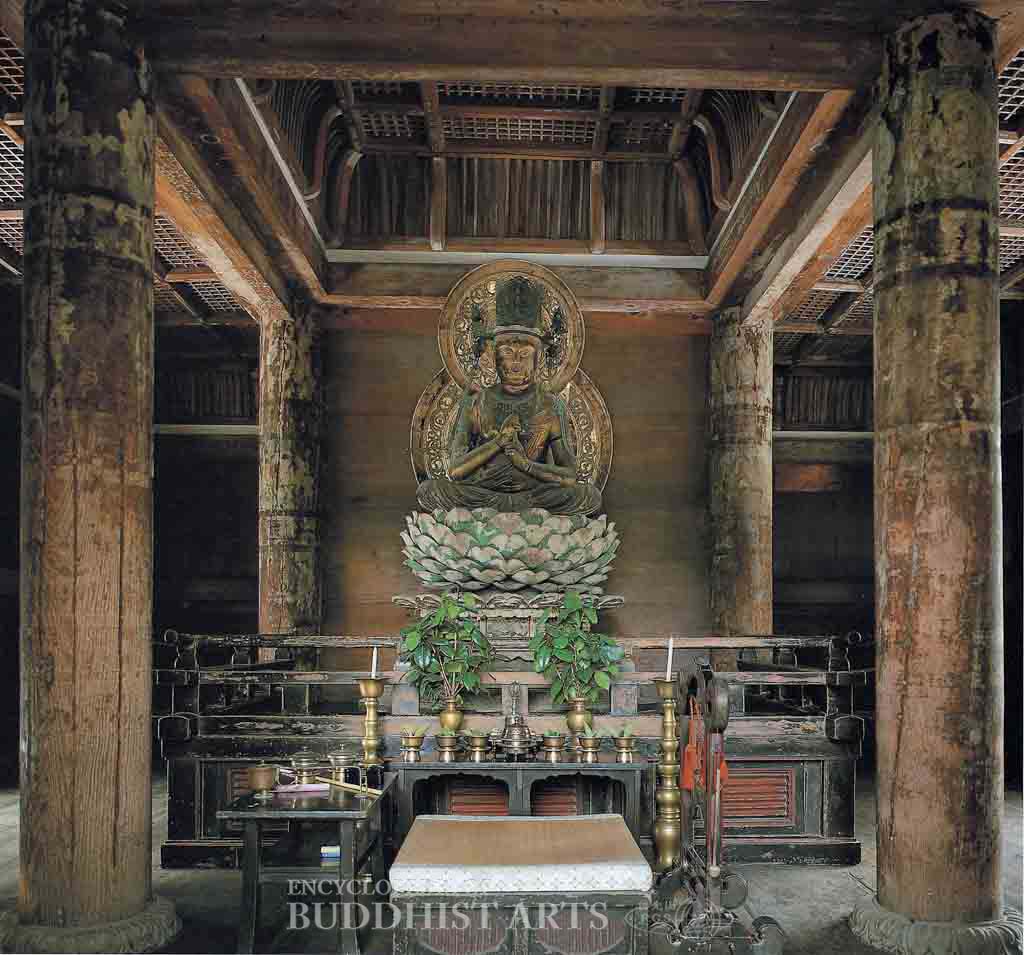
Ishiyamadera Temple Prabhutaratna Pagoda (interior)
Ishiyamadera Temple Prabhutaratna Pagoda
JAPAN, Shiga, Otsu
It is the oldest Prabhutaratna Pagoda in Japan: according to the records, it was constructed in 1194 during the Kamakura period, with the support of shogun Minamoto no Yoritomo. It is considered to have an appearance characteristic of the Heian period (794–1185). This is a miniature version of the Kongobuji Prabhutaratna pagoda, which was built by the monk Kukai. It was listed as a National Treasure in 1951.
The pagoda is approximately 17 m high. It has two levels and its roofs are covered with cypress bark. The lower level has three bays on each side and one-tier bracket sets are used to support the eaves. The upper level is round and four-tier bracket sets support the eaves above, which extend outwards from the white dome in the center. The spire consists of a harmika, inverted bowl, upturned lotus, nine stacked rings, a flame, and a jewel.
A statue of Vairocana Buddha seated on a Sumeru throne is enshrined within the pagoda. It is a work of Kaikei from the Kamakura period (1185–1333). The columns have colored depictions of 16 Buddhas and Bodhisattvas. The ceiling and beams have floral designs representing the Mandalas of the Two Realms.
For more details, go to the Encyclopedia of Buddhist Arts: Architecture G-L, page 494.
Cite this article:
author = Hsingyun and Youheng and Johnson, Peter and Mankuang and Lancaster, Lewis,
booktitle = {Encyclopedia of Buddhist Arts: Architecture G-L},
pages = 494,
title = {{Ishiyamadera Temple Prabhutaratna Pagoda}},
volume = 2,
year = {2016}}