
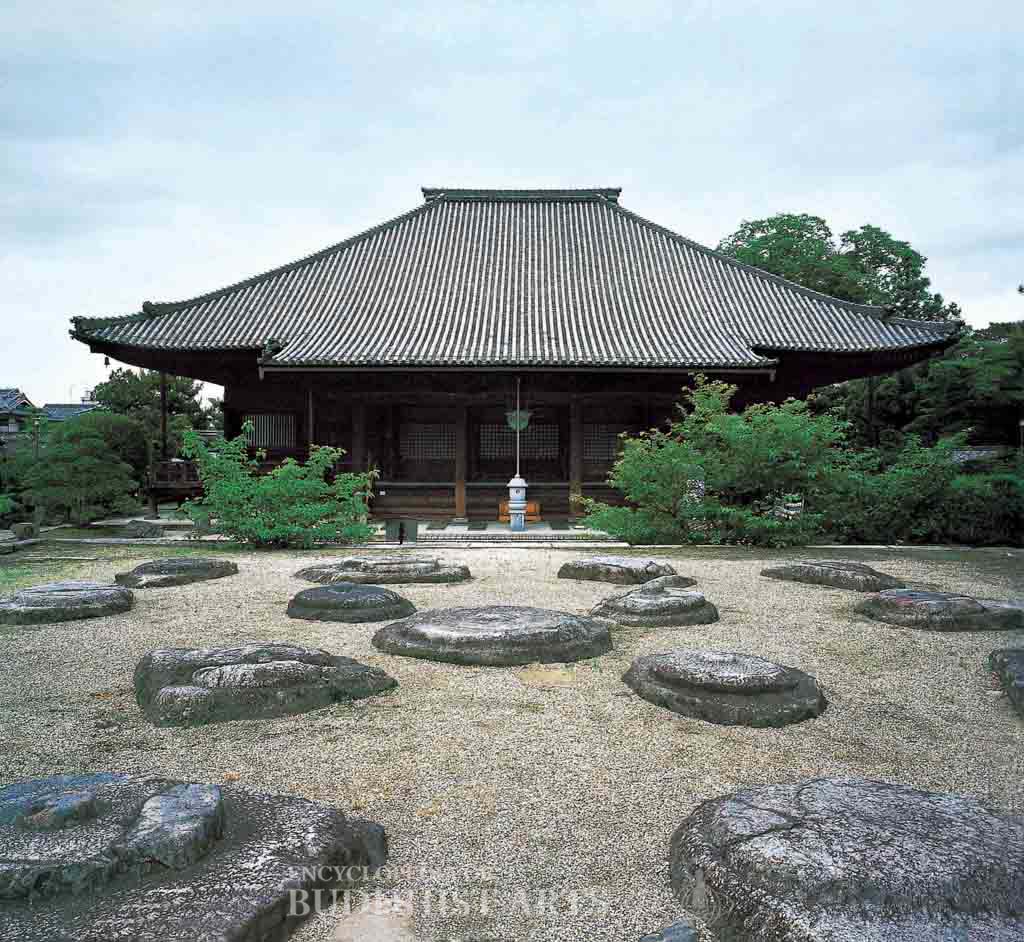
Saidaiji Temple: Main Hall
Saidaiji Temple
JAPAN, Nara
Saidaiji means Great Western Temple. It is the head temple of the Shingon Risshu school of Japanese Buddhism and is one of the Seven Major Temples in Nara. In 764 during the Nara period, after defeating the rebellion led by Fujiwara no Nakamaro, Emperor Koken expanded the temple and named it Saidaiji, a counterpart to Todaiji (Great Eastern Temple). Saidaiji Temple was a major Buddhist complex housing the east and west pagodas, as well as more than a hundred halls. When the capital was moved to Kyoto, however, the temple was destroyed due to fires and war. During the Kamakura period (1185–1333), Master Eizon became the abbot and revived the temple. Unfortunately the temple was again destroyed during wartime. The current buildings were all built in the late Edo period (1615–1868).
The main structures of the temple include the main hall, Heavenly King Hall, Ragaraja Hall, Homa Hall, kitchen, south gate, Okunoin Hall, five-element stupa, and Great Master Hall. The main hall, listed as an Important Cultural Property in 1998, is the largest building within the temple compound. It was built during the rule of Emperor Kokaku (reigned 1780–1817) of the Edo period, and has a single-eave hip roof covered with cylindrical tiles. Both the front and the back have wide porticos in the center that serve as areas for worship. The main hall houses statues of Sakyamuni Buddha, Manjusri Bodhisattva, and an attendant. The foundations in front of the hall contain the remains of the East Pagoda that was built in the Nara period (710–794).
The Heavenly King Hall was rebuilt in 1711 during the Edo period. It has a double-eave hip roof and houses statues of the Four Heavenly Kings. The south gate, which is the main gate, has an overhanging gable roof covered with cylindrical tiles supported by four square columns at the corners. The five-element stupa is 3.5 m high and stands on a two-layer base. The five elements, earth, water, fire, air, and emptiness, are symbolized by the cube, sphere, pyramid, crescent, and jewel stacked on top of one another.
The temple also contains a number of National Treasures, including sutras from the Nara period, a painting of the Twelve Heavenly Beings from the early Heian period (794–1185), a reliquary, as well as stupas and other valuable artifacts from the Kamakura period. Other Important Cultural Properties include a wooden sculpture of a seated Sakyamuni Buddha and the image of Master Eizon.
For more details, go to the Encyclopedia of Buddhist Arts: Architecture M-S, page 912.
Cite this article:
author = Hsingyun and Youheng and Johnson, Peter and Mankuang and Lancaster, Lewis,
booktitle = {Encyclopedia of Buddhist Arts: Architecture M-S},
pages = 912,
title = {{Saidaiji Temple}},
volume = 3,
year = {2016}}