
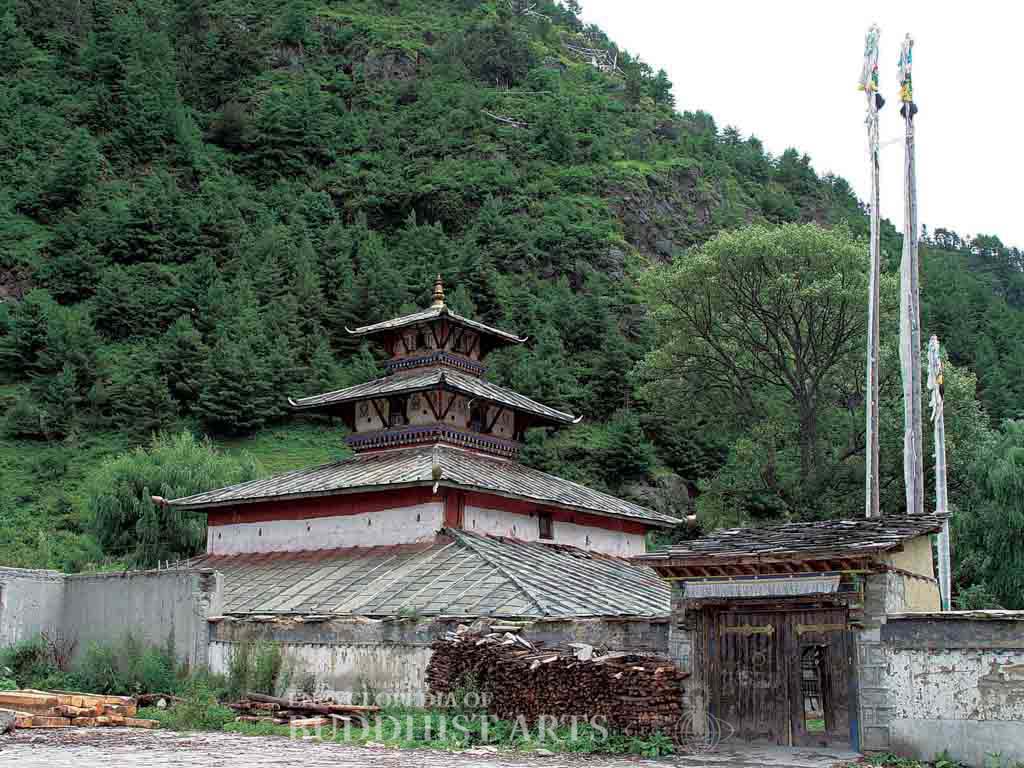
Phagpa Monastery
Phagpa Monastery
CHINA, Tibet, Shigatse
Located at Gyirong in Shigatse, the monastery is situated in the foothills of the Himalayas, on an essential route that has connected India, Nepal, and Tibet since ancient times. It was built by monks of the Gelug school of Tibetan Buddhism during the Ming dynasty (1368–1644).
The Phagpa Monastery was constructed with wood cut from the local forest. The four-story assembly hall has a broad base and narrow top, resembling temples in South and Southeast Asia, as well as the stupas in Nepal. It is considered unique in Tibetan Buddhist architecture. Strong contrasting colors are applied, with the buildings generally in red and white, while details are added in blue. A large pole with prayer flags is erected in front of the assembly hall, adding to the solemn ambience of the monastery. The presence of the Phagpa Monastery is especially valuable, as it is difficult to maintain buildings like this in the foothills of the Himalayas due to the high humidity and rainfall, as well as human-inflicted damage. Artifacts such as the bronze bell and stone lions from the Ming dynasty are still preserved in the monastery.
For more details, go to the Encyclopedia of Buddhist Arts: Architecture M-S, page 814.
Cite this article:
author = Hsingyun and Youheng and Johnson, Peter and Mankuang and Lancaster, Lewis,
booktitle = {Encyclopedia of Buddhist Arts: Architecture M-S},
pages = 814,
title = {{Phagpa Monastery}},
volume = 3,
year = {2016}}