
Green Tara
Gilt copper alloy
Green Tara
CHINA; Ming dynasty
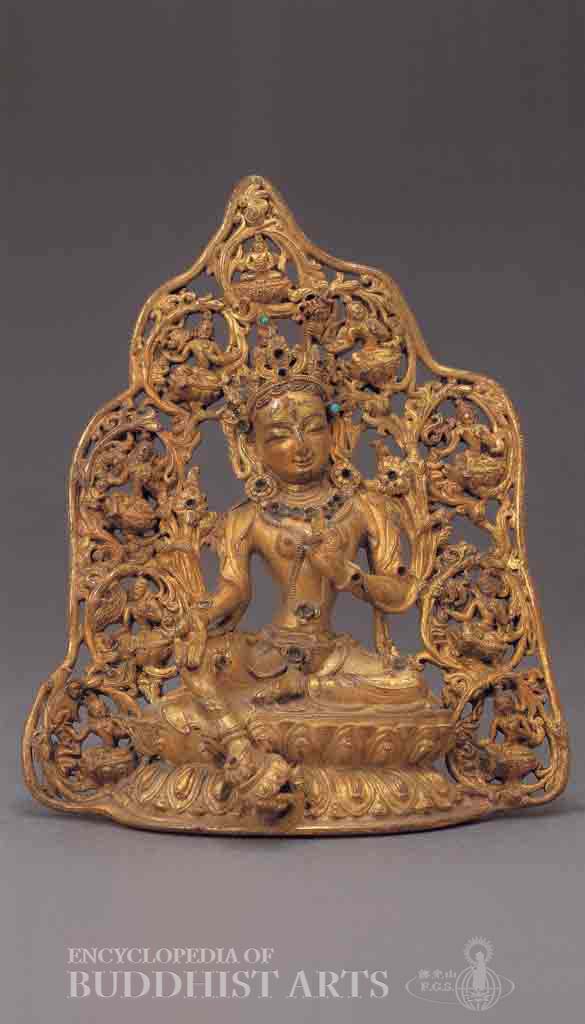
The crowned and smiling Green Tara sits in the relaxation posture on a double lotus pedestal. The figure is in the tribhanga posture and her extended right foot is supported by an outgrowing blossom. The upper body is decorated with ornate jewelry and a thin stole. The right hand is held open in varada (wish-granting) mudra, but both hands hold lotus stalks that bloom at shoulder height.
The most noteworthy element of this sculpture is the elaborate mandorla with seated figures incorporated the vine-like tendrils of the frame. Amitabha Buddha is located at the very top, while lively monkeys frolic among the foliage or next to the Taras. Judging by the appearance of the main figure and the remaining turquoise inlays, it is believed that this is a 15th century Tibetan artwork. However, the way the frame and pedestal are connected is something rarely seen and may have been influenced by the Chinese Ming dynasty (1368–1644).
For more details, go to the Encyclopedia of Buddhist Arts: Sculpture G-M, page 377.
Cite this article:
author = Hsingyun and Youheng and Lovelock, Yann and Chou, Yuan and Huntington, Susan and Edson, Gary and Neather, Robert,
booktitle = {Encyclopedia of Buddhist Arts: Sculpture G-M},
pages = 377,
title = {{Green Tara}},
volume = 11,
year = {2016}}