
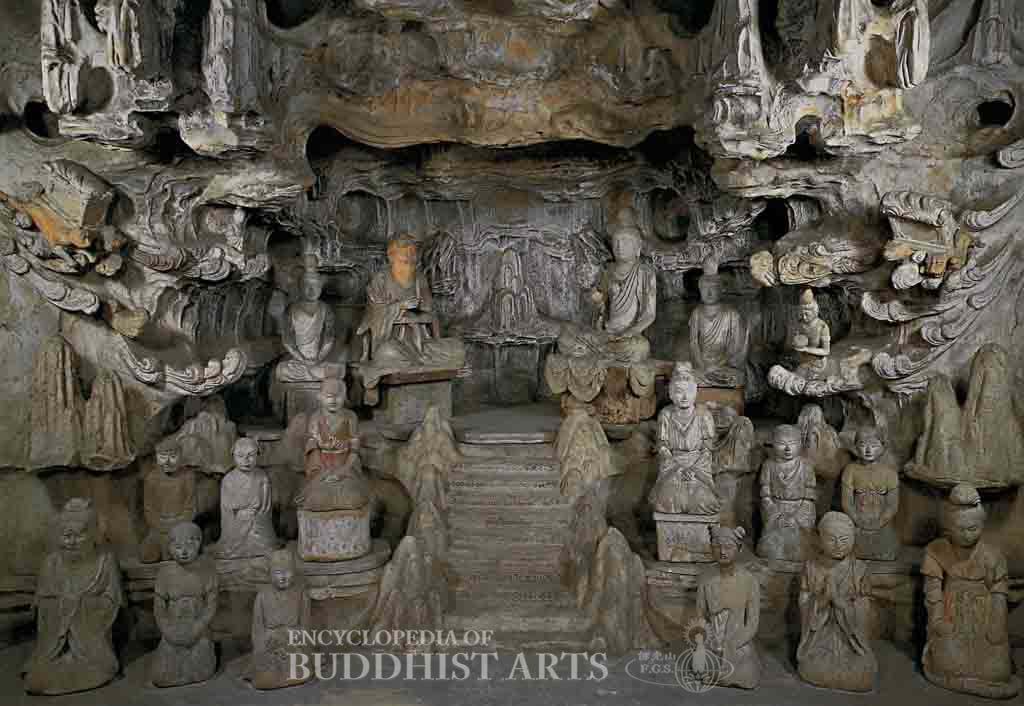
Horyuji Temple Five-Story Pagoda Sculptures: Manjusri Inquiring about Vimalakirti; H: 52.4 cm (Manjusri), 45.2 cm (Vimalakirti)
Clay
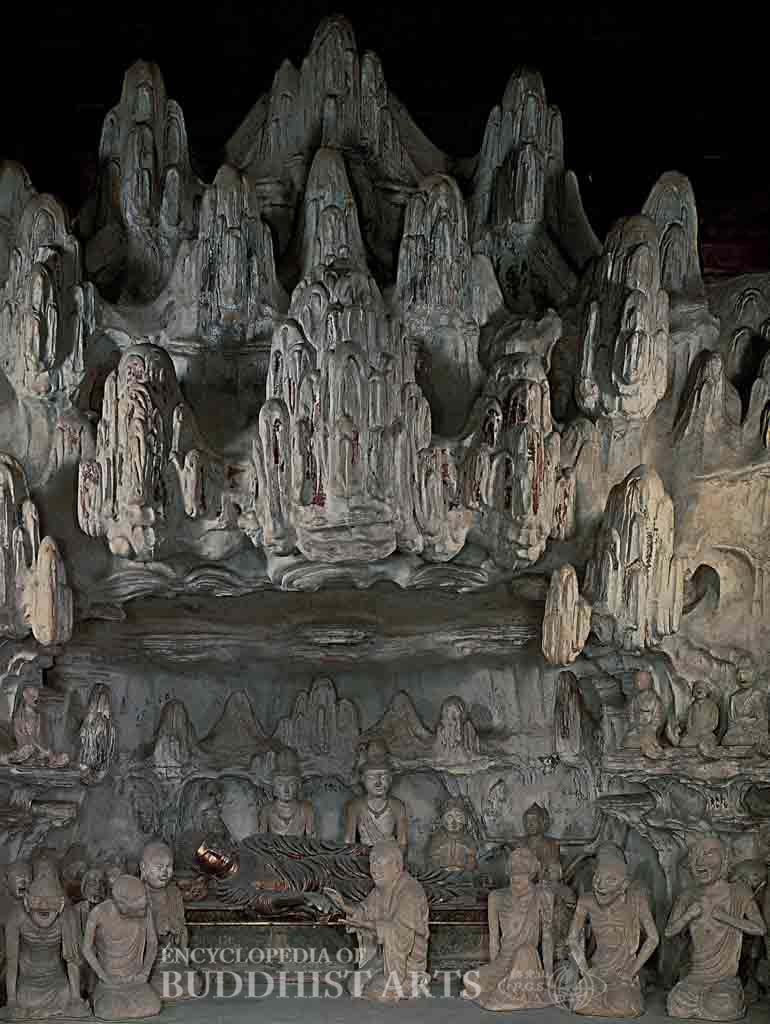
Horyuji Temple Five-Story Pagoda Sculptures: Life of the Buddha - Parinirvana; L: 98 cm (Buddha)
Horyuji Temple Five-Story Pagoda Sculptures
JAPAN, Nara, Ikoma; Nara period
The sculptures are located on all four sides of the central pillar on the pagoda’s first story. Niches are set into each side of the pillar with dioramas of rocks and grottos molded in clay. The figures are formed about a central support, and the fingers and clothing are embedded with copper wires or plates, upon which the covering is overlaid.
The east side of the pillar illustrates a chapter from the Vimalakirti Sutra where Manjusri visits the ill Vimalakirti. The north side shows the Buddha passing into parinirvana. The west side depicts the distribution of the Buddha’s relics. The south side presents Maitreya Bodhisattva manifesting in the earthly realm. There are almost a hundred figures, forming the largest collective group of sculptures that still remains in Japan. They were recognized as a National Treasure in 1956.
The two main characters sit opposite each other on stands, in the scene in which Vimalakirti debates with Manjusri, while Bodhisattvas, disciples, and females dressed in Tang clothing are surrounded by foreigners. Mountains and rocky landscape fill the background, while two lion thrones are depicted flying in on moving clouds from the two sides. Grieving Bodhisattvas and disciples encircle the gilded Buddha in the scene of the Buddha’s parinirvana. The grieving asura figure next to the Buddha’s feet is one of the earliest depictions of asura in Japan.
For more details, go to the Encyclopedia of Buddhist Arts: Sculpture G-M, page 450.
Cite this article:
author = Hsingyun and Youheng and Lovelock, Yann and Chou, Yuan and Huntington, Susan and Edson, Gary and Neather, Robert,
booktitle = {Encyclopedia of Buddhist Arts: Sculpture G-M},
pages = 450,
title = {{Horyuji Temple Five-Story Pagoda Sculptures}},
volume = 11,
year = {2016}}