
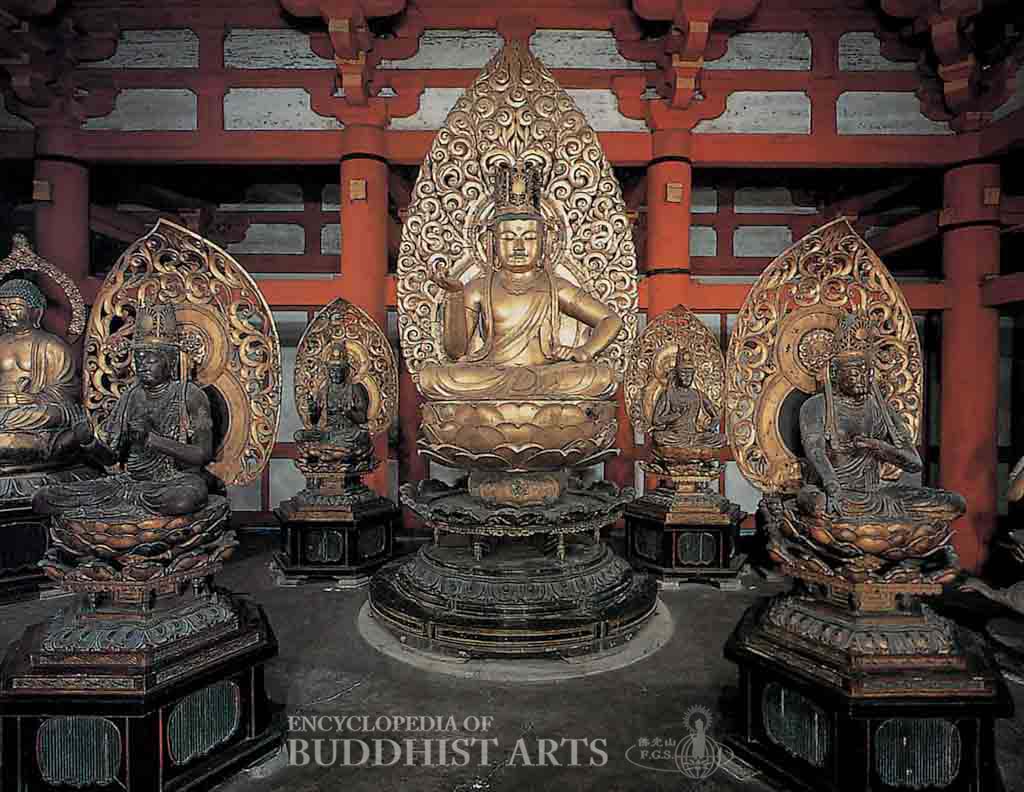
Toji Temple Lecture Hall: Five Great Bodhisattvas
Wood
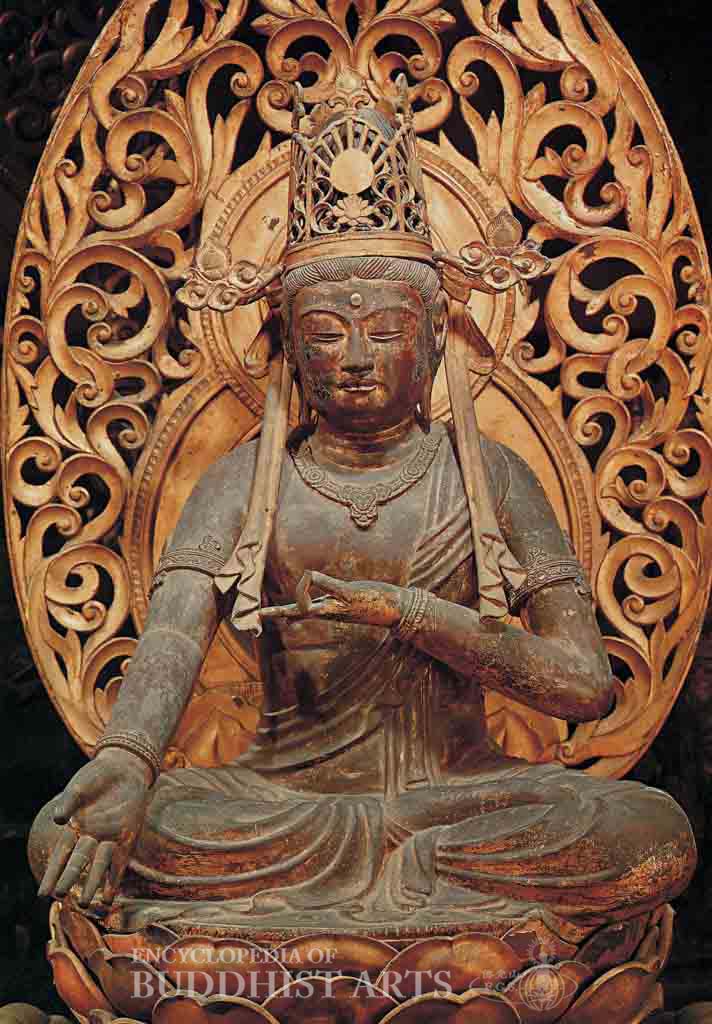
Toji Temple Lecture Hall: Five Great Bodhisattvas - Vajraratna
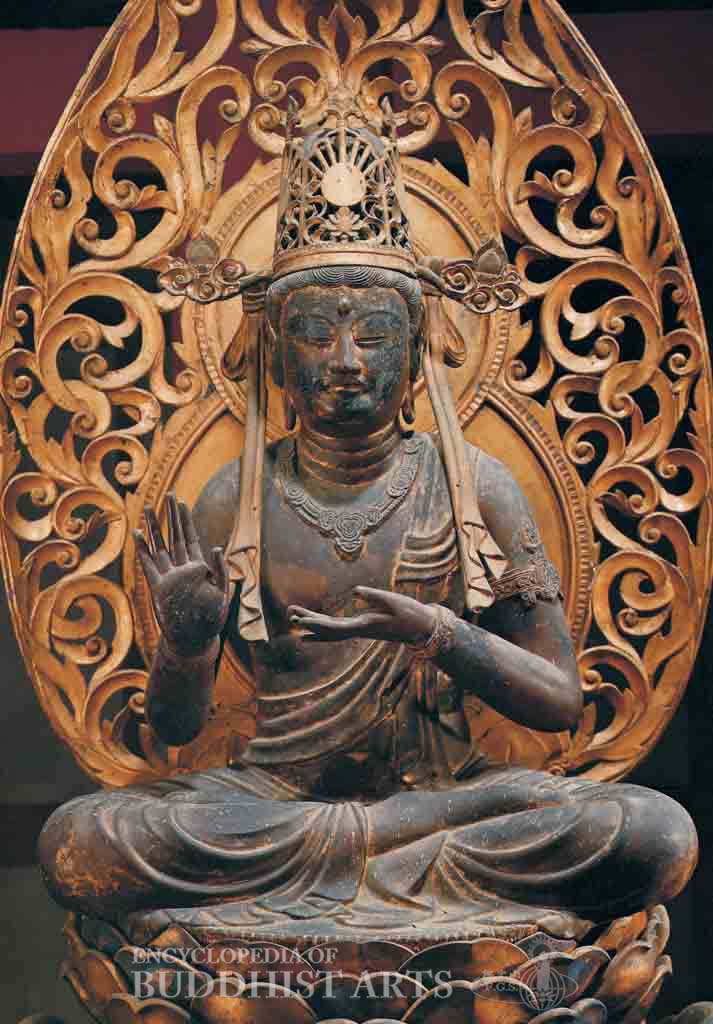
Toji Temple Lecture Hall: Five Great Bodhisattvas - Vajrakarma
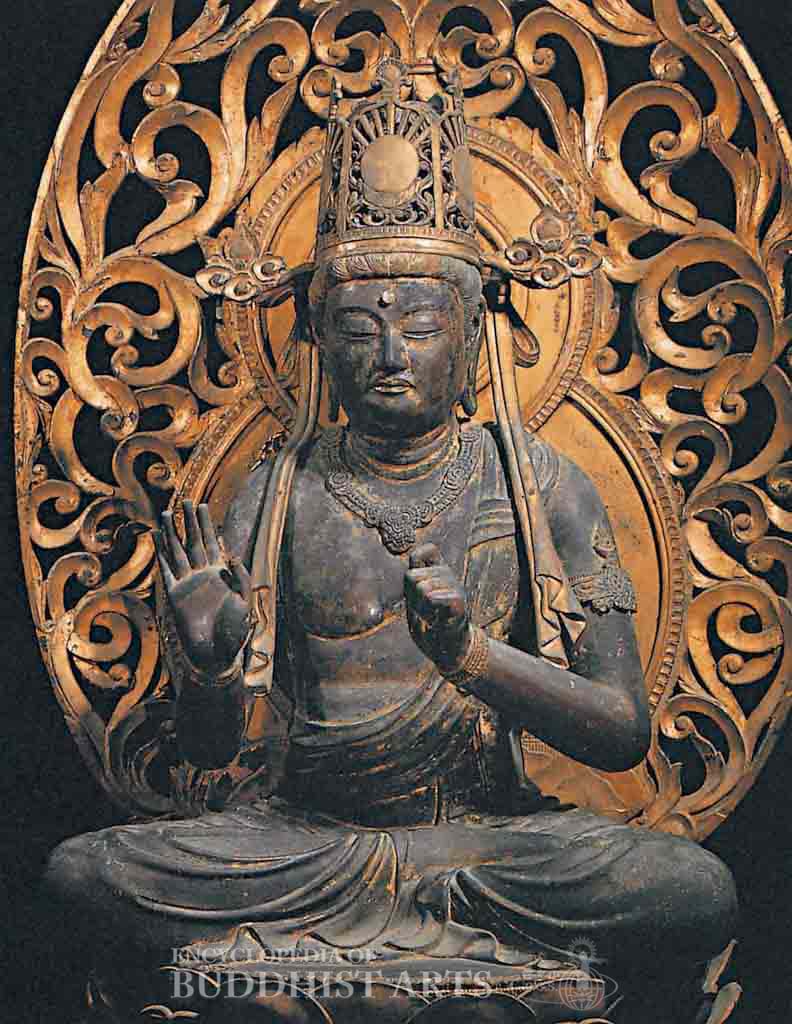
Toji Temple Lecture Hall: Five Great Bodhisattvas - Vajradharma
Toji Temple Lecture Hall: Five Great Bodhisattvas
JAPAN, Kyoto; Heian period
The life-size Bodhisattvas in the temple’s lecture hall, except for the central figure of Vajraparamita, which was a more recent replacement, date from 839. They were listed as a National Treasure in 1954.
The four original figures of Vajrasattva, Vajraratna, Vajradharma, and Vajrakarma are carved from single blocks of hollowed cypress wood, to which the arms and legs were attached. The hair, faces, bodies, limbs and clothing are detailed in dry lacquer, and are transitional between the Nara (710–794) and early Heian (794–1185) sculptural styles. The openwork mandorlas behind the figures are leaf-shaped and carved with a pattern of intertwining tendrils that contain interlocking nimbuses and aureoles. The Bodhisattvas wear tall crowns about their topknots, with a distinctive rising sun decoration above a lotus. Ribbons hang below the shoulders from the sides of the extended cloud-patterned wings of the crowns. The Bodhisattvas are adorned with jewelry and their hands make mudras or once held attributes. The figures sit in full lotus position with knees folded beyond the edges of their four-layered lotus thrones. The heads and bare chests are sturdy and broad giving a sense of solid balance that affixes them upon the Sumeru bases.
For more details, go to the Encyclopedia of Buddhist Arts: Sculpture St-Z, page 1235.
Cite this article:
author = Hsingyun and Youheng and Lovelock, Yann and Chou, Yuan and Huntington, Susan and Edson, Gary and Neather, Robert,
booktitle = {Encyclopedia of Buddhist Arts: Sculpture St-Z},
pages = 1235,
title = {{Toji Temple Lecture Hall: Five Great Bodhisattvas}},
volume = 13,
year = {2016}}