
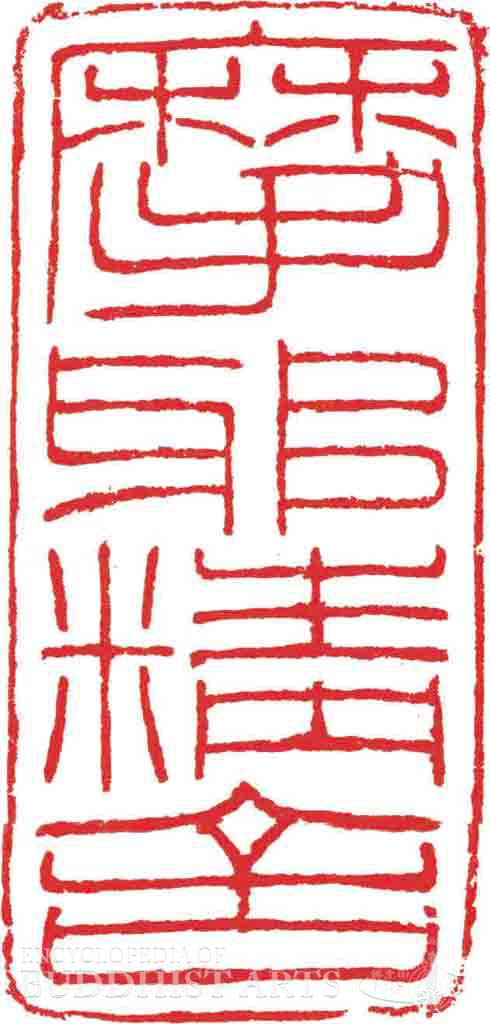
Maya Vihara
Red-character rectangular seal
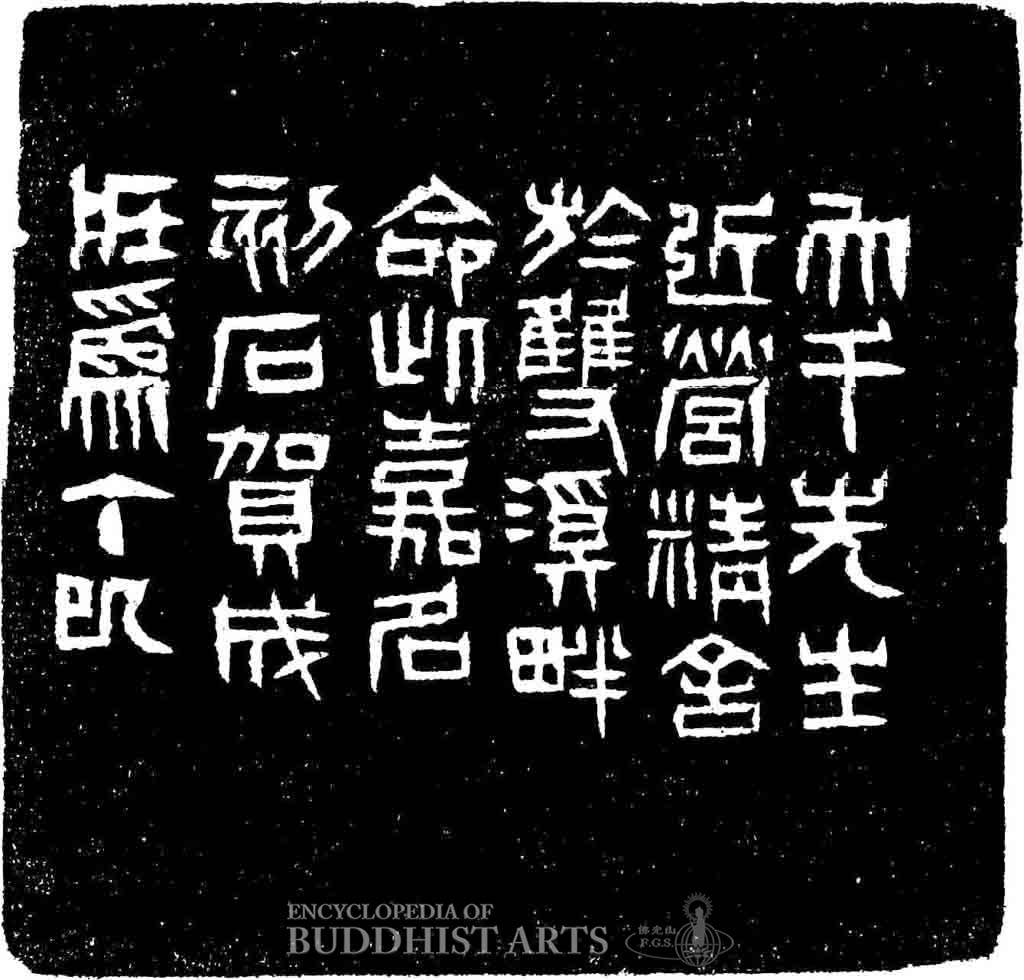
Maya Vihara (side colophon)
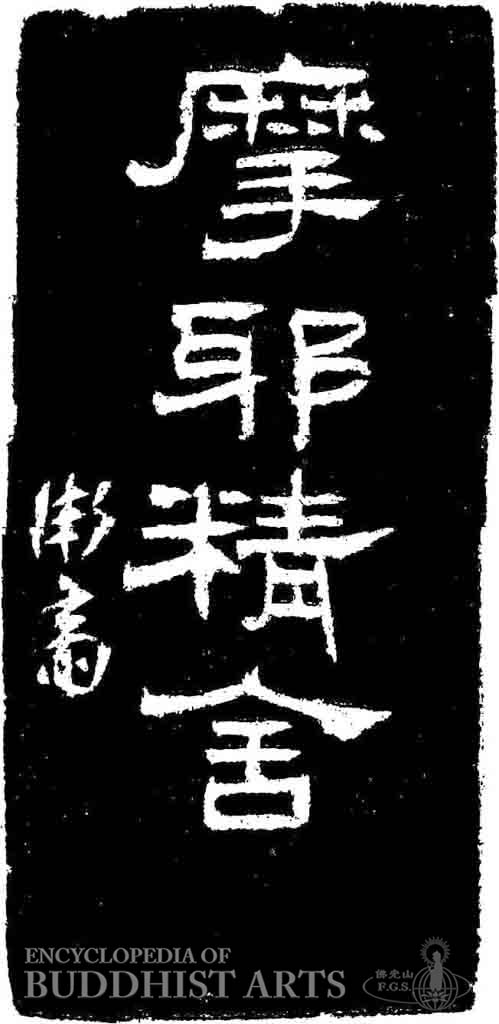
Maya Vihara (side colophon)
Maya Vihara
TAIWAN
Maya Vihara is a reference to the dwelling of the famed artist Chang Dai-Chien. Also a committed devotee of Buddhism, Chang is said to have named the place after Queen Maya, the Buddha’s mother.
There is ample space between the characters of this seal, all of which are confined within a thin and open border. The overall layout spreads out at ease. The thin strokes of the four characters are slightly flexed to form oval-shaped curves, enhancing the decorative tone, and the employed seal script is sturdy and mature with a style of its own. Carving is neat and brisk, and the overall seal style is mellow and rich.
Wang Zhuang-Wei was originally named Yuanli and was also known as Jianzhai. A native of Yixian, Hebei, he learned the arts of calligraphy and seal engraving at a young age, following his family’s tradition. Wang moved to Taiwan in 1949, where he dedicated himself to art education and continued to create works of calligraphy, seal engraving, and painting.
For more details, go to the Encyclopedia of Buddhist Arts: Calligraphy, page 310.
Cite this article:
author = Hsingyun and Youheng and Youlu and Pokorski, Stefanie and Mankuang and Edson, Gary,
booktitle = {Encyclopedia of Buddhist Arts: Calligraphy },
pages = 310,
title = {{Maya Vihara}},
volume = 17,
year = {2016}}