
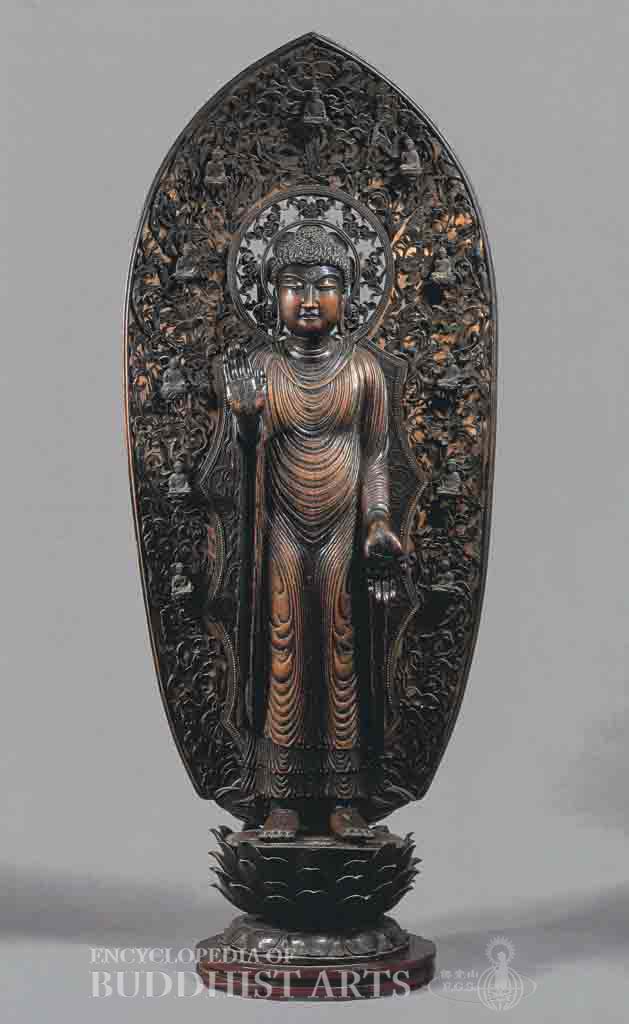
Udayana Buddha
Cherry wood
Udayana Buddha
CHINA; Northern Song dynasty
According to an inscription found on the back of the statue, the piece was commissioned in China by Chonen, a Japanese monk from Todaiji Temple, in 983. It was carved by Zhang Yanjiao and Zhang Yanxi after the Udayana model, and was made more lifelike by the inclusion of internal organs made from silk. The statue was carved in four segments and the hollow back contained more than 200 artifacts, including wooden scriptures, bronze mirrors, pearls, jades, and engraved paintings. The statue was listed as a National Treasure of Japan in 1955.
The Buddha is dressed in clinging robes and has the right hand in the abhaya (fearlessness) mudra. The left hand is in varada (wish-granting) mudras. The urna is a thin silver inset, the usnisa is inlaid with a pearl, and the eyes with black stones, while there are crystals in both ears. The floriated mandorla surrounded by eleven seated Buddhas was carved from cherry wood. Enclosed within the mandorla is an openwork nimbus. A four-layered lotus on a circular base composes the pedestal.
For more details, go to the Encyclopedia of Buddhist Arts: Sculpture St-Z, page 1271.
Cite this article:
author = Hsingyun and Youheng and Lovelock, Yann and Chou, Yuan and Huntington, Susan and Edson, Gary and Neather, Robert,
booktitle = {Encyclopedia of Buddhist Arts: Sculpture St-Z},
pages = 1271,
title = {{Udayana Buddha}},
volume = 13,
year = {2016}}