
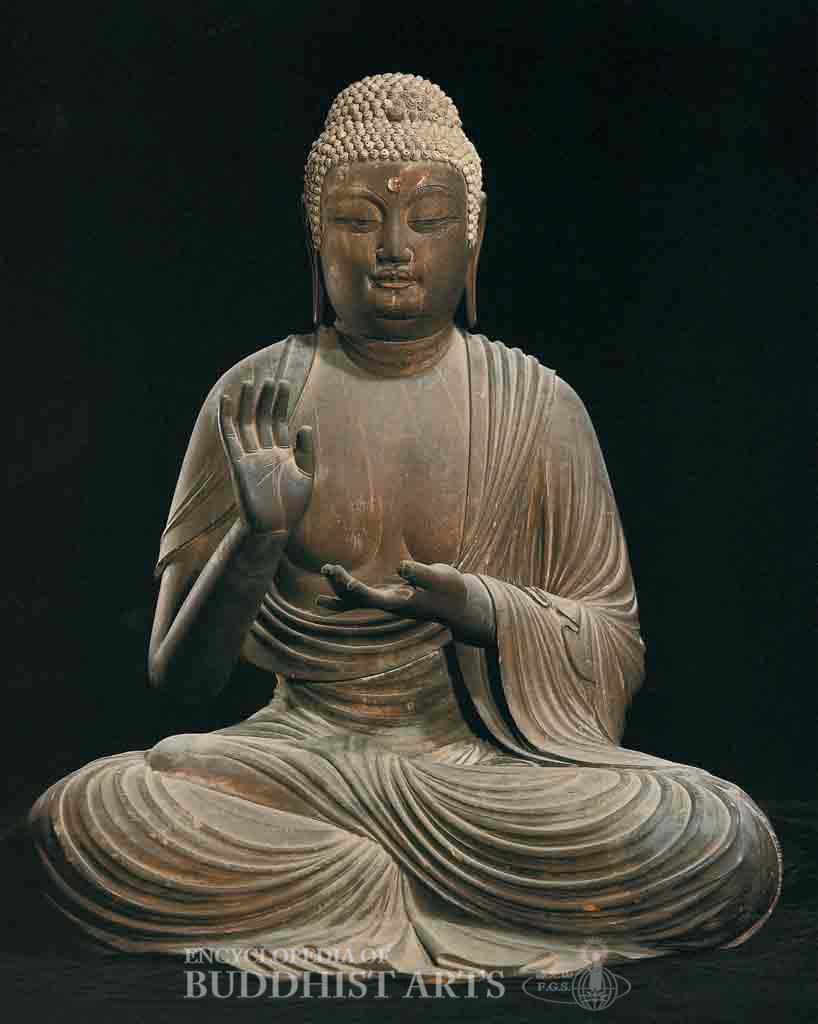
Shishikuji Temple Main Hall: Medicine Buddha
Nutmeg wood
Shishikuji Temple Main Hall: Medicine Buddha
JAPAN, Osaka, Katano; Heian period
The statue was created around the late 9th to early 10th century, and is assembled from nutmeg wood. The Buddha’s snail-shell curls were molded in dry-lacquer and secured to the body with nails, which is not a common method. The sculpture is in its original condition with the exception of damage to the left elbow, right arm and repairs to the folds of the garment. Traces of paint remain, and the urna between the brows is has a semi-precious stone. The sculpture was listed as a National Treasure in 1910.
The Buddha’s facial features and bare chest are smooth and well defined. The right arm is raised in the abhaya (fearlessness) mudra while the left hand most likely once held a medicine pot. The figure sits in half lotus position dressed in a red monastic robe that unusually covers the left foot. The distinctive folds of the robe resemble the raised veins of a leaf. Many characteristics of the statue resemble the High Tang (712–756) sculptural style.
For more details, go to the Encyclopedia of Buddhist Arts: Sculpture N-Sr, page 1064.
Cite this article:
author = Hsingyun and Youheng and Lovelock, Yann and Chou, Yuan and Huntington, Susan and Edson, Gary and Neather, Robert,
booktitle = {Encyclopedia of Buddhist Arts: Sculpture N-Sr},
pages = 1064,
title = {{Shishikuji Temple Main Hall: Medicine Buddha}},
volume = 12,
year = {2016}}