
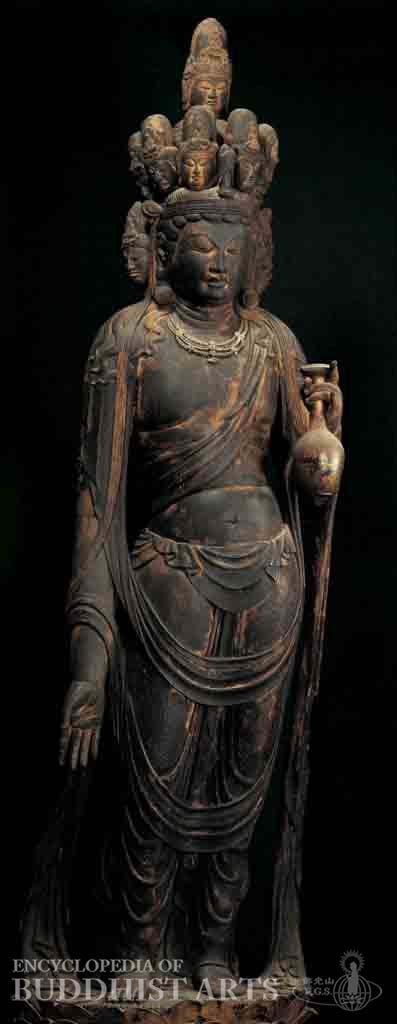
Kogenji Temple Avalokitesvara Hall: Eleven-Headed Avalokitesvara
Cypress wood
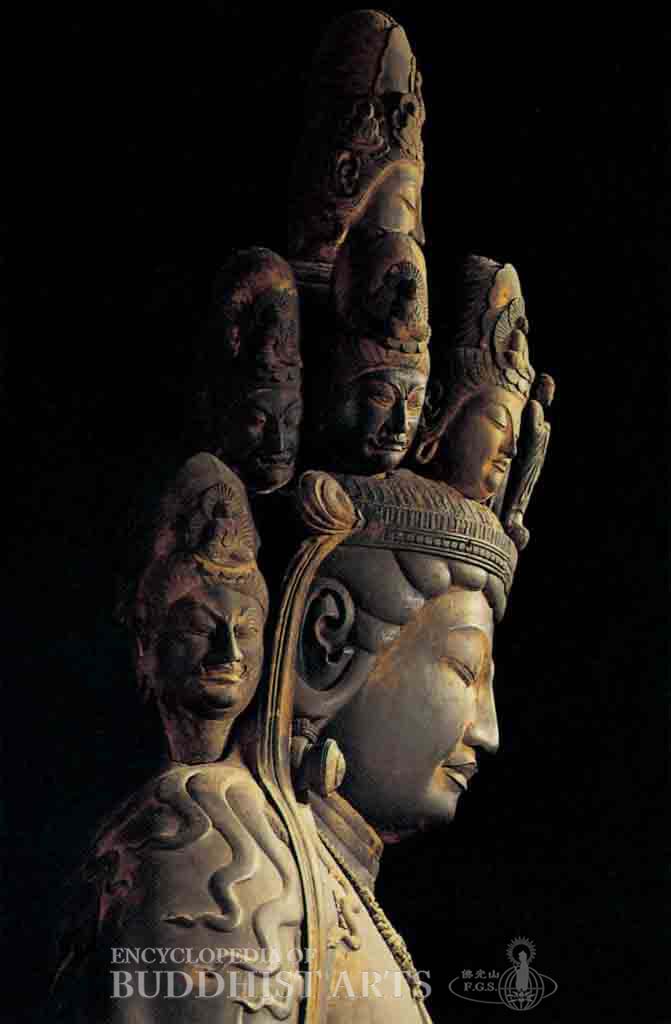
Kogenji Temple Avalokitesvara Hall: Eleven-Headed Avalokitesvara (detail)
Kogenji Temple Avalokitesvara Hall: Eleven-Headed Avalokitesvara
JAPAN, Shiga, Nagahama; Heian period
The life-size statue was carved from a single block of cypress wood. The additional heads and ornaments were affixed afterwards using other materials. The exterior was polished while the back was hollowed and inlaid with lighter wood. This representative work of the early Heian period (794–1185) was listed as a National Treasure in 1953.
The figure is well-proportioned and has a slight sinuous posture that owes its aesthetic reference to Indian statues. A vase is held in the Bodhisattva’s left hand while the right is opened in varada (wish-granting) mudra. The figure stands upon a many-layered lotus pedestal. A three-stranded golden necklace sits just below the neck. Stoles cross the chest and wind about the arms, then loops across the lower body.
At the top of the crown there is a serene head with the Bodhisattva’s other heads distributed in two tiers below, each crowned with an image of a sitting Buddha. To either side of the main head are an angry face and a face full of fangs, demonstrating the protective function of compassion. There is, in addition, a laughing face on the back.
For more details, go to the Encyclopedia of Buddhist Arts: Sculpture G-M, page 552.
Cite this article:
author = Hsingyun and Youheng and Lovelock, Yann and Chou, Yuan and Huntington, Susan and Edson, Gary and Neather, Robert,
booktitle = {Encyclopedia of Buddhist Arts: Sculpture G-M},
pages = 552,
title = {{Kogenji Temple Avalokitesvara Hall: Eleven-Headed Avalokitesvara}},
volume = 11,
year = {2016}}